400-Amp Electrical Service Upgrade in Middleton, MA
Why Modern Homes Need More Capacity, Better Protection and Proper Panel Planning
A modern home can place very different demands on its electrical system than it did when it was built.
Heat pumps, central air conditioning, electric vehicle chargers, hot tubs, induction cooking, generators, home offices, finished basements, workshops and battery storage can all increase electrical demand—and sometimes expose the limitations of older service equipment and crowded panels.
A recent project completed by Denommee Plumbing, HVAC & Electric in Middleton, Massachusetts is a good example.
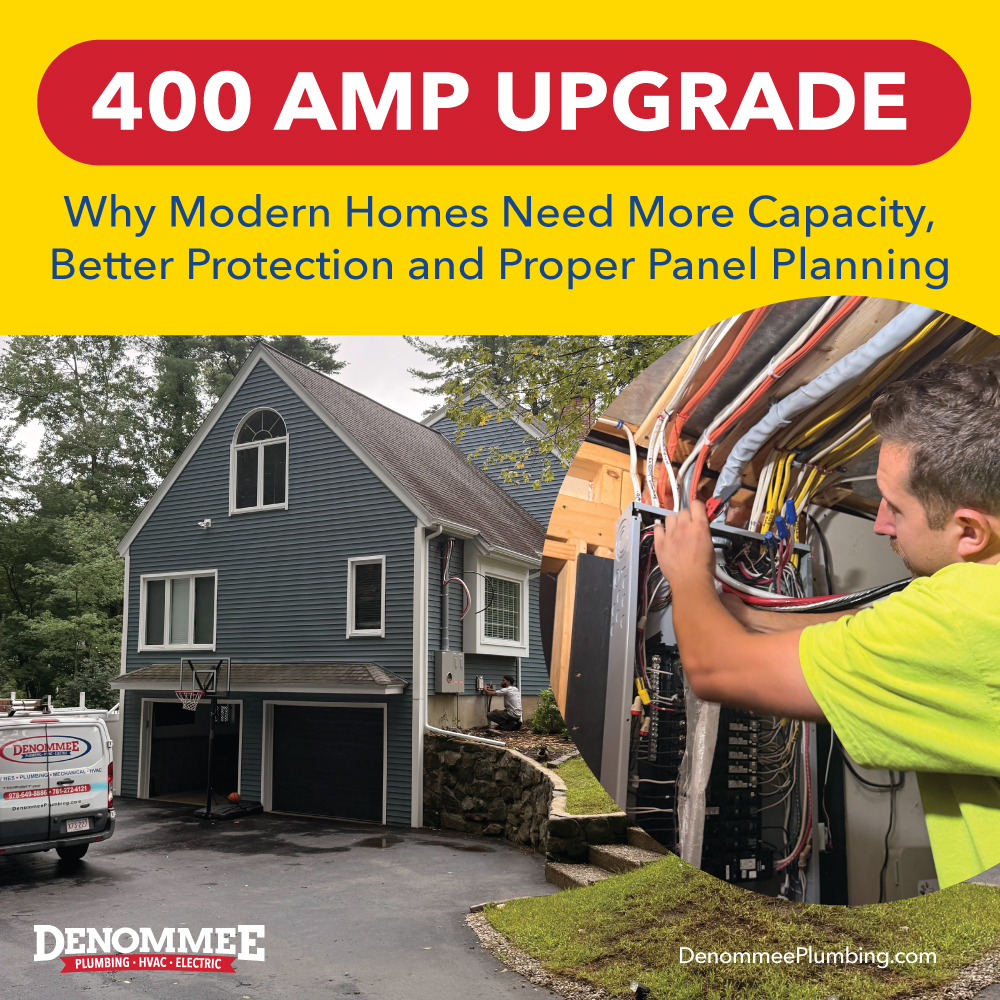
The property is a circa-1989, 3,619-square-foot single-family home with four bedrooms and 3.5 bathrooms. The existing electrical infrastructure needed more capacity, cleaner circuit organization and updated service equipment. Denommee's licensed electricians coordinated directly with Middleton Power Company, secured the required permits, stood the required inspections and completed a substantial upgrade centered around a new 400-amp meter-main assembly feeding two 200-amp service sections.
The scope also included replacing an existing 100-amp panel with a new 200-amp-rated panel, refeeding the existing garage panel, eliminating tandem breakers, adding whole-home surge protection and testing the completed system.
This wasn't simply a "bigger panel" project.
It was a coordinated electrical-service upgrade designed to improve capacity, organization, protection and future flexibility throughout the home.
Middleton Electrical Upgrade: Project at a Glance
Location: Middleton, Massachusetts
Home: Single-family residence
Built: Circa 1989
Size: Approximately 3,619 square feet
Bedrooms: 4
Bathrooms: 3.5
Primary upgrade: 400-amp service configuration with two 200-amp main breakers
Utility coordination: Middleton Power Company
Permits and inspections: Included
Additional improvements: Panel replacement, branch-circuit reorganization, tandem-breaker elimination and whole-home surge protection
Scope of Work
Denommee's electrical team:
- Coordinated utility disconnect and reconnect
- Secured the necessary permits
- Stood all required inspections
- Removed the existing meter equipment
- Installed a new 400-amp meter-main assembly
- Integrated two 200-amp main breakers into the new meter equipment
- Installed a new 4-inch PVC riser to a new utility point of attachment
- Re-fed the existing 200-amp garage panel
- Replaced an existing 100-amp mechanical-room panel with a 200-amp-rated panel
- Relocated three branch circuits into a subpanel
- Eliminated tandem breakers from the main panel
- Installed three new single-pole breakers
- Added whole-home surge protection at both 200-amp panels
- Reused compatible existing dual-function breakers where appropriate
- Tested equipment and circuits after completion
What Is a 400-Amp Electrical Service?
The phrase 400-amp electrical service can be confusing because homeowners sometimes picture one enormous 400-amp breaker feeding everything in the house.
That isn't necessarily how the equipment is configured.
In this Middleton project, the new service equipment was designed around a 400-amp meter-main assembly with two 200-amp main breakers integrated into the meter socket.
That allows the home to distribute electrical capacity across two major service sections.
This type of arrangement can provide much more room for present and future loads than a single smaller residential service.
For a larger home, especially one adding or anticipating high-demand electrical equipment, that extra capacity can be valuable.
Why Would a Home Need a 400-Amp Service?
Not every large home needs 400 amps.
And not every house adding a heat pump or EV charger needs a service upgrade.
The correct service size depends on the actual electrical load and the home's existing infrastructure.
But modern homes can accumulate substantial demand over time.
Possible contributors include:
- Multiple central air-conditioning systems
- Heat Pumps
- Electric resistance backup heat
- EV Chargers
- Electric ranges and ovens
- Induction cooking
- Electric dryers
- Hot Tubs
- Pools
- Well pumps
- Workshops
- Finished accessory spaces
- Home offices
- Heat Pump Water Heaters
- Standby generators
- Battery storage
- Future electrification projects
A service upgrade should therefore be based on load calculations and actual project requirements, not simply on square footage.
For this 3,619-square-foot Middleton home, the electrical infrastructure had evolved over time and needed a more robust and organized configuration.
Why Utility Coordination Matters
Electrical service work does not happen in isolation.
When the meter equipment or service entrance is being replaced, the utility company has to be involved.
For this project, Denommee coordinated with Middleton Power Company for the disconnect and reconnect.
That coordination is an important part of the job because the utility controls the incoming power supply.
The general sequence for a major service upgrade can involve:
- Planning the new service
- Obtaining permits
- Coordinating with the utility
- Disconnecting electrical service
- Completing the new meter and service equipment
- Passing required inspections
- Reconnecting utility power
- Testing the electrical system
Homeowners often see only the finished panel and meter.
Much of the actual project involves coordination behind the scenes.
Why Permits and Inspections Matter on Electrical Service Upgrades
Denommee's scope specifically included securing all necessary permits and standing required inspections.
That matters.
A service upgrade affects some of the most critical electrical infrastructure in the entire house.
The project can involve:
- Utility service conductors
- Meter equipment
- Main disconnecting means
- Grounding and bonding
- Panelboards
- Branch-circuit protection
- Service entrance routing
- Exterior equipment
- Surge protection
Proper permitting provides another level of accountability.
Inspection helps verify that the completed work meets applicable requirements before the new service is placed into normal operation.
For homeowners, that becomes especially important later during:
- Home resale
- Renovations
- Insurance questions
- Future electrical upgrades
- Additional high-demand equipment installations
The Meter Equipment Before and After
The project photographs show a major visual difference between the old and new service equipment.
The existing meter configuration was compact and relatively limited.
The upgraded installation uses a larger, modern Milbank multi-section meter-main assembly with clearly separated service-disconnect sections.
This is a practical improvement as much as a visual one.
The new equipment creates a cleaner, more serviceable arrangement for the home's electrical distribution.
It also allows the two major 200-amp sections to be clearly identified and managed independently.
Why the New 4-Inch PVC Riser Matters
The project also included a new 4-inch PVC service riser installed on the exterior of the home to a new utility point of attachment.
This is part of the service-entrance pathway.
The riser provides a protected route for the utility/service conductors between the meter equipment and the overhead point of connection.
Routing, support, weather exposure and clearances all matter in this part of the installation.
A service upgrade isn't simply a panel replacement inside the basement or garage.
It often involves the entire electrical path from the utility connection into the home.
Refeeding the Existing Garage Panel
The existing garage panel remained part of the system.
Rather than replacing everything indiscriminately, Denommee re-fed that panel from the new meter-main equipment.
This is an important point.
A major electrical upgrade doesn't necessarily mean every existing component has to be discarded.
When equipment is serviceable, compatible and appropriate for continued use, a thoughtful electrical design may incorporate it into the new system.
That can help control project cost without compromising the overall objective.
Why the Existing 100-Amp Panel Was Replaced With a 200-Amp Panel
The home also had an existing 100-amp panel in the mechanical room.
Denommee removed it and installed a new 200-amp-rated panel in its place.
That upgrade provides greater circuit capacity and flexibility for the loads served from that location.
The before-and-after photographs show a major improvement in panel organization and available space.
For homeowners, this matters because older or undersized panels can become increasingly difficult to work with as electrical loads expand.
A larger panel does not automatically mean the house is drawing more electricity.
It means the electrical system has more properly organized capacity available for current and future circuits.
What Are Tandem Breakers—and Why Were They Removed?
One part of the project involved relocating three branch circuits into the subpanel and eliminating tandem breakers from the main panel.
A tandem breaker allows two circuits to occupy the space normally used by one full-size breaker.
In some panel designs, tandems are allowed in specified positions.
In others, they may not be appropriate.
Even where permitted, a panel crowded with tandem breakers can indicate that circuit space has become limited.
For this Middleton home, Denommee reorganized the circuits so the main panel could use standard single-pole breakers instead.
That resulted in a cleaner, more conventional layout.
Why Panel Organization Matters
Electrical panels are not only distribution points.
They also need to be serviceable.
A well-organized panel makes future troubleshooting, maintenance and circuit identification easier.
The project photos show a clear difference between the older panel condition and the upgraded layout.
Good panel work includes attention to:
- Circuit identification
- Conductor routing
- Breaker compatibility
- Neutral and grounding conductors
- Panel capacity
- Serviceability
- Future expansion
This kind of work may not be visible after the panel cover is reinstalled.
But it matters every time an electrician has to return to that panel in the future.
Whole-Home Surge Protection Added at Both 200-Amp Panels
Denommee installed whole-home surge protection devices at both 200-amp panels.
That's increasingly relevant as homes contain more electronic equipment.
Modern appliances and systems can include sensitive circuit boards and controls in:
- Heat pumps
- Furnaces
- Boilers
- Refrigerators
- Washers and dryers
- Induction ranges
- TVs
- Computers
- Smart-home equipment
- EV chargers
- Generators
- HVAC controls
Whole-home surge protection helps reduce the risk of damage from voltage transients entering the home's electrical system.
It does not guarantee that every electrical event will be harmless.
But it adds another layer of protection for the many electronic devices connected throughout the house.
Why Surge Protection Belongs in Modern Electrical Upgrades
Older electrical systems were designed in an era when homes had far fewer circuit boards and electronic controls.
Today's homes are different.
Even equipment that looks mechanical often contains sophisticated electronics.
That's why surge protection is no longer just about protecting a television or computer.
It may also help protect expensive mechanical systems and appliances that contain control boards.
Including surge protection during a major electrical upgrade is a practical way to improve system resilience while the panel work is already underway.
Reusing Existing Dual-Function Breakers Where Appropriate
One particularly important part of Denommee's scope was the decision to reuse existing dual-function breakers where compatible and code-compliant.
That may not sound significant.
It actually reflects a larger principle.
Not every existing component needs to be thrown away simply because a panel is being upgraded.
If a breaker remains appropriate, compatible and suitable for reuse, keeping it can help reduce unnecessary project cost.
That approach is different from automatically replacing everything to maximize the invoice.
The objective should be to build the right electrical system—not replace equipment simply because replacement is possible.
What Is a Dual-Function Breaker?
A dual-function breaker typically combines more than one type of circuit protection within the same device.
Depending on the breaker and application, this can include protection against:
- Arc-fault conditions
- Ground-fault conditions
- Overcurrent
These devices are commonly used in modern residential electrical systems to provide required or enhanced protection for certain branch circuits.
Compatibility matters.
Breakers must be appropriate for the panel in which they are installed and for the circuit they protect.
That is why Denommee's scope specified reuse only where compatible and code-compliant.
Why Electrical Service Upgrades Are Becoming More Common
Residential electrical demand is changing.
Homeowners who once relied heavily on fossil fuels are increasingly considering:
- Heat pumps
- Heat-pump water heaters
- EV charging
- Induction cooking
- Battery storage
- Solar integration
- Electric backup heating
At the same time, many homes are adding:
- Multiple HVAC systems
- Hot tubs
- Pools
- Workshops
- Finished basements
- Home offices
- Additional appliances
That does not mean every house needs a 400-amp service.
But it does mean electrical capacity should be evaluated more carefully than it was in the past.
The electrical system is becoming the backbone of more of the home's mechanical infrastructure.
Electrical Capacity and Home Electrification
This Middleton project is especially relevant to homeowners planning future electrification.
Before adding major new loads, an electrician should understand:
- Existing service size
- Main-panel capacity
- Available breaker spaces
- Existing household loads
- Future planned loads
- Utility requirements
- Equipment specifications
Some homes can add new electrical equipment without a service upgrade.
Others may need a panel replacement.
Others may benefit from a larger service.
The correct answer depends on the specific property.
Why a 400-Amp Service Is Not Automatically "Better"
More capacity is not inherently better if the home doesn't need it.
A 400-amp service costs more and involves more equipment.
There is no reason to oversize a service simply for marketing value.
A professional electrician should determine the appropriate service capacity based on actual current and anticipated loads.
For this Middleton home, the upgraded configuration addressed real system requirements and created additional flexibility.
For another house, 200 amps might be entirely sufficient.
The Denommee Multi-Trade Advantage
Large electrical upgrades often connect directly to HVAC and plumbing decisions.
A homeowner may upgrade electrical service because they're planning:
- Multiple heat pumps
- Central air conditioning
- EV charging
- Heat-pump water heating
- Battery storage
- Generator installation
- Electric cooking
- Broader home electrification
Denommee provides electrical, HVAC and plumbing services under one locally owned company.
That allows us to consider more than just the electrical panel.
For example, if a service upgrade is being driven by a future heat-pump project, our electricians and HVAC professionals can coordinate the design instead of requiring the homeowner to act as the project manager between separate companies.
Why Middleton Homeowners Choose Denommee for Electrical Service Upgrades
Electrical service work requires more than installing new breakers.
A successful project may involve:
- Utility coordination
- Permitting
- Inspection scheduling
- Service entrance work
- Meter equipment
- Panelboards
- Branch-circuit reorganization
- Grounding and bonding
- Surge protection
- Future-load planning
- Final testing
Denommee handles that coordination as part of the project.
We also believe in:
Pulling required permits
Standing required inspections
Reusing appropriate equipment where it makes sense
Explaining the scope before work begins
Providing upfront pricing
Testing the completed system before leaving
That approach helps homeowners understand not just what is being replaced—but why.
Frequently Asked Questions About 400-Amp Electrical Service Upgrades
Does a large house automatically need 400 amps?
No. Service size should be based on electrical load, not square footage alone.
Why would a home use two 200-amp panels?
A 400-amp service can be configured to distribute capacity across two major 200-amp sections, allowing the home's loads to be organized across separate panels.
Is 400-amp service common in residential homes?
It is less common than 100- or 200-amp service, but larger homes and properties with substantial electrical demand may benefit from it.
Do I need 400 amps for EV chargers and heat pumps?
Not necessarily. Many homes can support one or both with a properly designed 200-amp service. Load calculations are important.
Does a service upgrade require utility involvement?
Usually, yes. Meter and service-entrance work typically requires coordination with the electric utility.
Do permits matter for a service upgrade?
Yes. Major electrical service work should be properly permitted and inspected.
What is a meter-main?
A meter-main combines utility metering equipment with main disconnect or breaker functions in one assembly.
Why replace a 100-amp panel with a 200-amp-rated panel?
A larger panel can provide more circuit capacity and flexibility where the existing panel no longer adequately supports the home's electrical distribution needs.
What is whole-home surge protection?
It is a device installed at the electrical service or panel that helps reduce the effect of voltage surges entering the home's electrical system.
Will whole-home surge protection protect everything?
It adds an important layer of protection, but no surge device can guarantee complete protection against every electrical event.
Are tandem breakers bad?
Not inherently. Their use depends on the panel design and allowed breaker positions. In some cases, eliminating tandems improves panel organization and circuit space.
Can old breakers be reused during a panel upgrade?
Sometimes. Reuse depends on condition, compatibility and code requirements.
Planning an Electrical Service or Panel Upgrade in Middleton, MA?
If your electrical panel is crowded, your service capacity is limiting planned upgrades or you're preparing for future electrical loads, a professional evaluation is the best place to start.
You may need:
- A panel replacement
- Additional circuit capacity
- A 200-amp service
- A 400-amp service
- Surge protection
- Load management
- Dedicated circuits
- Or no major service upgrade at all
The right answer depends on your home's existing electrical system and what you plan to add.
This recent Middleton project demonstrates Denommee's approach:
Evaluate the existing system. Coordinate with the utility. Obtain permits. Complete the work properly. Stand the inspections. Reuse appropriate components when practical. Test the finished installation.
Denommee Plumbing, HVAC & Electric provides residential electrical service upgrades, panel replacements, surge protection, EV charging, generator work and broader home-electrification services throughout northeastern Massachusetts.
If you're planning a major electrical project in Middleton, North Andover, Andover, Boxford, Topsfield, Danvers, Beverly, Wilmington, Reading, North Reading or surrounding communities, contact Denommee to schedule an electrical evaluation.
A service upgrade should do more than add amperage. It should create a safer, cleaner and more flexible electrical foundation for the home.


