Gas Water Heater Replacement in Dracut, MA
A Smarter Solution That Avoided Chimney Liner Costs
Replacing an aging gas water heater isn't always as simple as disconnecting the old unit and installing a new one. In some homes, the existing chimney, venting configuration, and gas piping can significantly affect the cost and complexity of a replacement.
That was the situation our team at Denommee Plumbing, Heating, Cooling & Electrical encountered during a recent residential water heater replacement in Dracut, MA.
The home's existing gas water heater was vented through an exterior masonry chimney. Installing a new water heater using that same chimney would have required a properly sized chimney liner, adding significant expense to the project.
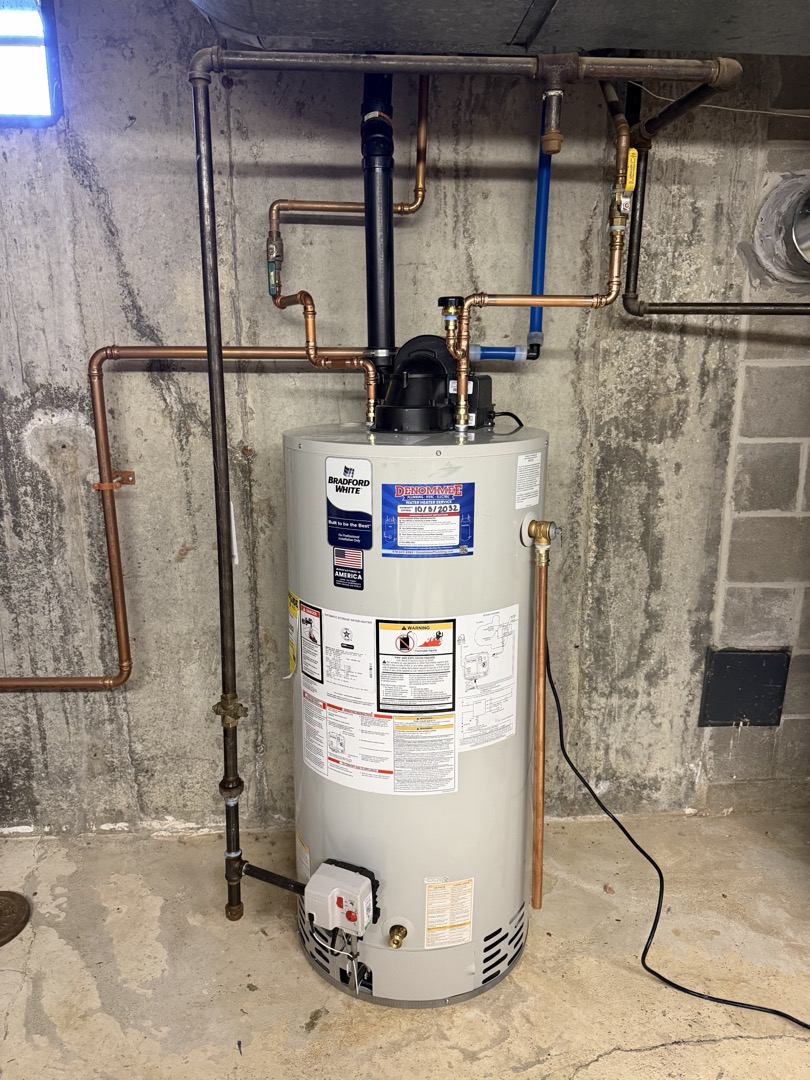
Rather than automatically proceeding with the more expensive option, our team evaluated an alternative: installing a Bradford White power-vented gas water heater with a properly designed mechanical venting system.
The result was a professionally installed replacement that met applicable plumbing, gas, and venting requirements while avoiding the additional expense of relining the chimney.
Here's how we approached the project and what other homeowners can learn from it.
Project Overview: Residential Water Heater Replacement in Dracut, MA
This project took place in a single-family home built around 1990 in Dracut, Massachusetts.
Property details:
-
Location: Dracut, MA
-
Property type: Single-family residence
-
Approximate construction year: 1990
-
Home size: 2,648 square feet
-
Layout: 4 bedrooms, 3 bathrooms
-
Existing equipment: Gas-fired storage water heater vented through an exterior masonry chimney
-
Replacement equipment: Bradford White power-vented gas storage water heater
-
Primary challenge: Existing chimney venting configuration required additional work for a compliant replacement
-
Denommee's solution: Install a power-vented water heater with properly designed mechanical venting, avoiding the need for a new chimney liner
The project illustrates why evaluating the entire water heating system—not just the tank—is an important part of a professional replacement.
The Challenge: An Existing Masonry Chimney That Complicated Replacement
The home's original water heater configuration relied on an exterior masonry chimney to exhaust combustion gases.
This type of installation is found in many older Massachusetts homes. However, an existing chimney is not automatically suitable for a new gas water heater.
A replacement appliance may have different venting requirements than the equipment it replaces. Chimney dimensions, construction, condition, location, and the appliances connected to it all influence whether an existing venting arrangement is appropriate.
Why Would a New Water Heater Need a Chimney Liner?
A gas water heater produces combustion gases that must be safely discharged outdoors.
When an existing masonry chimney is too large or otherwise unsuitable for a replacement appliance, exhaust gases can cool excessively as they travel through the chimney. This can contribute to condensation, deterioration of masonry materials, and venting performance problems.
A properly selected chimney liner can help establish a venting pathway compatible with the connected equipment.
At this Dracut property, our team determined that continuing to use the existing chimney would require a properly sized liner to accommodate the new water heater.
That additional work would have increased the overall replacement cost.
Rather than treating the chimney liner as the only available solution, we evaluated another way to provide safe, compliant venting.
The Solution: A Bradford White Power-Vented Gas Water Heater
Our team selected a Bradford White power-vented gas water heater.
Unlike a conventional natural-draft water heater that relies on buoyancy and chimney draft to move combustion gases upward, a power-vented water heater uses a powered exhaust blower to discharge combustion gases through a manufacturer-approved venting system.
This makes it possible, in suitable installations, to route exhaust through an approved exterior termination rather than relying on an existing masonry chimney.
Why Power Venting Made Sense for This Home
For this Dracut replacement, the power-vented configuration offered several important advantages:
1. It avoided the additional chimney liner expense.
By installing a properly designed mechanical venting system, our team eliminated the need to reline the existing masonry chimney for the new water heater.
2. It provided an appropriate venting solution for the replacement equipment.
The new venting arrangement was designed for the selected water heater and applicable installation requirements.
3. It allowed the homeowner to continue using a gas storage water heater.
The homeowner received a replacement gas-fired tank water heater without needing to rely on the original chimney venting configuration.
4. It addressed the home's actual installation conditions.
Instead of assuming the original venting arrangement could be reused, our team evaluated the existing setup and selected an alternative suited to the property.
Power venting isn't automatically the best option for every home. Equipment cost, available electrical power, vent routing, termination clearances, gas supply, and manufacturer requirements all need to be considered.
For this particular project, however, it provided a practical, cost-effective alternative to chimney relining.
Step-by-Step: How Denommee Completed the Water Heater Replacement
Step 1: Evaluate the Existing Water Heater and Venting
Before selecting the replacement configuration, our team assessed the existing gas water heater, masonry chimney connection, and installation conditions.
The key finding was that the existing chimney would require a properly sized liner if it were to be used with the new water heater.
Identifying this issue before proceeding allowed us to consider other replacement options and avoid unnecessary additional work.
Step 2: Remove the Existing Water Heater
Our team disconnected and removed the existing water heater to prepare the installation area for the new equipment.
Removing an older tank also creates an opportunity to examine accessible plumbing connections, gas piping, and other installation components that may need attention during replacement.
Step 3: Bring the New Bradford White Water Heater Into Position
The replacement water heater was carefully transported into the home and positioned in the basement installation area.
Moving a large storage water heater through a basement entry requires planning, equipment handling, and attention to the surrounding property.
Our technicians coordinated the process to prepare the new tank for installation.
Step 4: Install the New Water Heater and Mechanical Venting
With the new unit in place, our technicians completed the required water and gas connections and installed the power-venting components.
The project included properly designed venting to an approved exterior termination, allowing the new appliance to exhaust combustion gases without using the original masonry chimney.
The installation was completed in accordance with applicable plumbing, gas, and venting requirements.
Step 5: Complete the Installation and Apply the Denommee Service Sticker
Once the replacement was complete, our team applied a Denommee water heater service sticker directly to the equipment.
This is a standard part of our water heater installation process.
The sticker provides homeowners with convenient access to important information, including:
-
Water heater service information
-
Emergency shut-off guidance
-
Warranty information
-
A QR code connecting homeowners with additional resources
It's a small detail with an important purpose: making it easier for homeowners to find useful information when they need it.
Power-Vented vs. Conventional Gas Water Heaters: What's the Difference?
Homeowners comparing replacement options may encounter several types of gas water heaters, including conventional atmospheric-vent and power-vent models.
Understanding the differences can help explain why the best replacement isn't always identical to the original equipment.
| Feature | Conventional Natural-Draft Gas Water Heater | Power-Vented Gas Water Heater |
|---|---|---|
| Exhaust method | Relies on natural draft | Uses a powered exhaust blower |
| Venting pathway | Typically an approved vertical vent or chimney system | Manufacturer-approved mechanical venting system |
| Electrical power | Many conventional models do not require household electrical power for venting | Requires electrical power for the blower and controls |
| Existing chimney | May require a suitable liner or other corrections | Can eliminate reliance on the chimney where exterior venting is feasible |
| Installation considerations | Chimney condition, draft, and vent sizing | Electrical supply, vent routing, termination clearances, and blower operation |
| Best application | Homes with a suitable natural-draft venting arrangement | Homes where approved mechanical venting offers an installation advantage |
Neither design is universally better.
The right choice depends on the home's existing conditions, the water heater's requirements, installation costs, and the homeowner's priorities.
For this Dracut home, a power-vented system made sense because it avoided additional chimney liner work.
How Much Does a Water Heater Replacement Cost in Dracut, MA?
The cost of replacing a water heater depends on more than the price of the tank itself.
Two homes with similar water heaters may require substantially different installation work.
Factors that can affect replacement cost include:
-
Water heater capacity and equipment type
-
Conventional, power-vented, or other approved venting configurations
-
Condition and compatibility of existing chimney or venting
-
Gas piping and plumbing modifications
-
Installation location and accessibility
-
Electrical requirements for powered equipment
-
Required permits, inspections, and code-related work
-
Removal and disposal of the existing unit
For this project, the existing masonry chimney was a particularly important cost consideration.
Installing a new chimney liner would have added expense. By selecting an appropriate power-vented replacement, our team avoided that additional scope of work.
The important takeaway: A lower equipment price does not necessarily mean a lower total installed cost.
A professional evaluation should consider the complete installation, including the work needed to make the system safe and compliant.
For more information, explore our Water Heater Cost Guide and Water Heater Pricing Tool to better understand replacement options and potential costs.
Why Professional Venting Design Matters
Gas water heater venting is a critical safety consideration.
Improperly designed or installed venting can create conditions in which combustion gases do not exhaust as intended, potentially increasing the risk of carbon monoxide exposure and other hazards.
A professional installation must account for the requirements of the selected appliance, the venting materials and configuration, applicable codes, and manufacturer instructions.
For power-vented equipment, this includes appropriate vent sizing, routing, support, termination location, and clearances.
At Denommee, our goal is to recommend a replacement configuration that works for the specific home—not simply duplicate an older installation without evaluating it.
More Than Installation: Helping Homeowners After the Job Is Complete
One of the finishing touches visible in this Dracut project is the Denommee service sticker applied to the new Bradford White water heater.
Our responsibility to the homeowner doesn't end when the equipment is installed.
We want customers to know where to find important service information and how to access resources related to their equipment.
By placing this information directly on the water heater, we make it easier to locate when needed.
It's part of our commitment to providing thoughtful, professional service throughout the life of the equipment.
Water Heater Replacement in Dracut and Surrounding Communities
Homes throughout Dracut, Lowell, Tyngsborough, Chelmsford, Tewksbury, and nearby Massachusetts communities have a wide variety of plumbing and mechanical configurations.
Some homes have conventional chimney-vented gas water heaters. Others use power-vented equipment, electric water heaters, or tankless systems.
Older installations may also have venting, piping, or accessibility conditions that affect replacement decisions.
Denommee Plumbing, Heating, Cooling & Electrical helps homeowners evaluate these conditions and select replacement options appropriate for their homes.
Whether you're dealing with an aging water heater, inconsistent hot water, a leaking tank, or questions about an existing chimney connection, our team can assess the installation and explain the available options.
Frequently Asked Questions About Gas Water Heater Replacement
Do I need a chimney liner when replacing a gas water heater?
Not always. The answer depends on the existing chimney, the replacement appliance, and the proposed venting configuration. Some natural-draft replacements require a properly sized chimney liner. In other situations, an approved power-vented water heater may provide an alternative that does not use the chimney.
Can a gas water heater be vented through an exterior wall?
Certain gas water heaters are designed and listed for mechanical venting through an approved exterior termination. The venting materials, routing, clearances, and termination location must meet the manufacturer's instructions and applicable codes. A conventional natural-draft water heater cannot simply be converted to sidewall venting without an approved system.
Is a power-vented water heater more expensive than a regular gas water heater?
Power-vented models generally have a higher equipment cost than comparable conventional natural-draft models. However, total installation costs depend on the home. If an existing chimney requires substantial corrective work, power venting may be a more cost-effective overall solution.
How much does a water heater cost in Dracut, MA?
The installed price depends on the type and size of the water heater, venting requirements, plumbing and gas connections, access to the installation area, and required code-related work. Homeowners should compare complete installed solutions rather than equipment prices alone. Denommee's Water Heater Cost Guide and Pricing Tool can help homeowners begin evaluating their options.
Can I replace a conventional gas water heater with a power-vented model?
Often, yes, provided the home can accommodate the selected equipment and its installation requirements. A qualified professional should evaluate electrical availability, gas supply, vent routing, exterior termination clearances, and the manufacturer's specifications before recommending the conversion.
How long does a gas water heater typically last?
Many conventional tank-style water heaters have an expected service life of roughly 8–12 years, although actual lifespan varies with water quality, maintenance, usage, and installation conditions. Age alone does not determine whether replacement is necessary, but an older unit showing signs of corrosion, leakage, or declining performance should be evaluated.
Does a power-vented water heater work during a power outage?
Typically not. A power-vented water heater relies on electricity to operate its exhaust blower and controls. If electrical power is unavailable, the system generally cannot operate normally. This is an important consideration when comparing replacement options.
Does Denommee install Bradford White water heaters in Dracut?
Yes. This Dracut project included installation of a Bradford White power-vented gas storage water heater. Our team can evaluate the home's requirements and recommend an appropriate replacement configuration.
Need a Gas Water Heater Replacement in Dracut, MA?
Don't assume your existing water heater setup is the only replacement option.
As this Dracut project demonstrates, evaluating the chimney, venting, and installation conditions can uncover solutions that help homeowners avoid unnecessary costs while meeting applicable safety and code requirements.
At Denommee Plumbing, Heating, Cooling & Electrical, we take the time to evaluate the complete system and explain the options available for your home.
Planning a water heater replacement in Dracut, Lowell, Chelmsford, Tyngsborough, or a nearby community?
Contact Denommee to discuss your water heater replacement, or explore our water heater pricing resources to get started.


