Bosch Heat Pump + Unico High-Velocity HVAC Upgrade in a Circa-1900 Brookline, MA Condo
Upgrading the heating and cooling system in a modern home can be relatively straightforward.
Doing it in a circa-1900 three-family condominium building in Brookline, Massachusetts can require an entirely different approach.
Older Greater Boston homes often present HVAC contractors with conditions that weren't contemplated when the buildings were constructed: limited mechanical space, finished interiors worth preserving, existing hydronic heating systems, unusual duct configurations and difficult equipment access.
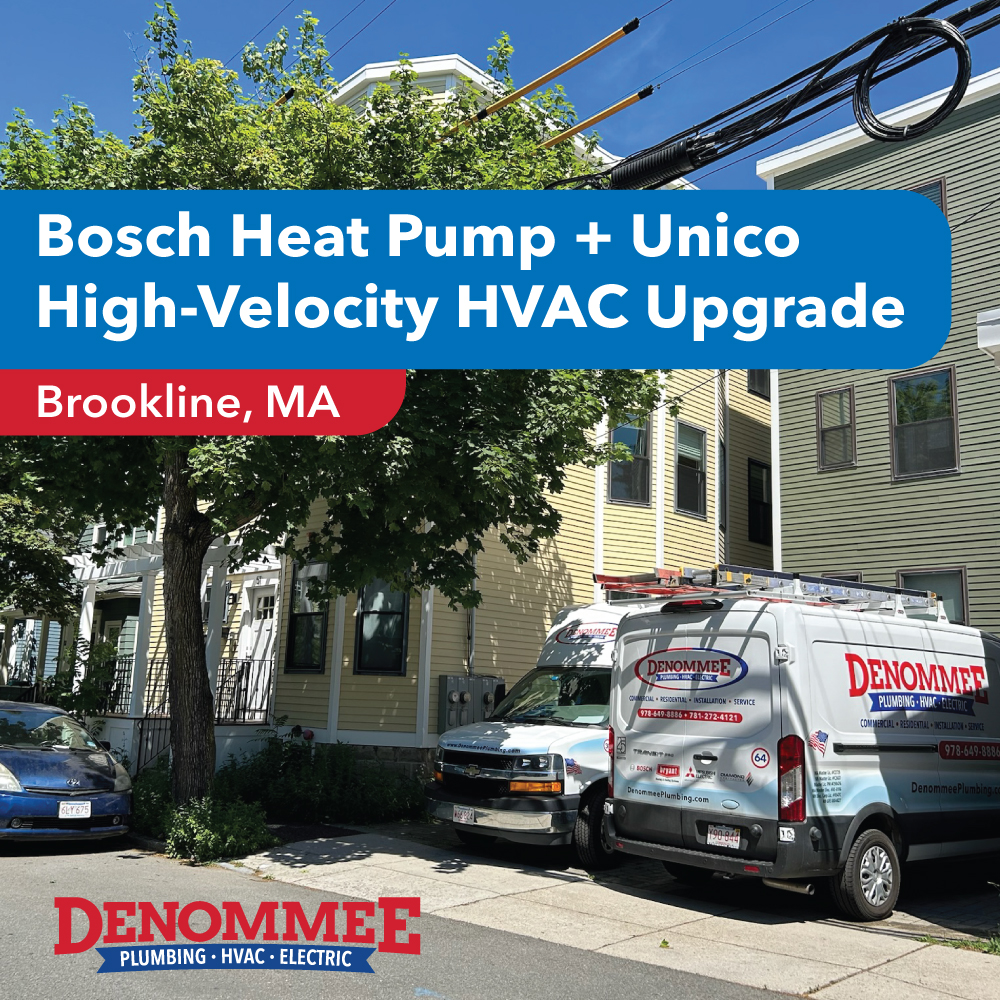
For a recent project near Beacon Street in Brookline, Denommee Plumbing, HVAC & Electric upgraded one condominium's existing HVAC system with a combination particularly well suited to those challenges:
A Bosch IDS 2.0 variable-capacity heat pump paired with a Unico high-velocity air handler and hydronic heating coil.
The new system is designed to use the heat pump as the primary source of heating and cooling, displacing much of the home's natural-gas hydro-air heating while retaining hydronic heat as part of a dual-fuel strategy.
It's a good example of something Massachusetts homeowners sometimes overlook when researching electrification:
Adding a heat pump doesn't necessarily require abandoning an existing hydronic heating system or conventional ductwork strategy.
In an older home, the better solution may be finding a way for old and new technologies to work together.
Brookline HVAC Project at a Glance
| Project detail | Installation |
|---|---|
| Location | Brookline, Massachusetts |
| Building | Circa-1900 flat-top three-family condominium |
| System type | Dual-fuel heat pump + hydronic hydro-air |
| Heat pump | Bosch BOVA-36RTB-M20S |
| Heat-pump series | Bosch IDS 2.0 |
| Nominal size | 3 ton |
| Indoor equipment | Unico high-velocity air handler |
| Blower | ECM |
| Hydronic coil | Unico HW-2430 |
| Primary heating | Bosch inverter heat pump |
| Hydronic heat | Retained as dual-fuel heat source |
| Control | Existing Nest T300 |
| Refrigerant | R-454B |
| AHRI reference | 217048334 |
| Electrical work | New outdoor whip/disconnect and rewiring as required |
| Project incentives | $2,475 Mass Save + $650 NEHPA |
| Service membership | One year of Denommee Peace of Mind membership included |
Why Older Brookline Homes Can Present Unique HVAC Challenges
Brookline contains a large inventory of homes and multifamily buildings constructed long before central air conditioning—much less modern heat pumps—became commonplace.
That doesn't mean these homes can't benefit from modern HVAC technology.
It means the system needs to be designed around the building.
Conventional full-size ductwork can be difficult to incorporate into older homes without sacrificing closets, ceilings, wall cavities or architectural details. Mechanical equipment may also be located in attics, upper floors or other spaces that make replacement substantially more complicated than carrying a furnace through a basement door.
This Brookline condominium already had a high-velocity hydro-air system, creating an opportunity to modernize the heating and cooling equipment while continuing to use a distribution strategy suited to the building.
Denommee paired a new Unico high-velocity air handler with a Bosch inverter heat pump and a Unico hydronic heating coil.
The result preserves an important feature of the existing system while fundamentally changing how the home can be heated.
What Is a Unico High-Velocity HVAC System?
A high-velocity HVAC system distributes conditioned air through smaller ducts and outlets than a conventional forced-air system.
That can make high-velocity systems particularly useful in older homes where installing large traditional ductwork would be difficult or excessively disruptive.
Instead of designing the renovation around bulky new ductwork, high-velocity equipment can provide another option for distributing heating and cooling through the home.
For this project, Denommee installed a Unico M3036-series high-velocity air handler equipped with an ECM blower motor.
The air handler performs an important job in both seasons:
During cooling operation, it distributes conditioned air produced by the Bosch heat-pump system.
During heat-pump heating operation, it distributes heat generated by the Bosch outdoor unit.
And when hydronic heating is called for, air moves across the Unico HW-2430 hot-water coil, allowing boiler-generated heat to continue using the home's air-distribution system.
That makes this considerably more than an air-conditioner replacement.
How Does a Heat Pump Work With Hydro-Air Heat?
Hydro-air heating combines two familiar heating concepts:
Hot-water heat + forced-air distribution.
A boiler heats water, which circulates through a hydronic coil installed in the air handler. The blower moves air across that hot coil and distributes the resulting warm air through the home's duct system.
Traditionally, the boiler provides the heat and the air handler distributes it.
Adding the Bosch heat pump changes that equation.
The new Bosch BOVA-36RTB-M20S IDS 2.0 heat pump can produce heat directly through the refrigeration cycle, allowing the home to use electricity for primary space heating rather than relying exclusively on natural gas.
The hydronic coil remains available as another source of heat.
In simplified form:
Bosch heat pump → primary heating
Existing natural-gas hydronic system + Unico coil → dual-fuel heating capability
Bosch heat pump → summer cooling
That is what Denommee means in this project when describing the installation as designed to displace natural-gas hydro-air heat.
It doesn't mean the existing hydronic resource suddenly becomes useless.
It means the heat pump can assume much of the heating job that previously depended on natural gas.
Why Retain Hydronic Heat Instead of Removing It?
Home electrification doesn't have to happen according to a single formula.
For some homeowners, complete conversion away from fossil fuels may be the objective.
For others—particularly in older homes—retaining an existing heating resource while substantially increasing heat-pump use can provide a practical path toward electrification.
This Brookline project demonstrates the latter approach.
Rather than treating the home's existing hydronic infrastructure as something that automatically had to be discarded, the new system incorporates it into the design.
That gives the homeowner the benefits of a modern inverter heat pump while maintaining another heating source already integrated into the building.
For homeowners researching similar projects, that's an important distinction:
“Can I install a heat pump?” and “Do I have to remove my boiler?” are two different questions.
Bosch IDS 2.0 Variable-Capacity Heat Pump
The outdoor equipment for this project is a 3-ton Bosch BOVA-36RTB-M20S IDS 2.0 variable-capacity heat pump inverter.
Unlike conventional single-stage equipment that generally operates in an on/off fashion, inverter technology allows heat-pump operation to adjust according to changing system demand.
The installed Bosch/Unico equipment combination carries AHRI reference number 217048334.
Its rated capacities include:
Cooling at 95°F: 26,400 BTU
Heating at 47°F: 37,200 BTU
Heating at 5°F: 19,400 BTU
That last number is particularly useful for Massachusetts homeowners.
When comparing heat pumps for New England, don't look only at nominal “tonnage” or heating capacity under relatively mild outdoor conditions.
Ask:
How much heating capacity does the actual matched system provide when it's 5°F outside?
For this particular AHRI-rated combination, that figure is 19,400 BTU at 5°F.
That's one reason proper HVAC design needs to consider the home's heating requirements and the equipment's low-temperature performance rather than choosing a system based solely on square footage.
This Is a Dual-Fuel System—but Not a Conventional Furnace/Heat-Pump Hybrid
“Dual fuel” often describes a heat pump paired with a gas furnace.
This Brookline installation demonstrates another configuration.
There is no conventional gas furnace providing the second heating source.
Instead, the second source is hydronic heat delivered through the Unico HW-2430 hot-water coil.
That's useful for homeowners researching hybrid HVAC systems because there are multiple ways to combine a heat pump with an existing fuel-fired heating system.
The appropriate solution depends on what the home already has and what the homeowner is trying to accomplish.
Existing Nest Controls Were Retained
Not every component needs replacement simply because the HVAC equipment is changing.
The existing Nest T300 control was retained for this project and therefore excluded from Denommee's installation scope and warranty.
That detail illustrates a principle worth considering during any major HVAC upgrade:
Replace what needs replacing. Evaluate what can appropriately remain.
A good retrofit shouldn't require discarding functional components merely for the sake of making everything new.
Equipment Access Is Part of HVAC Design in Older Multifamily Buildings
One line in this project's scope might look mundane:
“Crane delivery or manual walkup of equipment included.”
In a circa-1900 three-family Brookline building, it isn't mundane at all.
Mechanical access can become a significant part of an HVAC replacement in older urban and suburban buildings.
Equipment needs to reach the mechanical location without unnecessary damage to the building. Stairways, upper floors, roof access, finished interiors and exterior conditions can all influence how a project must be planned.
That is one reason an HVAC proposal for an older Brookline condo can't reasonably be based only on the model number of the equipment.
How the equipment gets into the building can matter almost as much as what equipment is being installed.
What Denommee Replaced
The project involved removing and disposing of the existing:
- Air handler
- Hydronic coil
- Outdoor cooling unit
Denommee then modified the existing ductwork as required to connect the new Unico air handler and installed the new hydronic coil.
The affected hydronic heating zone was drained, and shutoff valves at the air handler were replaced as part of the work.
The new Bosch outdoor heat pump was installed on a pad and connected to the indoor equipment through the refrigeration circuit.
Refrigeration Installation: The Details Homeowners Don't Usually See
The quality of a heat-pump installation isn't determined solely by how neatly the outdoor equipment looks when the project is finished.
Some of the most important work happens inside the refrigeration circuit.
For this Brookline installation, Denommee's scope included:
Nitrogen flushing and pressure testing
The refrigeration circuit was flushed and pressure tested using nitrogen.
Evacuation below 500 microns
Before commissioning, the refrigerant piping was evacuated to below 500 microns to help remove air and moisture from the system.
Measured refrigerant charging
The system was weighed and charged with R-454B refrigerant according to the installation requirements.
Leak testing
The completed refrigeration circuit was checked for leaks.
Startup and commissioning
The system was run and tested to confirm operation according to manufacturer specifications.
These procedures aren't usually visible in a finished-project photograph.
They're nevertheless fundamental parts of professional heat-pump installation.
R-454B: A Newer Generation of HVAC Refrigerant
The new Bosch/Unico system operates with R-454B refrigerant.
Homeowners replacing older air-conditioning systems are increasingly encountering equipment using newer refrigerants as the HVAC industry transitions away from older higher-global-warming-potential refrigerants.
For homeowners, that makes proper installation practices and technician training particularly important.
The refrigerant isn't simply something that gets “topped off.”
The system needs to be properly installed, pressure tested, evacuated, charged and commissioned for the specific equipment and refrigerant being used.
Electrical Work Was Part of the Heat-Pump Conversion
Converting an air-conditioning system to a heat pump isn't exclusively an HVAC project.
Electrical requirements have to be considered too.
The attached project video shows Denommee's electrical work at the property, and the project scope included:
Replacing the outdoor electrical whip and disconnect
and
Rewiring the feed as required for the heat-pump upgrade.
Having in-house HVAC and electrical teams allows those requirements to be coordinated as part of the same project rather than leaving the homeowner to arrange a second contractor after the HVAC installation has already begun.
That's especially useful with electrification projects, where mechanical and electrical requirements increasingly overlap.
Permits, Testing, Labeling and Commissioning Are Part of the Installation
Denommee's scope also included the required permits and permit approvals for the project, with work performed in accordance with applicable state and local codes.
After installation, the team:
- Started and tested the equipment
- Verified operation
- Tagged and labeled affected shutoffs
- Commissioned the system to manufacturer specifications
- Registered applicable equipment warranties
- Cleaned the affected work areas
- Provided operating and warranty documentation to the customer
Those aren't extras added after an HVAC installation.
They're part of completing one properly.
$3,125 in Heat-Pump Incentives Applied to This Brookline Project
This particular installation qualified for two incentives:
Mass Save Instant Cash Rebate: $2,475
NEHPA Instant Cash Rebate: $650
Combined, those incentives provided $3,125 toward this project.
Incentive programs, eligibility requirements and rebate amounts can change, so homeowners shouldn't assume that the amounts associated with this completed project automatically apply to a future installation.
Instead, they provide a real-world example of why available incentives should be investigated during the design and proposal process—not after the new equipment has already been installed.
One Year of Denommee's Peace of Mind Service Program Included
The homeowner also received one year of Denommee's Peace of Mind Service Program with the installation.
That extends the relationship beyond installation day.
Membership includes benefits such as priority scheduling, waived standard repair dispatch fees, annual whole-home plumbing/HVAC/electrical safety and performance assessments, member pricing and Loyalty Credits toward qualifying future work.
For an older condominium containing both modern heat-pump equipment and existing hydronic infrastructure, ongoing service provides an opportunity to evaluate how the complete system is performing after real-world use.
Can You Install a Heat Pump in an Older Brookline Home?
Often, yes—but older homes shouldn't be treated like new construction.
A successful retrofit may require consideration of:
- Existing heating system
- Available ductwork
- Heat loss
- Electrical capacity
- Mechanical space
- Equipment access
- Building configuration
- Condominium requirements
- Exterior equipment locations
- Permitting
- Low-temperature heat-pump capacity
- Homeowner electrification goals
High-velocity HVAC can provide another option where conventional ductwork would be difficult to install.
Existing hydronic heat may potentially remain useful.
And inverter-driven heat pumps can substantially change how the home is heated without requiring every existing mechanical component to disappear.
The objective shouldn't be to force an old building to behave like new construction.
It should be to design a modern HVAC system that works with the building you actually have.
Frequently Asked Questions About High-Velocity Heat Pumps in Older Homes
Can a Unico high-velocity system work with a heat pump?
Yes. This Brookline project uses a Unico high-velocity air handler paired with a Bosch IDS 2.0 inverter heat pump. The exact equipment combination needs to be properly matched and designed for the particular application.
Can I add a heat pump and keep my boiler?
Potentially. This project retained hydronic heating through a Unico hot-water coil while using the Bosch heat pump to displace natural-gas hydro-air heating. Whether that strategy is appropriate depends on the home's existing system and heating requirements.
What is hydro-air heat?
Hydro-air heating uses hot water—typically produced by a boiler—to heat a coil inside an air handler. A blower moves air across the coil and distributes the heated air through ductwork.
Is high-velocity HVAC good for older homes?
It can be particularly useful where conventional large ductwork would be difficult to install without substantial changes to the building. The appropriate distribution system still depends on the home's layout, loads and existing construction.
Does a Bosch heat pump still produce heat at 5°F?
The specific matched Bosch/Unico system installed at this Brookline property has an AHRI-rated high-heating capacity of 19,400 BTU at 5°F. Heat-pump capacity varies by equipment and outdoor temperature, which is why low-temperature performance should be considered during system design.
Is a heat pump with hydronic backup considered dual fuel?
It can be. In this project, the heat pump provides electric heating while the existing natural-gas-fired hydronic system provides another available source of heat through the Unico coil. This differs from the more familiar heat-pump-plus-gas-furnace configuration.
Do you need an electrician when replacing an AC with a heat pump?
Electrical requirements depend on the existing system and new equipment. This project required replacement of the outdoor whip and disconnect and rewiring of the feed as necessary for the heat-pump conversion. Denommee's in-house electrical team performed that portion of the work.
Considering a Heat Pump for an Older Home in Brookline, MA?
Older homes don't have to be excluded from modern HVAC technology simply because they weren't designed around it.
Sometimes they just require a more thoughtful retrofit.
For this circa-1900 Brookline condominium, Denommee combined a Bosch IDS 2.0 variable-capacity heat pump, Unico high-velocity air handler and Unico hydronic heating coil to create a system that increases heat-pump heating while retaining the home's existing natural-gas hydronic resource.
Our HVAC and electrical teams coordinated the mechanical installation, refrigeration work, hydronic modifications, electrical upgrades, permitting, testing and commissioning as part of the project.
If you own an older home or condominium in Brookline, Greater Boston or Eastern Massachusetts and are wondering whether heat pumps can work with your existing boiler, hydro-air or high-velocity system, Denommee can evaluate the building and help you understand the available options.
Get an online HVAC price estimate or schedule a consultation with Denommee Plumbing, HVAC & Electric.


