Whole-Home Surge Protection in Massachusetts: Denommee Master Electrician Featured in Lexington Living
Power surges aren't limited to dramatic lightning strikes.
Smaller electrical disturbances can occur much more frequently—and today's homes contain more sensitive electronic equipment than ever before.
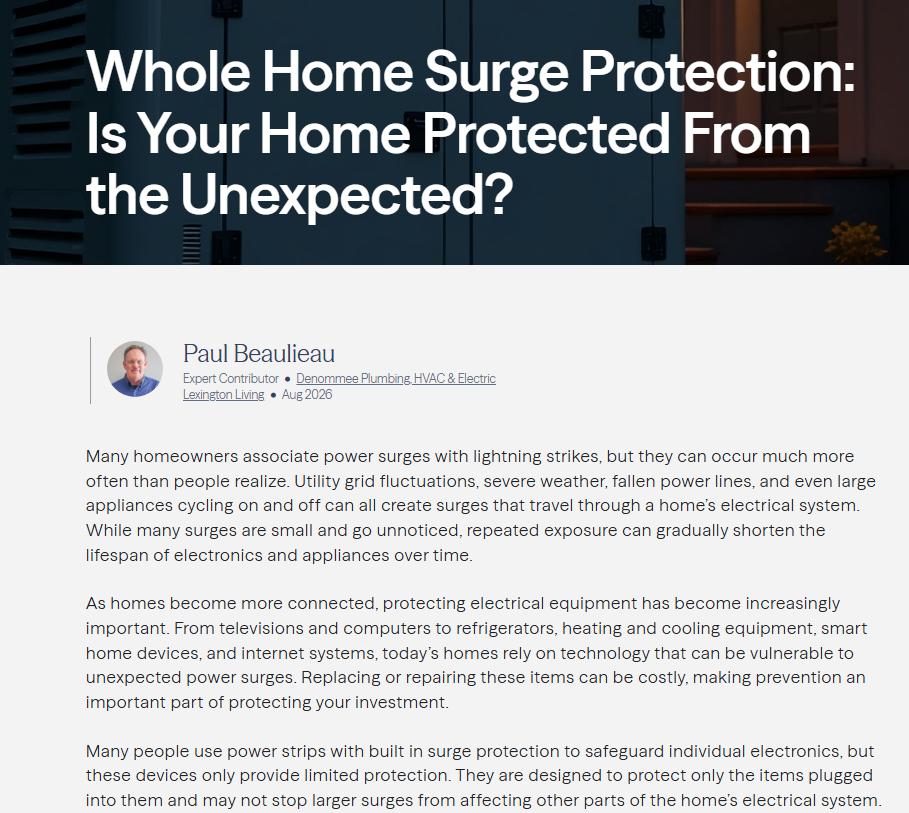
That was the subject of Denommee Plumbing, HVAC & Electric Master Electrician Paul Beaulieau's expert-contributor article in the August 2026 edition of Lexington Living, published by Best Version Media.
In “Whole Home Surge Protection: Is Your Home Protected From the Unexpected?”, Paul explains why Massachusetts homeowners should consider protection beyond the familiar plug-in surge strip and how a whole-home surge protective device can help protect electrical equipment throughout a house.
It's an increasingly relevant subject for homeowners in Lexington and throughout Greater Boston and the Merrimack Valley.
Modern homes don't simply have more electrical devices. They increasingly depend on electronics for essential functions—including heating and cooling, communications, security, appliances, vehicle charging and home automation.
That makes understanding whole-home surge protection an important part of modern electrical safety and system planning.
What Causes a Power Surge?
Lightning is probably the first thing homeowners associate with an electrical surge, but it isn't the only potential source.
As Paul explained in Lexington Living, power disturbances can also be associated with:
- Utility-grid fluctuations
- Severe weather
- Fallen power lines
- Large appliances cycling on and off
Many surges can be relatively small and pass unnoticed. The concern isn't necessarily that every surge will immediately destroy a television or appliance. Repeated exposure to electrical disturbances can potentially affect sensitive electronic equipment over time.
That's particularly relevant because the number—and value—of electronics in an average home has changed considerably.
What Electronics in Your Home Could Be Affected by a Power Surge?
Think beyond televisions and desktop computers.
As the Lexington Living article points out, modern homes increasingly depend upon electronics associated with:
Refrigerators and appliances
Heating and cooling systems
Computers and home offices
Internet equipment
Smart-home devices
Connected security equipment
And that list continues to grow.
Many newer furnaces, boilers, heat pumps, air-conditioning systems and water heaters contain electronic controls. Smart appliances incorporate control boards and communications electronics. EV charging equipment adds another substantial electrical system to the home.
This changes the way homeowners should think about surge protection.
You're no longer protecting only the television in the family room.
You're helping protect an increasingly interconnected electrical ecosystem throughout the house.
What Is a Whole-Home Surge Protector?
A whole-home surge protective device, commonly called a whole-home surge protector, is installed as part of the home's electrical system—typically at or associated with the main electrical panel, depending on the installation and equipment.
Its purpose is to help limit transient overvoltage before it reaches electrical equipment throughout the house.
That's fundamentally different from a conventional plug-in surge strip.
As Paul explained in Lexington Living, a power strip with surge protection is designed to protect the particular devices connected to it. Whole-home protection takes a broader approach by providing protection at the home's electrical system.
That distinction matters.
You might have your television plugged into a surge protector.
But what about your refrigerator?
Your furnace?
Central air conditioner or heat pump?
Dishwasher?
Electric range?
Hardwired smart devices?
Garage equipment?
Those aren't necessarily protected by the surge strip under your desk.
Does Whole-Home Surge Protection Prevent All Electrical Damage?
No—and homeowners should be wary of anyone promising that it does.
No surge-protection strategy can guarantee that every device will survive every possible electrical event.
The Lexington Living article makes this distinction explicitly:
“While no system can prevent damage from every event…”
Whole-home surge protection instead provides a broader level of protection for the home's electrical system and can reduce the likelihood of damage associated with many common surge events.
That's a much more useful way to think about it.
A surge protective device isn't an invisible force field around your house.
It's an electrical protection measure intended to reduce risk.
Why Whole-Home Surge Protection Is Increasingly Relevant in Massachusetts
Late summer provided a timely reason for Paul to address the subject in the August edition of Lexington Living.
Massachusetts and southern New Hampshire can experience thunderstorms and unpredictable summer weather. And, as Paul notes, lightning doesn't necessarily have to strike the house directly for electrical equipment to be affected. Nearby strikes and electrical-grid disturbances can also create surge conditions.
But surge protection isn't only a summertime consideration.
Utility disturbances and other electrical events aren't limited to thunderstorm season.
For homeowners making improvements to their electrical systems, surge protection therefore deserves consideration as part of the home's broader electrical infrastructure.
Do New Electrical Panels Include Whole-Home Surge Protection?
This is an especially useful question for homeowners planning an electrical panel or service upgrade.
A panel replacement gives the electrician an opportunity to evaluate the home's electrical system more broadly rather than simply exchanging one metal box for another.
Depending on the project and applicable requirements, that evaluation can include:
- Available electrical capacity
- Breaker-panel condition
- Grounding and bonding
- Circuit requirements
- Electrical service capacity
- Future electrification plans
- EV charging
- Heat pumps
- Electrical safety
- Surge protection
Denommee incorporates whole-home electrical considerations into our panel and service-upgrade work rather than treating the panel as an isolated component.
[See a real 200-amp electrical service and panel upgrade completed by Denommee in Chelmsford, MA →]
That completed project is particularly useful here because it gives homeowners an actual example of the electrical-upgrade work discussed in educational articles like this one.
Surge Protection Becomes More Important as Homes Electrify
This is where Paul's Lexington Living column intersects with another major trend we're seeing throughout Massachusetts: home electrification.
Many homeowners are adding or considering equipment such as:
- Air-source heat pumps
- Heat-pump water heaters
- EV chargers
- Smart electrical panels
- Induction cooking
- Battery storage
- Solar equipment
- Home automation
- Standby generators
Paul specifically identified EV chargers, standby generators, smart appliances, home offices and connected security systems as examples of newer technologies that can make surge protection particularly valuable.
The more sophisticated a home's electrical infrastructure becomes, the more important it is to think about the electrical system as a whole.
An EV charger isn't simply another appliance.
A heat pump isn't simply another air conditioner.
A modern high-efficiency furnace may contain sophisticated electronic controls.
A smart panel can monitor and manage electrical loads.
All of these technologies depend on a reliable electrical system.
Should You Use Plug-In Surge Protectors If You Have Whole-Home Protection?
Whole-home and point-of-use protection shouldn't necessarily be viewed as competing ideas.
A whole-home device provides broad protection at the electrical-system level, while quality point-of-use surge protection can provide another layer for selected sensitive electronics.
The important thing for homeowners to understand is that a collection of power strips around the house isn't equivalent to protecting the electrical system at the panel.
Paul's article makes that distinction clearly: plug-in devices protect the equipment connected to them, while a whole-home device is intended to provide protection across the home's electrical system.
Can a Whole-Home Surge Protector Be Added to an Existing Electrical Panel?
Often, yes.
A homeowner doesn't necessarily need to be replacing the entire electrical service just to consider surge protection.
As Paul explained to Lexington Living readers, installation is typically straightforward when performed by a qualified electrician, with the device integrated into the home's electrical panel.
The specific installation depends upon the existing electrical system, panel, available space, equipment selected and other site conditions.
That's why the appropriate first step is an evaluation rather than assuming that one product or installation method applies to every house.
Why Have a Licensed Electrician Evaluate the Electrical System?
Adding surge protection creates another useful opportunity: looking at the electrical system around it.
Paul noted in the article that during an evaluation, an electrician can also identify other conditions that may affect the overall safety and reliability of the home's electrical system.
That's important because homeowners don't routinely inspect the parts of their electrical systems that matter most.
An electrical evaluation can provide useful information about the condition and suitability of the panel and related electrical infrastructure—and can help homeowners prioritize future work instead of waiting until an electrical problem becomes urgent.
For homeowners planning heat pumps, EV charging, major appliances or other electrification projects, it can also be an opportunity to discuss whether the existing electrical service is appropriate for future plans.
Who Is Paul Beaulieau?
Paul Beaulieau is a Master Electrician with Denommee Plumbing, HVAC & Electric and contributed the whole-home surge-protection article as an expert contributor to the August 2026 edition of Lexington Living.
That attribution is worth emphasizing on the Denommee site.
The information homeowners read in our electrical content isn't intended to be anonymous marketing copy. Denommee's electrical team works with these systems in actual Massachusetts homes—from everyday electrical troubleshooting and safety assessments to panel replacements, service upgrades, EV charging and broader electrification projects.
Our educational content is an extension of that work.
Denommee's Expert Contributor Series in Local Massachusetts Communities
Denommee contributes homeowner education to local publications because plumbing, HVAC and electrical systems are becoming increasingly complex.
Homeowners are being asked to make decisions about heat pumps, electrification, refrigerant transitions, EV charging, electrical capacity, energy efficiency, plumbing upgrades and increasingly sophisticated home technology.
Those decisions are easier when homeowners understand why a contractor recommends something—not simply what they're being asked to purchase.
Our contributions to publications such as Lexington Living are intended to make that professional knowledge accessible to the communities we serve.
And when a subject deserves more than the space available in a print column, we'll continue the discussion here.
Frequently Asked Questions About Whole-Home Surge Protection
Is a whole-home surge protector only for lightning?
No. Lightning is one potential source of surges, but electrical disturbances can also result from utility-grid fluctuations, severe weather, fallen power lines and equipment operation.
Will a whole-home surge protector guarantee my electronics won't be damaged?
No surge protection system can guarantee protection against every possible electrical event. Whole-home surge protection is intended to reduce the impact of many common surge events and provide broader protection than relying exclusively on point-of-use devices.
Is a power strip the same as whole-home surge protection?
No. A surge-protective power strip provides protection for equipment connected to that particular device. A whole-home surge protector is installed at the electrical system to provide broader protection throughout the house.
Can surge protection be installed without replacing my electrical panel?
Often it can, depending on the existing electrical system and panel. A licensed electrician can evaluate the panel and determine the appropriate installation approach.
Should I consider surge protection when upgrading to 200-amp service?
Yes, it's an excellent time to discuss it with your electrician. A service or panel upgrade creates an opportunity to evaluate surge protection along with grounding, bonding, electrical capacity and future loads such as heat pumps and EV chargers.
Are heat pumps and HVAC equipment vulnerable to power surges?
Modern HVAC equipment frequently incorporates electronic controls and components. Paul's Lexington Living article specifically identifies heating and cooling equipment among the technology found in today's homes that can be vulnerable to unexpected electrical surges.
Considering Whole-Home Surge Protection in Lexington, MA?
You don't have to wait until the next thunderstorm—or until you're replacing an electrical panel—to find out whether your home has appropriate surge protection.
Denommee Plumbing, HVAC & Electric's licensed electrical team can evaluate your existing panel and electrical system, discuss whole-home surge protection and help identify other electrical concerns or future capacity needs.
For homeowners investing in heat pumps, EV charging, smart-home technology, new appliances or other electrical upgrades, it's also an opportunity to consider how those investments fit into the home's electrical system as a whole.
Denommee provides residential electrical installation, repair, service upgrades, panel replacements, EV charging and electrical safety services throughout Lexington and surrounding Greater Boston, Middlesex County and Merrimack Valley communities.
Call Denommee: 978-649-8886
Text: 857-226-9140
Schedule electrical service online: Available 24/7


