Mitsubishi Electric Ductless Mini-Split Systems in Massachusetts
Efficient Heating & Air Conditioning Without Traditional Ductwork
You don't need conventional ductwork to have high-efficiency heating and air conditioning.
Mitsubishi Electric ductless mini-split systems provide heating and cooling directly to individual rooms and living areas without requiring a traditional central duct system.
That makes ductless technology particularly useful for Massachusetts homes that were never designed for central air conditioning, as well as additions, finished spaces and rooms that are difficult to keep comfortable with an existing HVAC system.
But "ductless" doesn't mean one-size-fits-all.
A Mitsubishi system might condition a single room.
It might serve several independently controlled zones.
It could provide supplemental heating and cooling while an existing boiler or furnace remains in place.
Or, when properly designed, Mitsubishi cold-climate technology can become part of a whole-home heating and cooling solution.
Denommee Plumbing, HVAC & Electric designs, installs, services and maintains Mitsubishi Electric ductless systems throughout Massachusetts and southern New Hampshire.
As a Mitsubishi Electric Diamond Elite Contractor and Massachusetts licensed Refrigeration Contractor RC-148415, Denommee combines Mitsubishi product experience with in-house HVAC, electrical and plumbing capabilities.
Our objective isn't to determine how many mini splits we can put in your house.
It's to determine where ductless makes sense—and where it doesn't.
Mitsubishi Ductless Mini Splits: Quick Answer
A Mitsubishi Electric ductless mini split is a heat-pump system that provides heating and air conditioning without conventional central ductwork. An outdoor heat-pump unit is connected by refrigerant piping and electrical/control wiring to one or more compatible indoor units. Mitsubishi systems can be designed for a single room, multiple independently controlled zones or, in appropriate applications, whole-home heating and cooling. Denommee Plumbing, HVAC & Electric is a Mitsubishi Electric Diamond Elite Contractor and Massachusetts Refrigeration Contractor RC-148415 providing ductless installation and service in Massachusetts.
What Is a Ductless Mini Split?
A traditional central HVAC system typically distributes conditioned air through a network of ducts.
A ductless mini split takes a different approach.
An outdoor heat-pump unit is connected to an indoor unit through a relatively small pathway containing the refrigerant lines, electrical/control connections and, where applicable, condensate drainage.
Instead of sending conditioned air through ducts to distant rooms, the indoor unit delivers heating or cooling directly to the space or zone it serves.
That's where the name comes from:
"Split" refers to the system being divided between indoor and outdoor equipment.
"Mini" distinguishes the equipment from larger traditional split HVAC systems.
"Ductless" means heating and cooling can be delivered without a conventional duct distribution system.
And because Mitsubishi mini splits use heat-pump technology, they can provide both air conditioning and heating.
Why Are Ductless Mini Splits So Popular in Massachusetts?
Massachusetts has an enormous inventory of homes built long before central air conditioning became standard.
Steam radiators, hot-water baseboards and boilers can provide excellent heat, but those systems don't give a homeowner ductwork for air conditioning.
Retrofitting traditional central AC into these homes can sometimes require extensive construction to find pathways for large supply and return ducts.
Ductless provides another option.
Rather than designing the house around the HVAC system, a well-planned mini-split installation can often work with the existing architecture.
That makes Mitsubishi ductless systems particularly relevant for:
- Older Massachusetts homes without ductwork
- Homes with steam heat
- Homes with hydronic baseboard heating
- Finished attics
- Finished basements
- Additions
- Home offices
- Primary bedroom suites
- Bonus rooms
- Converted garages
- Sunrooms
- Rooms with persistent hot or cold spots
- Homes replacing window air conditioners
- Properties where extensive new ductwork would be impractical
Ductless isn't automatically the correct answer for every one of these situations.
But it gives homeowners an option that simply didn't exist when many New England homes were built.
Mitsubishi Mini Splits Provide Air Conditioning—and Heat
The phrase "mini split" is still frequently associated with air conditioning.
That's only half of the story.
Mitsubishi Electric mini splits are heat pumps, meaning appropriately configured systems can provide both cooling and heating.
During summer, the system transfers heat from inside the house to the outdoors.
During heating operation, the refrigeration cycle allows the system to transfer available heat from outdoor air into the home.
For Massachusetts homeowners, that creates several possibilities.
A homeowner might install ductless primarily because they want air conditioning and discover that the system can also reduce reliance on their existing heating equipment during appropriate conditions.
Another homeowner may deliberately use Mitsubishi cold-climate equipment for substantial winter heating.
And in a properly evaluated whole-home application, heat pumps can potentially become the primary heating system.
The important distinction is that adding a mini split for cooling isn't the same design problem as sizing a heat pump to carry a home's winter heating load.
System objectives should be established before equipment is selected.
What Is Mitsubishi Hyper-Heat?
Massachusetts homeowners researching ductless heating will frequently encounter the term Hyper-Heat.
Mitsubishi Electric developed cold-climate heat-pump technology specifically to maintain heating performance as outdoor temperatures fall.
That matters in New England, where an HVAC system needs to perform under conditions very different from those experienced during a mild spring afternoon.
Hyper-Heat technology can make ductless systems appropriate for more substantial cold-weather heating applications than earlier generations of heat pumps.
But the Hyper-Heat name itself does not eliminate the need for professional design.
Equipment still needs to be matched to the home's heating load, application and expected operating conditions.
Learn more about Mitsubishi Electric Heat Pumps and Hyper-Heat →
Single-Zone vs. Multi-Zone Mitsubishi Mini Splits
One of the first decisions in a ductless project is how many spaces need heating and cooling.
Single-Zone Mini Split
A single-zone system typically pairs an outdoor unit with one indoor unit.
This can be an excellent solution when the problem is highly specific.
For example:
A finished attic is unbearably hot every summer.
A home office above the garage is always cold.
A new addition isn't served by the existing HVAC system.
A primary bedroom needs independent temperature control.
Rather than modifying the entire home's heating and cooling system to solve one localized problem, a single-zone mini split may provide a targeted solution.
Multi-Zone Mini Split
A multi-zone system can allow one compatible outdoor unit to serve multiple indoor units.
Each indoor zone can provide individual temperature control, making it possible to condition several areas without creating conventional central ductwork throughout the house.
This can be particularly appealing in older homes with distinct rooms and floors.
But more zones do not automatically mean one giant outdoor unit should serve everything.
Depending on the house and its loads, multiple outdoor systems or a combination of system types may provide a better design.
That's why we prefer to design the system around the house rather than design the house around a predetermined equipment package.
What Does "Zoning" Actually Mean?
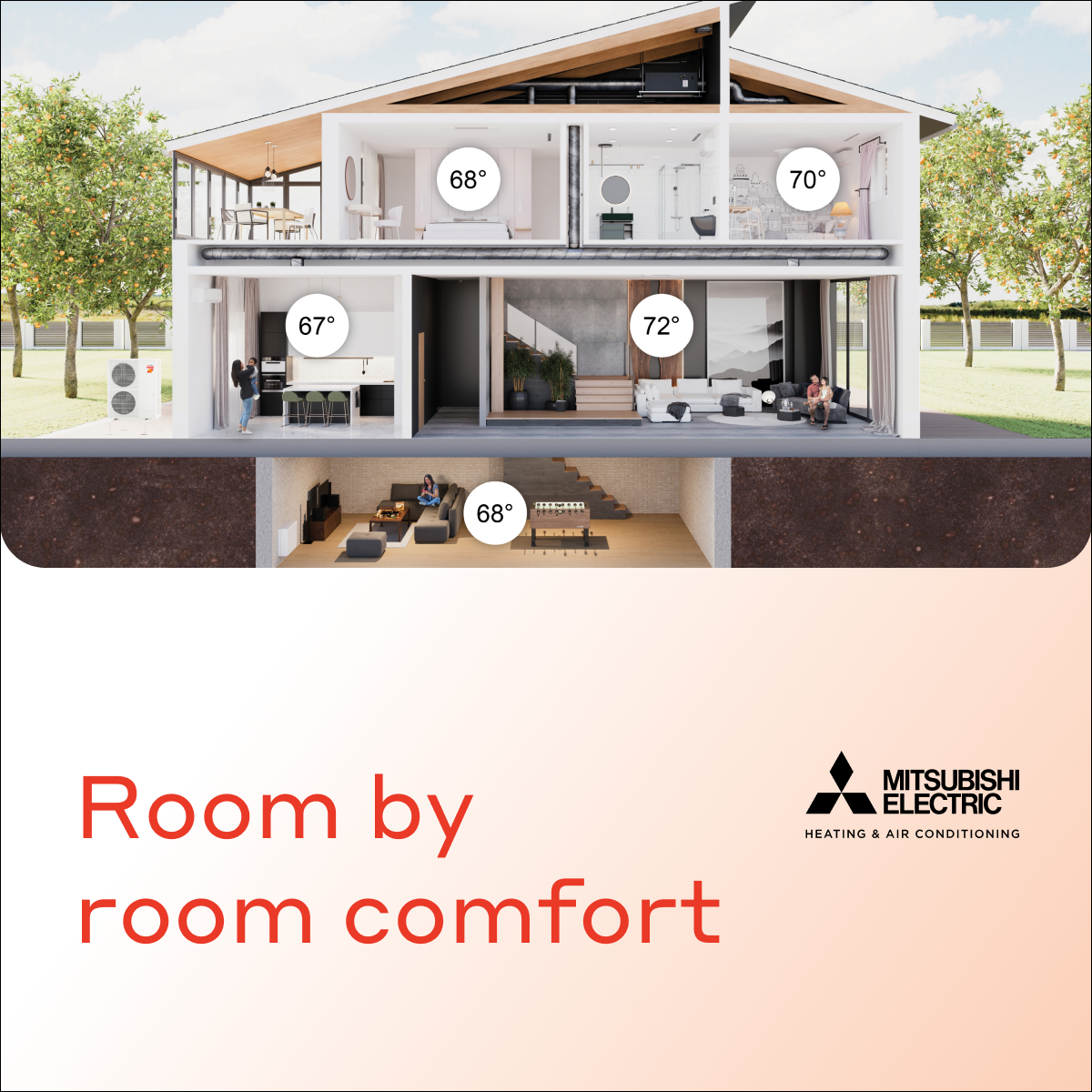
One of the biggest advantages of ductless HVAC is individual zone control.
With conventional central HVAC, a single thermostat may represent the temperature of a large portion of the house.
That doesn't mean every room actually experiences the same conditions.
Sun exposure, floor level, windows, insulation, room usage and internal heat gains can all affect comfort.
Ductless systems allow separate areas to respond more independently.
A bedroom doesn't necessarily need to be maintained at the same temperature as an unused guest room.
A sunny living room can have different cooling needs from a shaded bedroom.
A home office occupied all day may have different requirements from rooms used primarily at night.
Zoning gives homeowners more control over where heating and cooling are delivered.
That doesn't mean the most efficient strategy is to install an indoor unit in every room.
Proper design considers how air moves through the house, room loads, floor plan and how the spaces are actually used.
Do I Need a Mini Split in Every Room?
Not necessarily.
This is one of the most important questions to answer during system design.
An indoor unit serves the zone in which it is installed. Whether adjacent rooms can be adequately conditioned depends on the home's layout, heat loss and heat gain, door positions, airflow and homeowner expectations.
An open kitchen/living area presents a very different design opportunity from a hallway containing five bedrooms with doors that are routinely closed.
Simply installing the fewest possible indoor units isn't necessarily good design.
Neither is covering every wall with equipment.
The goal is to create an appropriate number of zones for the home and the people living in it.
Indoor Mini-Split Units Don't All Have to Look the Same
When many homeowners picture a mini split, they imagine the familiar rectangular wall-mounted unit.
That's a common solution—but it isn't the only approach available.
Depending upon the Mitsubishi system and application, indoor equipment can include different configurations suited to different architectural conditions.
That becomes important when aesthetics, ceiling construction, wall space or room layout make a conventional high-wall unit less desirable.
The best indoor-unit selection should balance:
Comfort. Performance. Serviceability. Architecture. Appearance.
Where equipment is located matters almost as much as which equipment is selected.
Where Should a Mitsubishi Mini Split Be Installed?
Indoor-unit placement should never be treated as an afterthought.
A good location needs to account for both mechanical performance and the room itself.
Factors can include:
- Air distribution
- Room geometry
- Exterior walls
- Furniture placement
- Ceiling height
- Refrigerant piping routes
- Condensate drainage
- Service access
- Appearance
- Electrical requirements
- Outdoor-unit location
The easiest wall for an installer isn't automatically the best wall for the homeowner.
Denommee considers the equipment installation as part of the home's finished environment—not merely a mechanical exercise.
Can Mitsubishi Mini Splits Heat an Entire Massachusetts Home?
Yes, in appropriate homes, ductless Mitsubishi cold-climate systems can be designed as part of a whole-home heating and cooling solution.
Denommee has direct experience doing exactly that.
Arlington, MA: Mitsubishi Hyper-Heat Replaces Steam Heat
At an Arlington home, Denommee completed a whole-home Mitsubishi Hyper-Heat installation as part of an upgrade from existing steam heating.
The project is particularly relevant to homeowners with older heating systems because steam-heated houses typically don't contain the duct network required for conventional central air conditioning.
Ductless technology created another pathway: modern air conditioning and cold-climate heat-pump heating without first constructing a traditional whole-home duct system.
See the Whole-Home Mitsubishi Hyper-Heat Installation in Arlington →
That project demonstrates what is possible.
Whether a similar conversion is appropriate for another house requires an evaluation of that property's heating load, construction, electrical system and homeowner objectives.
Real Mitsubishi Multi-Zone Installation in Billerica, MA
Denommee also completed a Mitsubishi multi-zone ductless installation in Billerica, Massachusetts, demonstrating a different use of the technology.
Rather than viewing mini splits merely as isolated room air conditioners, a multi-zone system can provide coordinated heating and cooling across several living areas while maintaining individual zone control.
See the Mitsubishi Multi-Zone Ductless Installation in Billerica →
This distinction matters.
The Arlington and Billerica projects both use Mitsubishi ductless technology, but they illustrate different homeowner objectives.
One demonstrates a major whole-home heating conversion.
The other demonstrates the flexibility of high-efficiency multi-zone comfort.
The technology can be similar while the system design is completely different.
Another Massachusetts Example: Mitsubishi Hyper-Heat in Groton
At a 3,310-square-foot, three-bedroom home built in 1986, Denommee installed a Mitsubishi Electric multi-zone Hyper-Heat system to provide heating and cooling to selected areas of the house.
The project included a Mitsubishi MXZ-series R-454B outdoor unit serving indoor units in the living room and primary bedroom.
The installation also demonstrates what homeowners don't typically see after the finished system is operating:
- Refrigerant piping
- Electrical installation
- Condensate management
- Nitrogen pressure testing
- Deep vacuum evacuation
- Refrigerant commissioning
- Equipment setup and testing
The completed indoor units may be the most visible parts of a ductless installation.
The work behind the walls and covers is equally important.
See the Mitsubishi Hyper-Heat Installation in Groton →
Mini Splits for Older Massachusetts Homes
Ductless HVAC and older New England homes can be particularly good partners.
But older homes also require thoughtful planning.
A home built in 1900, 1920 or 1950 can contain:
- Steam or hydronic heating
- Multiple additions
- Limited mechanical chases
- Plaster walls
- Finished attics
- Uneven insulation
- Older electrical systems
- Numerous renovations from different eras
Those characteristics don't make a home unsuitable for a heat pump.
They mean the contractor needs to understand the building before deciding how the heat pump should be installed.
Sometimes ductless is the least invasive solution.
Sometimes limited new ductwork is possible.
Sometimes a mixed ducted and ductless Mitsubishi system provides a better answer than either approach alone.
Explore Whole-Home Multi-Zone & Mixed Ducted Mitsubishi Systems →
Can I Keep My Existing Boiler or Furnace?
Yes.
Installing a Mitsubishi mini split doesn't automatically mean removing your existing heating equipment.
For some Massachusetts homeowners, keeping a boiler or furnace is intentional.
A homeowner might use Mitsubishi equipment to provide:
- Central or zoned air conditioning
- Supplemental heating
- Heating during selected outdoor conditions
- Comfort in areas underserved by the existing system
- An incremental step toward electrification
Other homeowners may want to eliminate fossil-fuel heating entirely.
Neither objective is universally correct.
Denommee works with heat pumps, furnaces, boilers and hydronic heating, which allows us to discuss the existing heating system as part of the decision rather than assuming it has to disappear simply because a heat pump is being installed.
Mini Splits vs. Central Air Conditioning
If your home has no ductwork, installing conventional central air may require creating an entirely new distribution system.
Ductless avoids that requirement.
If your home already has excellent ductwork, however, a ducted system may deserve serious consideration.
This is why the question shouldn't simply be:
"Are mini splits better than central air?"
A better question is:
"Which distribution strategy makes the most sense for this house?"
Ductless offers exceptional flexibility.
Ducted HVAC offers its own advantages.
And Mitsubishi technology allows some homes to use both.
What About the Appearance of Mini Splits?
This deserves discussion because homeowners care about it.
We do too.
An HVAC system is mechanical equipment, but indoor units become part of rooms where people live every day.
Outdoor equipment, line-set covers and condensate routing also become part of the exterior of the house.
Good installation planning should consider:
- Indoor-unit visibility
- Wall and ceiling placement
- Line-set routing
- Exterior line-hide
- Outdoor-unit location
- Condensate routing
- Equipment clearances
- Snow considerations
- Service access
The objective isn't to pretend the HVAC system is invisible.
It's to integrate necessary mechanical equipment into the property as cleanly and thoughtfully as practical.
Massachusetts Snow Changes Outdoor-Unit Installation
Outdoor heat-pump placement is especially important in New England.
A Massachusetts installation has to account for conditions that aren't particularly relevant to an air conditioner operating only during summer.
Cold-climate heat pumps operate during winter.
That means outdoor equipment location should account for manufacturer requirements as well as site conditions such as snow accumulation, drainage, clearances and access.
This is another reason a cold-climate heat pump shouldn't simply be approached as an air conditioner that happens to run backward.
It's a year-round HVAC system.
What Electrical Work Is Required for a Mini Split?
Mitsubishi heat pumps require electrical power, including appropriately designed circuits and disconnecting means for the installed equipment.
But installing a mini split does not automatically mean your house needs a new electrical panel or service.
The existing electrical system and proposed equipment need to be evaluated.
Relevant considerations can include:
- Existing service capacity
- Panel capacity
- Available breaker spaces
- Required circuits
- Equipment electrical specifications
- Other significant electrical loads
- Future electrification plans
Denommee provides licensed electrical services in-house, allowing electrical requirements to be coordinated with the HVAC installation when needed.
Learn More: Electrical Considerations for HVAC System Upgrades →
A Mitsubishi Mini Split Is a Refrigeration System
Behind the simple appearance of a finished ductless installation is a refrigeration circuit that needs to be assembled and commissioned correctly.
Installation procedures can include refrigerant piping, properly prepared connections, pressure testing, evacuation and system startup.
Denommee holds Massachusetts Refrigeration Contractor License RC-148415.
We are also a Mitsubishi Electric Diamond Elite Contractor.
These credentials represent different qualifications: one is associated with Massachusetts refrigeration contracting, while the other reflects Denommee's relationship and qualifications within Mitsubishi Electric's contractor program.
For homeowners, both are relevant when evaluating the company responsible for designing, installing and servicing a Mitsubishi system.
What Happens Before We Turn Your New Mitsubishi System On?
Much of the most important work in a mini-split installation disappears from view when the project is complete.
Denommee's documented Mitsubishi installation procedures can include:
Refrigerant piping installation
Compatible piping connects the indoor and outdoor refrigeration equipment.
Nitrogen pressure testing
The refrigeration circuit is tested before final startup.
Deep vacuum evacuation
Air and moisture are removed from the refrigerant circuit. Denommee project documentation includes evacuation to specified micron levels before commissioning.
Electrical installation
Proper power, disconnects, protection and equipment connections are completed as required by the system.
Condensate management
Cooling produces moisture that needs a reliable drainage path.
System setup and commissioning
Equipment operation, controls and applicable settings are checked before the installation is considered complete.
A neat indoor unit is important.
A properly installed refrigeration system behind it is more important.
Why Choose Denommee for Mitsubishi Ductless Installation?
Denommee Plumbing, HVAC & Electric brings several capabilities together for Mitsubishi projects:
Mitsubishi Electric Diamond Elite Contractor
Massachusetts Refrigeration Contractor RC-148415
In-house HVAC professionals
In-house licensed electricians
In-house plumbing and hydronic expertise
Documented Massachusetts Mitsubishi installations
Required permits and inspections included within applicable project scopes
Startup and commissioning procedures
Ongoing maintenance and repair
24/7 emergency service
And because we install several types of heating and cooling systems, we're able to have a broader conversation.
Sometimes ductless is clearly the right answer.
Sometimes ducted HVAC makes more sense.
Sometimes the best system uses both.
And sometimes keeping part of the existing heating system is the smartest decision.
A consultation should help answer those questions—not assume the answer before anyone sees the house.
Frequently Asked Questions About Mitsubishi Mini Splits
Do Mitsubishi mini splits provide both heat and air conditioning?
Yes. Mitsubishi ductless mini splits use heat-pump technology and can provide both heating and cooling. The appropriate equipment and design depend on how the system will be used, particularly if it is expected to provide substantial winter heating.
Do mini splits need ductwork?
No. A primary advantage of ductless systems is their ability to deliver conditioned air directly to a room or zone without a traditional central duct network.
Can a mini split heat a house in Massachusetts?
Properly selected cold-climate Mitsubishi equipment can provide significant heating during Massachusetts winters. Whole-home applications require appropriate load evaluation and system design.
What is Mitsubishi Hyper-Heat?
Hyper-Heat refers to Mitsubishi Electric cold-climate heat-pump technology designed for enhanced heating performance at low outdoor temperatures.
Do I need an indoor mini split in every bedroom?
Not automatically. The correct number and placement of indoor units depends on room loads, floor plan, door positions, airflow and homeowner comfort expectations.
Can one outdoor Mitsubishi unit operate several indoor units?
Compatible Mitsubishi multi-zone systems can serve multiple indoor units from an appropriate outdoor system. System matching and sizing are important.
Can I install mini splits and keep my boiler?
Yes. Some homeowners retain existing boilers or furnaces while using Mitsubishi equipment for cooling and some or all of their heating needs.
Are mini splits good for homes with steam heat?
They can be particularly useful because steam-heated homes often lack central ductwork. Denommee has completed a whole-home Mitsubishi Hyper-Heat conversion in Arlington that replaced an existing steam-heating strategy.
Are Mitsubishi mini splits only wall mounted?
No. Mitsubishi offers multiple indoor-equipment configurations depending on the system and application. Equipment selection should consider both performance and the architecture of the room.
Will I need an electrical-panel upgrade?
Not necessarily. Electrical requirements depend on the existing service, panel, household loads and proposed HVAC equipment.
Does Denommee install the electrical circuit for the mini split?
Denommee provides both HVAC and electrical services in-house, allowing required electrical work to be coordinated as part of the project scope.
Does Denommee service Mitsubishi mini splits?
Yes. Denommee installs, services and maintains Mitsubishi Electric HVAC systems.
Is Denommee a Mitsubishi Diamond Elite Contractor?
Yes. Denommee is a Mitsubishi Electric Diamond Elite Contractor.
Is Denommee licensed for refrigeration work in Massachusetts?
Denommee holds Massachusetts Refrigeration Contractor License RC-148415.
How much does a Mitsubishi mini split cost in Massachusetts?
Cost varies considerably depending on the number of zones, equipment selection, installation conditions, electrical requirements and overall project scope. Denommee provides an online HVAC pricing tool so homeowners can begin exploring options before scheduling an in-home consultation.
How Much Does a Mitsubishi Ductless Mini Split Cost?
There isn't a useful single price for "a Mitsubishi mini split."
A one-room system and a whole-home multi-zone installation are fundamentally different projects.
Price can be influenced by:
- Number of indoor zones
- Equipment capacity
- Hyper-Heat equipment selection
- Indoor-unit type
- Number of outdoor units
- Refrigerant piping lengths and routes
- Outdoor-unit mounting
- Electrical requirements
- Condensate routing
- Installation complexity
- Controls
- Permits
- Existing HVAC equipment
- Whole-home versus supplemental application
That's why a price advertised for "a mini split" often tells a homeowner very little about what an appropriate system for their house will actually cost.
Denommee offers another starting point.
Explore Mitsubishi HVAC Pricing Online
You can use our online HVAC pricing tool to explore heating and cooling options freely before scheduling an appointment.
Explore Online HVAC Pricing →
https://www.denommeeplumbing.com/shop#/journey/h_v_a_c_quote
When you're ready for a property-specific recommendation, schedule a no-cost in-home HVAC consultation.
We'll evaluate the house, discuss the rooms you want to condition, consider the existing heating system and electrical infrastructure, and help determine whether ductless—or another approach—makes the most sense.
Mitsubishi Ductless Mini-Split Installation Near You
Denommee installs and services Mitsubishi Electric ductless heat pumps from our locations in Tyngsborough and Burlington, Massachusetts, serving homeowners throughout the Merrimack Valley, Greater Lowell, Greater Boston's northwestern suburbs and surrounding Massachusetts and southern New Hampshire communities.
Important service areas include Arlington, Acton, Andover, Belmont, Billerica, Burlington, Carlisle, Chelmsford, Concord, Dracut, Dunstable, Groton, Lexington, Lincoln, North Andover, Reading, Sudbury, Tewksbury, Tyngsborough, Westford, Wilmington, Winchester and Woburn, along with nearby communities throughout our service area.
Our local Mitsubishi project portfolio continues to grow because Massachusetts homes don't all need the same HVAC solution.
Some need one zone.
Some need five.
Some have ducts.
Some have steam.
Some have boilers homeowners want to keep.
And some are ready for whole-home electrification.
Mitsubishi gives us a flexible set of tools. Denommee's job is to determine how—or whether—to use them in your home.


