What Is a Massachusetts Refrigeration Contractor License—and Why Does It Matter When Choosing an HVAC Company?
When Massachusetts homeowners and commercial property owners compare HVAC contractors, they understandably look at equipment brands, online reviews, pricing, warranties and years in business.
There is another question worth asking:
Is the company properly licensed for the refrigeration work it performs?
Denommee Plumbing, HVAC & Electric is a licensed Massachusetts Refrigeration Contractor, License No. RC-148415.
That credential is more than another number to place at the bottom of a proposal. Massachusetts regulates refrigeration work through the Office of Public Safety and Inspections within the Division of Occupational Licensure, and the Commonwealth specifically states that a Refrigeration Contractor license allows its holder to maintain a regular place of business and employ duly licensed people to perform refrigeration work.
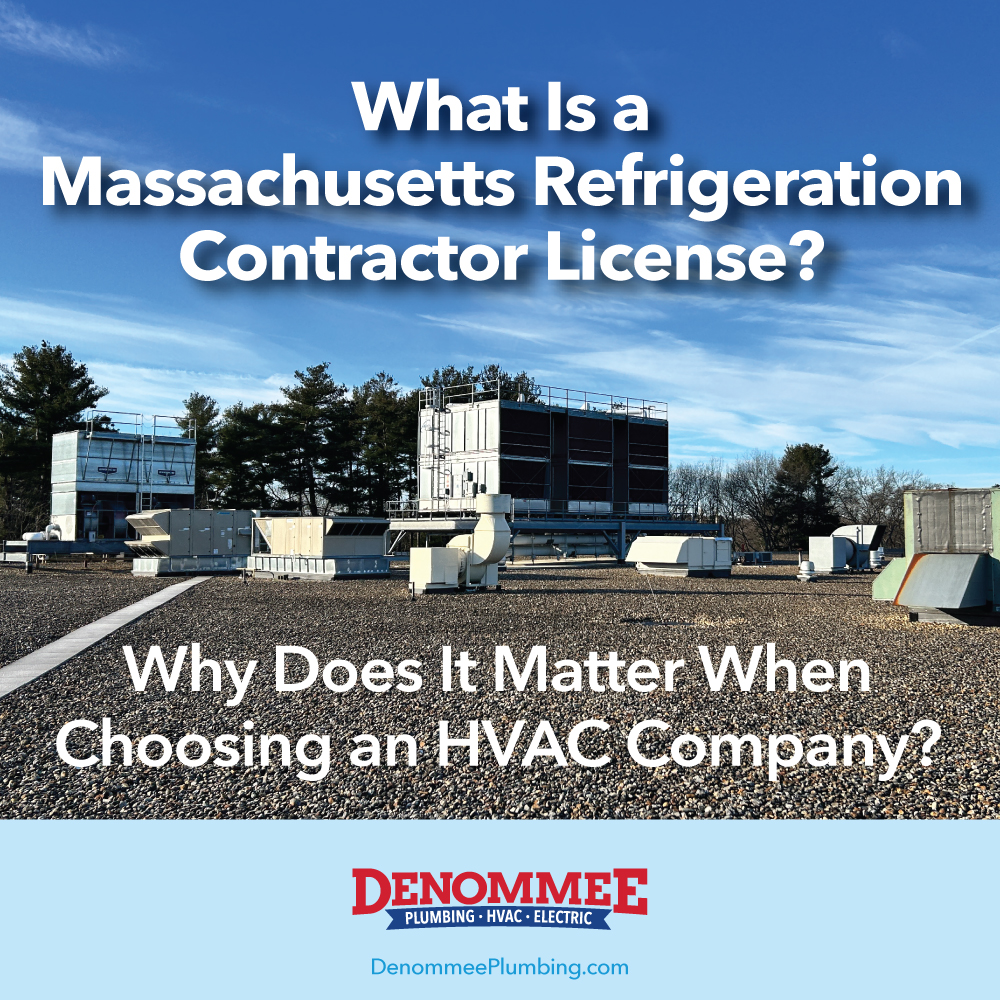
For Denommee customers, our RC-148415 Refrigeration Contractor license represents another layer of professional qualification and accountability behind the HVAC work we perform throughout Massachusetts.
It also becomes particularly important as HVAC systems become increasingly sophisticated. Today's residential and commercial buildings may depend upon variable-capacity heat pumps, VRF systems, cold-climate mini splits, large commercial air-conditioning systems and specialized refrigeration equipment that require technicians with considerably more knowledge than simply knowing how to replace a furnace or condenser.
Here's what a Massachusetts Refrigeration Contractor license means, when refrigeration licensing becomes particularly important, and why customers should consider contractor licensing when choosing an HVAC company.
Quick Answer: What Is a Massachusetts Refrigeration Contractor License?
A Massachusetts Refrigeration Contractor license authorizes its holder to maintain a regular place of business and employ appropriately licensed people to perform refrigeration work. Massachusetts regulates refrigeration contractors and technicians through the Office of Public Safety and Inspections within the Division of Occupational Licensure. Denommee Plumbing, HVAC & Electric holds Massachusetts Refrigeration Contractor License RC-148415.
That's the short answer.
Understanding why it matters requires looking more closely at how Massachusetts regulates refrigeration work and how that relates to modern HVAC systems.
What Does "Refrigeration" Mean in the HVAC Industry?
Homeowners often hear refrigeration and immediately think about refrigerators and freezers.
In the HVAC industry, refrigeration has a much broader meaning.
Air-conditioning and heat-pump systems operate using a refrigeration cycle. Refrigerant circulates through components such as compressors, coils, expansion or metering devices and piping, absorbing heat in one location and rejecting it somewhere else.
In an air conditioner, that process transfers heat from inside a building to outdoors.
A heat pump can reverse or otherwise redirect that refrigeration cycle so the equipment can provide both cooling and heating.
Refrigeration principles therefore underpin equipment such as:
- Central air-conditioning systems
- Commercial air-conditioning systems
- Air-source heat pumps
- Ducted heat pumps
- Ductless mini splits
- Variable Refrigerant Flow (VRF) systems
- Commercial refrigeration equipment
- Walk-in coolers and freezers
- Process cooling equipment
- Certain specialized environmental systems
Massachusetts has specific statutes and regulations governing refrigeration and air-conditioning systems, including provisions intended to protect life, health and property through recognized engineering and safety standards.
Massachusetts Doesn't Treat Refrigeration Licensing as a Formality
Massachusetts occupational licensing exists for an important reason.
The Commonwealth explains that occupational licensure is intended to protect consumers by establishing minimum qualifications—typically involving education, experience and examination—and by holding licensees to applicable standards of practice and regulations.
Refrigeration is among the trades Massachusetts specifically regulates.
The current 528 CMR regulations establish requirements governing refrigeration technicians and contractors, among other licensed trades. Massachusetts updated those regulations effective November 8, 2024, including changes addressing education, apprenticeships, technician licensing and applicable national codes and standards.
That distinction is important.
A Refrigeration Contractor license isn't a manufacturer's certification, marketing designation or membership purchased from an industry organization.
It is a state-regulated professional credential.
What Does Massachusetts Require of Refrigeration Professionals?
The licensing structure is designed around education, documented field experience and examination.
For example, Massachusetts currently states that a Refrigeration Technician applicant following the standard apprenticeship pathway must document at least 6,000 hours of Massachusetts employment as a duly licensed refrigeration apprentice under a Massachusetts Refrigeration Contractor, along with at least 450 hours of approved education. Technician applicants must also provide Universal CFC certification and pass the applicable licensing process.
Massachusetts separately regulates refrigeration apprentices. An apprentice must be appropriately licensed, registered with the Division of Apprentice Standards and employed by a Massachusetts Refrigeration Contractor for the duration of the apprenticeship if those work hours are to qualify toward licensing requirements.
The contractor level represents another step in that professional structure.
Massachusetts states that an applicant for a Refrigeration Contractor license must provide documentation of 100 additional hours of refrigeration training, receive approval to sit for the Refrigeration Contractor examination and pass that examination before receiving the license.
For customers, the larger point is simple:
Massachusetts refrigeration licensing represents a documented professional pathway—not merely someone describing themselves as an HVAC expert.
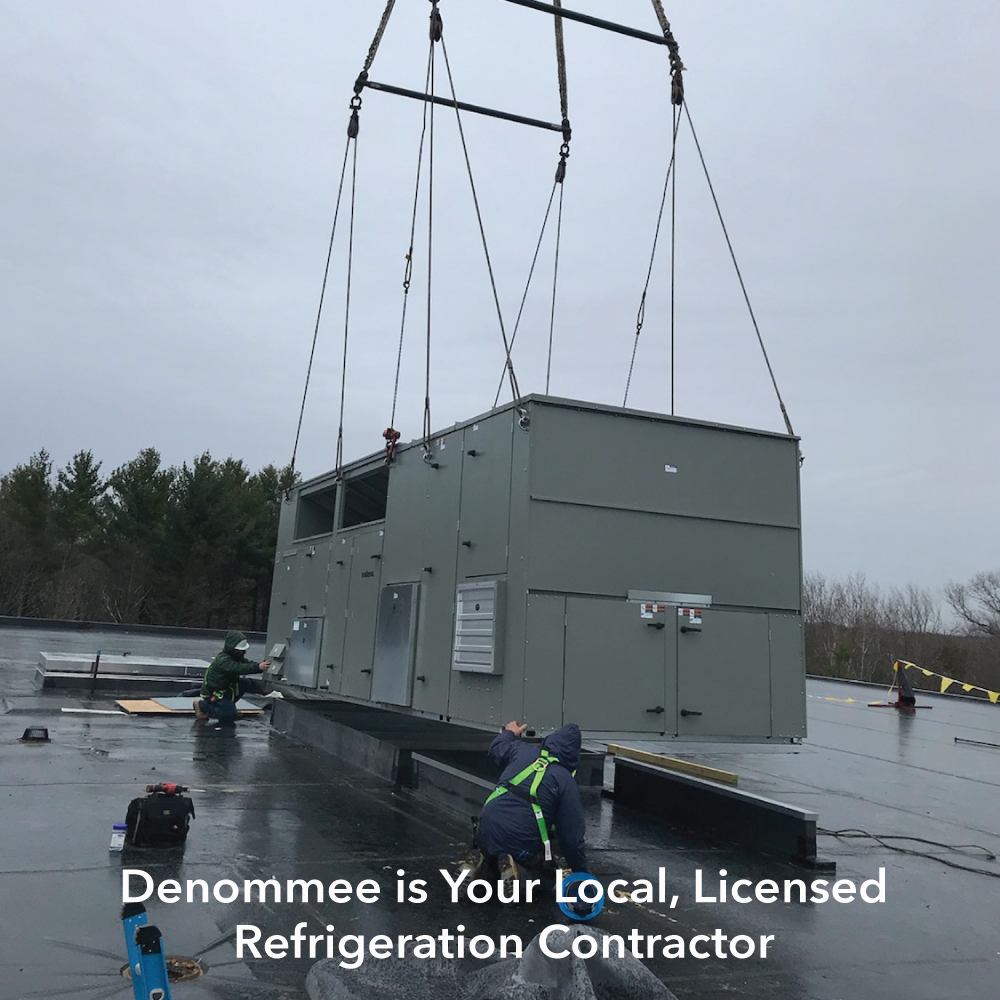
Denommee's Massachusetts Refrigeration Contractor License: RC-148415
Denommee Plumbing, HVAC & Electric holds:
Massachusetts Refrigeration Contractor License
RC-148415
That credential complements the broader HVAC expertise our customers already associate with Denommee.
Our teams work with heating and cooling technologies ranging from conventional equipment to sophisticated modern refrigeration-based HVAC systems, including:
- Central air conditioning
- Cold-climate heat pumps
- Ducted heat pumps
- Ductless mini splits
- Mitsubishi Electric Hyper-Heat systems
- Bosch inverter heat pumps
- Multi-zone systems
- Commercial rooftop equipment
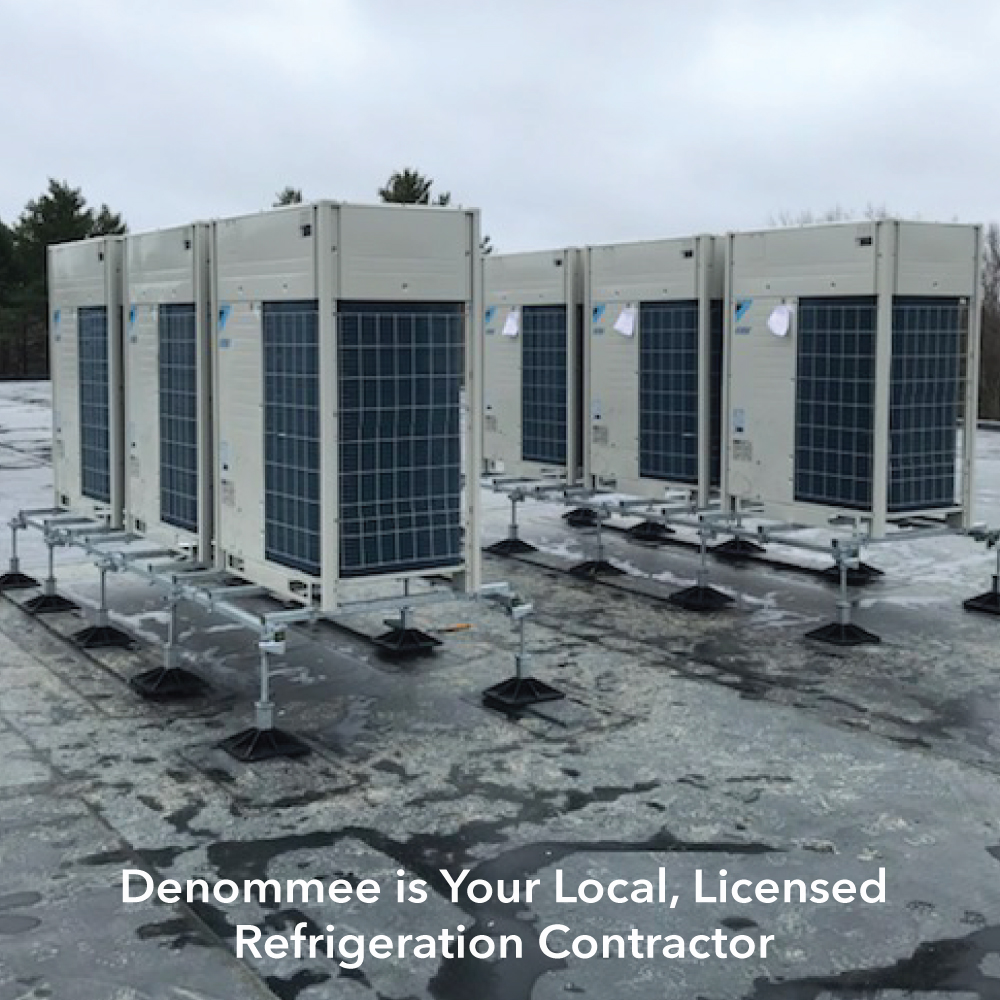
- VRF systems
- Specialized commercial HVAC equipment
- Furnaces
- Boilers
- Hydronic heating
- Indoor air quality equipment
The RC license is particularly relevant as projects grow in scale and refrigeration capacity.
Massachusetts specifically states that a Refrigeration Technician license is required for a person performing refrigeration work with capacity over 10 tons in the aggregate.
For a homeowner replacing a relatively small residential air conditioner, that threshold may seem remote.
For commercial HVAC customers, however, 10 tons can be reached very quickly.
Why Refrigeration Licensing Is Especially Important for Commercial HVAC
Consider a commercial building with multiple rooftop units.
A single small rooftop unit might have several tons of cooling capacity. Add several units across an office building, manufacturing facility, laboratory, medical facility, educational building or other commercial property and the aggregate refrigeration capacity can become substantial.
The same issue arises with:
- VRF installations
- Multi-zone commercial systems
- Large rooftop HVAC systems
- Commercial split systems
- Process cooling
- Laboratory HVAC
- Clean-room systems
- Specialized manufacturing environments
- Institutional buildings
- Large residential or mixed-use properties
This is where the difference between an HVAC company that performs primarily light residential work and a contractor equipped for broader refrigeration work becomes increasingly meaningful.
Denommee's RC-148415 Refrigeration Contractor license reinforces our ability to support customers whose HVAC requirements extend well beyond a typical residential condenser replacement.
What Does Denommee's RC License Mean for Residential Customers?
The licensing threshold associated with certain refrigeration work doesn't mean every residential HVAC project requires the same license.
But the credential still tells homeowners something useful about the company they're hiring.
1. You're Hiring a Company Invested in Professional Licensing
HVAC is becoming more technical, not less.
Variable-speed compressors, inverter technology, electronic expansion valves, communicating controls, cold-climate heat pumps and newer refrigerants have changed what technicians encounter in the field.
Denommee invests in the licensing, training and professional infrastructure required to work responsibly in that environment.
2. Denommee Can Support More Than Basic Residential HVAC
A company capable of servicing sophisticated commercial refrigeration-based HVAC systems brings a broader technical foundation to residential heating and cooling.
That doesn't mean a 3-ton residential system should be treated like a commercial chiller.
It means the organization behind your residential installation isn't limited to the simplest category of HVAC work.
3. Your Contractor Understands Massachusetts Regulatory Requirements
Massachusetts HVAC projects can involve multiple layers of requirements involving mechanical systems, electrical work, refrigeration, refrigerants, permits and inspections.
Denommee operates within that regulated environment every day.
4. You Have a Company Capable of Growing With Your Needs
Today's AC repair may eventually become tomorrow's heat-pump conversion.
A ductless installation may later involve electrical upgrades.
A business may expand and require larger commercial HVAC systems.
Having plumbing, HVAC, refrigeration and electrical expertise within one organization provides customers with continuity as their needs change.
Refrigeration Contractor License vs. EPA 608 Certification: They're Not the Same Thing
This is an important distinction for consumers.
Someone may tell you that they're "EPA certified."
That does not mean the same thing as holding a Massachusetts Refrigeration Contractor license.
Federal EPA Section 608 certification concerns technicians who work with regulated refrigerants.
Massachusetts refrigeration licensing is a state occupational licensing system governing refrigeration work and the professional qualifications associated with it.
One credential does not simply substitute for the other.
In fact, Massachusetts requires Refrigeration Technician applicants to provide proof of Universal CFC Certification as part of the state licensing process.
For consumers comparing HVAC companies, asking simply, "Are you certified?" therefore isn't particularly informative.
A better question is:
"What state licenses does your company hold for the work you're proposing?"
Refrigeration Contractor License vs. Manufacturer Certification
There is another important distinction.
Denommee's manufacturer relationships and credentials—including our experience with leading HVAC manufacturers—demonstrate specialized equipment training and installation expertise.
Those credentials are valuable.
But they serve a different purpose from state licensure.
A manufacturer credential generally demonstrates that a contractor has satisfied requirements established by that equipment manufacturer.
A Massachusetts Refrigeration Contractor license is issued within the Commonwealth's occupational licensing framework.
For homeowners and commercial customers, the strongest combination is therefore not one credential in isolation.
It's a contractor that combines:
State licensing + manufacturer training + field experience + proper permitting + professional commissioning + long-term service capability.
That's the model Denommee has built.
Why This Matters More as Heat Pumps Become Common in Massachusetts
Massachusetts is rapidly moving toward greater adoption of electric heating and cooling.
That means homeowners who previously relied upon boilers and furnaces are increasingly considering:
- Cold-climate heat pumps
- Mitsubishi Hyper-Heat systems
- Ducted heat pumps
- Ductless mini splits
- Dual-fuel systems
- Variable-capacity equipment
- Whole-home electrification
These aren't simply "electric heaters."
Heat pumps are refrigeration systems.
Their performance depends upon correct system design and installation practices involving refrigerant piping, evacuation, pressure testing, charging, controls, airflow and electrical infrastructure.
A high-quality heat pump can still perform poorly if installation fundamentals are ignored.
That's why Denommee's project scopes routinely emphasize procedures homeowners may never see once the equipment is operating, such as:
- Proper refrigerant piping
- Nitrogen pressure testing
- Deep evacuation
- Verification of system integrity
- Manufacturer-specified refrigerant charging
- Electrical testing
- Equipment commissioning
- Control verification
- Manufacturer registration
- Permitting and inspections when required
The equipment matters. The people installing and commissioning it matter just as much.
Why Licensing Matters When Refrigerants Are Changing
The HVAC industry is also undergoing a major refrigerant transition.
New equipment is increasingly using lower-global-warming-potential refrigerants such as R-454B, while millions of existing Massachusetts air-conditioning and heat-pump systems continue operating with R-410A and other refrigerants.
That means HVAC contractors need to understand both legacy systems and emerging technologies.
The fundamentals of safe, professional refrigeration work remain essential:
- Identifying the correct refrigerant
- Using appropriate equipment and procedures
- Preventing contamination
- Leak testing
- Proper evacuation
- Accurate charging
- Following equipment specifications
- Understanding pressure-temperature relationships
- Working safely around electrical and refrigeration equipment
As HVAC technology changes, professional licensing and continuing technical competency become more—not less—important.
What Does the Refrigeration Contractor License Mean for Commercial Facility Managers?
For commercial customers, contractor qualification should be part of the procurement process before work begins.
Facility managers responsible for laboratories, manufacturing facilities, offices, educational buildings, healthcare environments, clean rooms, data-sensitive environments or other critical spaces should understand the credentials of the companies servicing their mechanical equipment.
Before awarding a refrigeration or HVAC project, consider asking:
- What Massachusetts refrigeration licenses does the contractor hold?
- Who will actually perform the work?
- Are the individuals appropriately licensed for the scope?
- Does the contractor have experience with equipment of this capacity?
- Can the company handle associated electrical work?
- Does it understand controls and ventilation?
- Will required permits be obtained?
- Does the company provide ongoing service after installation?
- Can it support emergency HVAC failures?
- Does it have experience in occupied or operational critical environments?
For Denommee's commercial customers, RC-148415 provides a clear, verifiable credential to include in that qualification process.
Massachusetts also provides an online system through which consumers and businesses can check occupational licenses.
Does Having an RC License Automatically Make One HVAC Company Better Than Another?
No—and that's worth stating clearly.
A license establishes an important professional and regulatory qualification. It doesn't tell you everything about craftsmanship, customer service, system design or whether a contractor is the right fit for a particular project.
Homeowners and facility managers should look at the complete picture.
That includes:
- Appropriate licenses
- Relevant experience
- Technician training
- Manufacturer credentials
- References and reviews
- Proper insurance
- Permitting practices
- Installation procedures
- Diagnostic capability
- Commissioning practices
- Warranty support
- Maintenance capability
- Emergency service
- Pricing transparency
- Local reputation
Licensing should be a starting requirement—not the only criterion.
That's precisely why Denommee believes RC-148415 is most meaningful when viewed alongside the rest of our organization.
More Than an HVAC Company: The Denommee Multi-Trade Advantage
Modern HVAC increasingly overlaps with other building systems.
A heat-pump installation may require a new electrical circuit.
A commercial HVAC project may require plumbing, condensate drainage and controls.
A boiler replacement involves heating and plumbing expertise.
Electrification projects can involve heat pumps, electrical panels, heat-pump water heaters, generators, batteries and EV charging.
Denommee brings Plumbing, HVAC and Electrical expertise together under one locally owned company.
That gives homeowners, businesses and facility managers a single resource capable of looking beyond one piece of equipment and understanding how multiple building systems interact.
Combine that with our Massachusetts Refrigeration Contractor credential, and customers have access to capabilities spanning:
Plumbing + Heating + Air Conditioning + Heat Pumps + Refrigeration + Electrical
That breadth is particularly valuable for complicated projects where coordination between trades can determine whether the installation proceeds smoothly.
Licensed, Permitted and Accountable
Licensing also aligns with a larger principle that has guided Denommee for generations:
Do the work properly, even when the customer may never see the details behind the finished installation.
That's why we believe in obtaining required permits and standing required inspections.
It's why refrigerant circuits are tested and evacuated properly.
It's why electrical work is performed by qualified electrical professionals.
It's why equipment is commissioned rather than merely turned on.
And it's why Denommee continues investing in professional licenses such as our Massachusetts Refrigeration Contractor license.
Customers aren't simply buying a condenser, heat pump or rooftop unit.
They're trusting a contractor with systems responsible for the comfort, safety and operation of their home or facility.
That trust should be earned.
Frequently Asked Questions About Massachusetts Refrigeration Licensing
What is a Massachusetts Refrigeration Contractor?
Massachusetts defines the contractor/master refrigeration role around a person maintaining a regular place of business and performing refrigeration work personally or through appropriately licensed refrigeration professionals in their employ. The Commonwealth states that a Refrigeration Contractor license allows the holder to employ duly licensed people to perform refrigeration work.
What is Denommee's Massachusetts Refrigeration Contractor license number?
Denommee Plumbing, HVAC & Electric's Massachusetts Refrigeration Contractor license number is RC-148415.
Is a Refrigeration Contractor license the same as an HVAC certification?
No. Manufacturer certifications, federal refrigerant credentials and Massachusetts occupational licenses serve different purposes. A Massachusetts Refrigeration Contractor license is a state-regulated professional credential.
Does Massachusetts license refrigeration technicians?
Yes. Massachusetts has licensing requirements for refrigeration technicians involving qualifying education, documented experience and examination. The state says technician licensure is required for anyone performing refrigeration work having capacity over 10 tons in the aggregate.
Does Massachusetts regulate refrigeration apprentices?
Yes. Massachusetts requires refrigeration apprentices to be licensed through OPSI and registered with the Division of Apprentice Standards. Qualifying apprenticeship hours must be accumulated while employed by a Massachusetts Refrigeration Contractor under the applicable requirements.
Can consumers verify Massachusetts occupational licenses?
Yes. The Massachusetts Division of Occupational Licensure provides online tools that consumers can use to check licenses for regulated occupations and businesses.
Why should I care about my HVAC contractor's licenses?
Licensing provides evidence that applicable state qualification requirements have been satisfied and establishes regulatory accountability. Massachusetts itself describes occupational licensing as a consumer-protection mechanism involving minimum qualifications and ongoing standards.
Is a heat pump a refrigeration system?
Yes. Heat pumps transfer heat through a refrigeration cycle involving refrigerant, a compressor, heat exchangers and associated controls. That's why refrigeration knowledge is fundamental to professional heat-pump installation and service.
Looking for a Licensed HVAC and Refrigeration Contractor in Massachusetts?
Whether you're a homeowner considering a cold-climate heat pump or a facility manager responsible for sophisticated commercial HVAC equipment, don't be afraid to ask contractors about their qualifications.
You should know who you're hiring.
Denommee Plumbing, HVAC & Electric is a Massachusetts licensed Refrigeration Contractor — RC-148415—backed by generations of local experience and a team providing HVAC, plumbing and electrical services under one roof.
From residential air-conditioning and heat-pump installations to commercial rooftop systems, VRF equipment and specialized HVAC environments, our goal is the same: provide customers with knowledgeable recommendations, properly executed work and a local company they can continue calling after the project is complete.
We serve homeowners and businesses throughout communities including Lowell, Chelmsford, Dracut, Tyngsborough, Westford, Groton, Littleton, Acton, Concord, Billerica, Burlington, Wilmington, Tewksbury, Andover, North Andover, Reading, Woburn, Winchester, Lexington and surrounding northeastern Massachusetts communities.
If you're researching an HVAC repair, air-conditioning replacement, heat-pump installation or commercial HVAC project, contact Denommee to discuss your options with our team.
Don't choose an HVAC contractor based solely on the equipment they're selling. Ask who is qualified, licensed and accountable for installing it.
For Denommee customers in Massachusetts, one answer to that question is easy to document:
Massachusetts Refrigeration Contractor RC-148415.


