Commercial HVAC Services for Critical Environments Explained
Helping Laboratories, Medical Manufacturers, Data Centers & Advanced Commercial Facilities Maintain Reliable Environmental Control
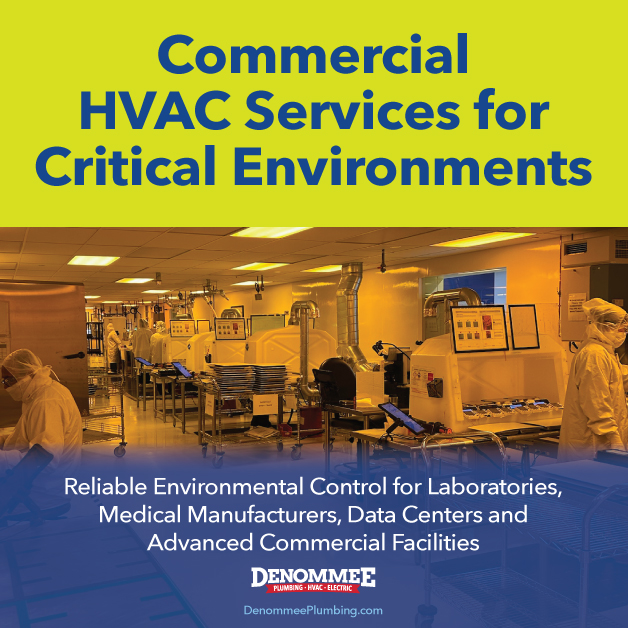
Executive Summary
Not every commercial building can tolerate fluctuations in temperature, humidity, airflow, or pressure.
In facilities such as medical device manufacturing plants, pharmaceutical laboratories, biotechnology companies, research institutions, clean rooms, hospitals, advanced manufacturing facilities, and mission-critical data centers, HVAC systems do much more than keep occupants comfortable—they are essential to operations, product quality, regulatory compliance, and business continuity.
Maintaining these environments requires far more than replacing rooftop units or servicing conventional air conditioning equipment. It requires a mechanical contractor who understands the unique performance requirements of specialized HVAC systems, can work safely within occupied and operational facilities, and appreciates that even minor disruptions can have significant operational consequences.
At Denommee Plumbing, HVAC & Electric, our commercial division has developed extensive experience supporting these demanding environments throughout Massachusetts and Southern New Hampshire. From precision ventilation systems inside medical manufacturing clean rooms to mission-critical cooling systems protecting university data centers, our team understands the planning, craftsmanship, documentation, and technical expertise required to help facility managers protect their operations.
Whether your organization is planning a capital improvement project, modernizing aging infrastructure, implementing preventative maintenance, or responding to an unexpected equipment failure, Denommee delivers comprehensive commercial HVAC, plumbing, and electrical services designed around one objective:
Keeping your facility operating safely, efficiently, and reliably.
When HVAC Is More Than Comfort
Many people think of HVAC as simply heating and air conditioning.
Facility managers know better.
In many commercial and institutional buildings, HVAC systems are responsible for maintaining conditions that directly affect manufacturing processes, research accuracy, employee safety, product quality, regulatory compliance, and business continuity.
Consider just a few examples.
A medical device manufacturer producing implantable medical products may require strict environmental controls to protect sensitive manufacturing processes.
A pharmaceutical laboratory depends on carefully managed airflow to prevent cross contamination.
A university research laboratory relies on specialized exhaust systems that safely remove hazardous fumes.
A data center cannot tolerate rising temperatures that threaten servers supporting thousands of users.
In these environments, HVAC systems become operational infrastructure—not merely building utilities.
The consequences of equipment failure may include:
- Production downtime
- Product loss
- Research interruptions
- Equipment damage
- Compliance issues
- Increased operating costs
- Unplanned shutdowns
For these organizations, choosing the right commercial HVAC contractor becomes a strategic decision rather than simply selecting the lowest bidder.
Understanding Critical Environment HVAC
Critical environments are facilities where environmental conditions must remain within carefully controlled parameters.
Unlike conventional office buildings, these facilities often require continuous monitoring and precise mechanical performance.
Common environmental parameters include:
Temperature Stability
Many manufacturing and laboratory processes require extremely stable temperatures.
Unexpected fluctuations can affect:
- Manufacturing tolerances
- Chemical reactions
- Testing accuracy
- Equipment calibration
- Product consistency
Relative Humidity
Humidity control plays an equally important role.
Improper humidity may contribute to:
- Static electricity
- Condensation
- Corrosion
- Material degradation
- Product contamination
Advanced humidification and dehumidification systems are often integrated into the building's HVAC infrastructure to maintain proper environmental conditions throughout the year.
Air Changes Per Hour (ACH)
Critical environments typically require significantly more air changes than conventional commercial buildings.
The number of air changes per hour helps dilute airborne contaminants while maintaining acceptable indoor air quality.
Proper airflow calculations require careful engineering and ongoing verification after installation.
Pressurization
Maintaining pressure relationships between adjacent rooms is often essential.
Facilities may require:
- Positive pressure rooms
- Negative pressure rooms
- Pressure cascading
- Differential pressure monitoring
These pressure relationships help prevent contaminants from entering—or leaving—controlled environments.
Air Filtration
Many specialized facilities rely on advanced filtration systems.
These may include:
- HEPA filtration
- ULPA filtration
- Multi-stage filtration
- Activated carbon filtration
Proper filter installation, inspection, replacement, and verification are critical to long-term system performance.
Why Clean Rooms Require Specialized HVAC Expertise
Few commercial environments place greater demands on mechanical systems than clean rooms.
Contrary to what many people believe, a clean room is not simply a room that is kept clean.
A clean room is an engineered environment specifically designed to control airborne particulate contamination while maintaining precise environmental conditions.
These facilities are commonly found in:
- Medical device manufacturing
- Pharmaceutical production
- Biotechnology
- Electronics manufacturing
- Semiconductor fabrication
- Aerospace manufacturing
- Advanced research
The HVAC system serves as the foundation that allows the clean room to function properly.
Without properly designed airflow, filtration, pressurization, and environmental controls, the room cannot consistently perform as intended.
Key Components of Clean Room HVAC Systems
HEPA and ULPA Filtration
Clean room air is typically filtered through high-efficiency particulate air (HEPA) filters or ultra-low penetration air (ULPA) filters.
These filtration systems remove extremely small airborne particles before conditioned air enters the space.
Maintaining filter integrity through inspection, testing, and replacement is an important component of ongoing facility maintenance.
Laminar Airflow
Many clean rooms utilize laminar airflow patterns.
Instead of turbulent air movement, laminar airflow moves air in a consistent direction to help sweep airborne particles away from sensitive work areas.
Maintaining this airflow requires careful balancing of supply and return air systems.
Pressure Relationships
Positive pressure helps prevent contaminants from entering clean spaces.
Negative pressure may be required for specialized laboratory applications where hazardous materials must remain contained.
Even relatively small pressure deviations can affect room performance.
Environmental Monitoring
Modern facilities often monitor:
- Temperature
- Relative humidity
- Differential pressure
- Airflow
- Filter performance
- Building automation system alarms
These systems provide facility managers with real-time operational visibility while supporting preventative maintenance programs.
Laboratory HVAC Systems Present Their Own Challenges
Laboratories differ from clean rooms, but they share one important characteristic:
Air movement directly affects safety.
Laboratory HVAC systems frequently incorporate:
- Fume hood exhaust systems
- General exhaust systems
- Makeup air units
- Dedicated outdoor air systems
- Variable air volume controls
- Specialized exhaust fans
Unlike conventional office HVAC systems, laboratory ventilation must balance occupant comfort with stringent safety requirements.
Proper airflow protects laboratory personnel while helping facilities comply with applicable engineering standards and operating procedures.
Working Inside Occupied Critical Facilities
One of the greatest challenges of commercial HVAC work isn't installing new equipment.
It's installing, maintaining, or repairing systems while the facility continues operating.
For many organizations, shutting down production simply isn't an option.
Medical manufacturers continue producing life-changing products.
Universities continue conducting research.
Hospitals continue treating patients.
Data centers continue processing information.
That means commercial HVAC work often requires:
- Detailed scheduling
- Phased implementation
- Careful coordination with facility personnel
- Clean work practices
- Temporary environmental controls
- Comprehensive communication throughout the project
These are capabilities developed through experience—not improvisation.
Experience Matters
At Denommee Plumbing, HVAC & Electric, we've learned that success in critical environments comes from understanding the facility before the first tool is picked up.
Every project begins by asking questions such as:
- How sensitive is the environment?
- What systems must remain operational?
- Can work be phased?
- Are temporary systems required?
- How will environmental conditions be maintained?
- What documentation is required after completion?
That planning process helps minimize disruption while maintaining the integrity of the facility's operations.
It is one of the reasons organizations such as the University of New Hampshire, Lockheed Martin, Cirtec Medical, EvolOH, the Markley Group and more trust Denommee to perform work in environments where precision, cleanliness, and reliability are essential.
Specialized HVAC Systems for Critical Environments
Modern critical environments rely on much more than traditional heating and cooling equipment. Every component of the HVAC system—from the outdoor equipment to the terminal devices serving individual rooms—plays a role in maintaining environmental stability, protecting occupants, preserving product quality, and supporting uninterrupted operations.
For facility managers, understanding how these systems work together can help prioritize maintenance, plan future capital improvements, and reduce the risk of unexpected failures.
At Denommee Plumbing, HVAC & Electric, our commercial mechanical team works with a wide range of commercial HVAC equipment found in laboratories, clean rooms, medical device manufacturing facilities, higher education, commercial office buildings, healthcare environments, and mission-critical infrastructure throughout Massachusetts and Southern New Hampshire.
Air Handling Units (AHUs): The Heart of Commercial HVAC Systems
If the electrical panel is often described as the brain of a building's electrical system, the air handling unit (AHU) is the heart of many commercial HVAC systems.
Air handlers are responsible for conditioning and distributing large volumes of air throughout a facility. Depending on the building type, they may:
- Heat incoming air
- Cool incoming air
- Control humidity
- Filter contaminants
- Maintain building pressure
- Deliver outside ventilation air
- Support laboratory exhaust systems
- Integrate with building automation systems
Unlike residential air handlers, commercial AHUs are highly customized and frequently include multiple stages of filtration, variable frequency drives (VFDs), energy recovery components, humidifiers, and sophisticated control systems.
Routine maintenance of commercial AHUs often includes:
- Filter inspections and replacement
- Coil cleaning
- Belt inspection and replacement
- Bearing lubrication
- Fan alignment
- Damper inspection
- Condensate management
- Motor testing
- Sensor calibration
- VFD diagnostics
- Control verification
Neglecting routine maintenance doesn't simply reduce efficiency—it can compromise airflow, increase operating costs, shorten equipment life, and negatively impact the controlled environment served by the unit.
Dedicated Outdoor Air Systems (DOAS)
Many modern commercial facilities utilize Dedicated Outdoor Air Systems (DOAS) to improve ventilation efficiency while maintaining excellent indoor air quality.
Unlike conventional HVAC systems that mix return air with outside air, a DOAS conditions 100% outdoor ventilation air before distributing it throughout the building.
These systems are particularly beneficial in:
- Medical facilities
- Laboratories
- Universities
- Office buildings
- High-performance commercial buildings
- Advanced manufacturing facilities
Benefits include:
- Better humidity control
- Improved ventilation effectiveness
- Reduced HVAC energy consumption
- Improved occupant comfort
- Enhanced indoor air quality
- Better compatibility with heat pump systems
Because outdoor air often carries significant heating or cooling loads, proper commissioning and maintenance of DOAS equipment is essential for long-term efficiency.
Makeup Air Units (MAUs)
Facilities that exhaust large volumes of air must replace that air.
This is the role of the Makeup Air Unit (MAU).
MAUs are common in:
- Laboratories
- Commercial kitchens
- Manufacturing facilities
- Pharmaceutical buildings
- Industrial plants
Without properly balanced makeup air:
- Building pressure becomes unstable.
- Doors become difficult to open.
- Drafts increase.
- Exhaust systems lose effectiveness.
- HVAC efficiency declines.
Balancing exhaust and makeup air is one of the most important aspects of maintaining laboratory and industrial ventilation systems.
Laboratory Exhaust Systems
Laboratory ventilation differs significantly from conventional office HVAC.
Rather than simply providing comfort, laboratory exhaust systems help protect researchers, technicians, students, and manufacturing personnel.
Typical laboratory exhaust equipment includes:
- Fume hood exhaust
- General exhaust
- Chemical exhaust
- Biological safety cabinet exhaust
- Specialty exhaust systems
Each must be carefully balanced with supply air to maintain proper pressure relationships throughout the building.
Because these systems often operate continuously, preventative maintenance becomes essential for long-term reliability.
Routine service may include:
- Fan inspection
- Belt replacement
- Bearing lubrication
- Vibration analysis
- Motor testing
- Damper adjustment
- Airflow verification
Commercial Exhaust Systems
Many commercial facilities rely upon specialized exhaust systems beyond laboratories.
These include:
- Manufacturing exhaust
- Welding exhaust
- Dust collection systems
- Commercial kitchen exhaust
- Industrial ventilation
- Process exhaust
Each system presents unique airflow, filtration, and code compliance considerations.
Improper airflow can negatively affect:
- Indoor air quality
- Employee comfort
- Process performance
- Building pressure
- Energy efficiency
Variable Refrigerant Flow (VRF) Systems
Over the past decade, Variable Refrigerant Flow (VRF) systems have become increasingly popular in commercial construction.
Unlike traditional rooftop units, VRF systems provide:
- Individual zone control
- High energy efficiency
- Heat recovery capabilities
- Quiet operation
- Flexible installation
Denommee has extensive experience installing commercial VRF systems in office buildings, educational facilities, and commercial renovations where flexibility and efficiency are priorities.
VRF systems require specialized knowledge involving:
- Refrigerant piping design
- Branch controller installation
- Pressure testing
- System evacuation
- Refrigerant charging
- Controls integration
- Commissioning
Proper installation directly affects system reliability for years to come.
Rooftop Units (RTUs)
Although newer technologies continue to emerge, Rooftop Units (RTUs) remain one of the most common commercial HVAC solutions.
Today's high-efficiency RTUs often incorporate:
- Variable speed compressors
- Energy recovery
- Economizers
- Advanced controls
- Demand-controlled ventilation
- Smart diagnostics
Replacing aging rooftop units provides opportunities to improve:
- Occupant comfort
- Energy efficiency
- Reliability
- Maintenance accessibility
Denommee frequently assists facility owners in evaluating replacement options before unexpected failures occur.
Hydronic Heating & Cooling Systems
Hydronic systems continue to play an important role in institutional and commercial facilities.
These systems circulate heated or chilled water through piping networks to deliver energy throughout the building.
Applications include:
- Universities
- Hospitals
- Office buildings
- Schools
- Manufacturing facilities
Proper hydronic performance depends on:
- Pump operation
- Water balancing
- Expansion tanks
- Air elimination
- Control valves
- Insulation
- Pressure management
Commercial hydronic systems require periodic inspections to maintain efficiency and prevent unexpected failures.
Humidification and Dehumidification Systems
Humidity control often receives less attention than temperature—but in many facilities it is equally important.
Medical manufacturing facilities may require tightly controlled humidity to protect sensitive production processes.
Laboratories may need humidity control to ensure testing accuracy.
Data centers often require stable humidity levels to minimize electrostatic discharge while preventing condensation.
Commercial humidification systems may include:
- Steam humidifiers
- Evaporative humidifiers
- Gas-fired humidifiers
- Electric humidifiers
Routine maintenance includes:
- Scale removal
- Water treatment inspection
- Drain cleaning
- Sensor calibration
- Steam cylinder replacement
Building Automation Systems (BAS)
Modern commercial HVAC systems rarely operate independently.
Instead, they communicate through sophisticated Building Automation Systems (BAS) that monitor and coordinate mechanical equipment throughout the facility.
Typical BAS functions include:
- Temperature monitoring
- Humidity monitoring
- Differential pressure monitoring
- Scheduling
- Alarm notification
- Energy optimization
- Equipment sequencing
- Trend logging
These systems provide facility managers with valuable operational insight while helping maintenance teams identify developing issues before they become equipment failures.
Denommee routinely works alongside building automation professionals during installations, upgrades, and service projects to ensure HVAC equipment performs as intended within the larger building management strategy.
Ventilation Is an Engineered System—Not an Afterthought
One of the most common misconceptions about commercial HVAC is that ventilation simply means moving air.
In reality, ventilation is a carefully engineered balance between:
- Supply air
- Return air
- Exhaust air
- Outdoor air
- Building pressure
- Occupancy
- Heat loads
- Process loads
Every adjustment affects another component of the system.
For example, increasing laboratory exhaust without adjusting makeup air may unintentionally place an entire facility under negative pressure.
Changing filter types can alter fan performance and airflow.
Replacing equipment without proper balancing may create comfort issues or compromise process conditions.
This interconnectedness is why experienced commercial HVAC contractors approach modifications holistically rather than treating equipment as isolated components.
Experience Across Complex Commercial Facilities
The breadth of commercial HVAC equipment described above is not theoretical—it reflects the types of systems our team encounters every day.
From high-performance office buildings and educational campuses to advanced manufacturing facilities and mission-critical environments, Denommee has developed experience coordinating installations, maintenance programs, retrofits, and repairs across a diverse range of commercial applications.
That experience allows us to understand not only how individual pieces of equipment operate, but how complete mechanical systems work together to support the building's purpose.
For facility managers, that systems-level perspective often translates into fewer surprises, better communication, and solutions that consider both immediate needs and long-term operational goals.
Commercial HVAC Maintenance, Repair & Retrofit Strategies for Critical Environments
Maintaining Performance Where Downtime Isn't an Option
Installing a high-performance HVAC system is only the beginning of its lifecycle.
For facilities such as clean rooms, medical device manufacturers, pharmaceutical laboratories, research facilities, data centers, hospitals, and advanced manufacturing plants, ongoing maintenance is what protects the investment and ensures the building continues performing as designed.
Unlike conventional office buildings, these environments often operate continuously. Production schedules, research programs, server infrastructure, and regulatory requirements don't stop because a fan motor failed or a coil became fouled.
That's why the most successful facility managers view HVAC maintenance as a risk management strategy rather than simply a scheduled expense.
At Denommee Plumbing, HVAC & Electric, our commercial service team partners with facility owners and operations managers to develop maintenance and repair programs that help maximize equipment reliability, improve energy efficiency, and reduce the likelihood of unexpected downtime.
Preventive Maintenance Is More Than Changing Filters
Preventive maintenance has evolved dramatically over the last decade.
Today's commercial HVAC systems contain sophisticated controls, variable-speed motors, energy recovery systems, electronically commutated motors (ECMs), variable frequency drives (VFDs), digital sensors, building automation integration, and high-efficiency heat transfer equipment.
Maintaining these systems properly requires technicians who understand how the mechanical, electrical, and control systems interact—not simply how to replace worn components.
A comprehensive maintenance program evaluates the entire mechanical system.
Rather than asking,
"Is the equipment still running?"
the better question becomes,
"Is the equipment operating the way it was engineered to operate?"
That distinction often determines whether a facility experiences years of reliable operation—or recurring service calls and premature equipment replacement.
The Cost of Deferred Maintenance
Facility budgets are always under pressure.
It can be tempting to postpone maintenance when equipment appears to be functioning normally.
Unfortunately, HVAC failures rarely occur without warning.
Small issues gradually become expensive ones.
For example:
A dirty evaporator coil increases airflow resistance.
The fan works harder.
Motor amperage increases.
Energy consumption rises.
Bearing temperatures increase.
Equipment life shortens.
Occupants begin noticing comfort issues.
Eventually, the motor fails.
What began as routine maintenance becomes an emergency repair.
The same progression occurs with:
- clogged filters
- loose belts
- dirty condenser coils
- worn bearings
- failing sensors
- leaking valves
- deteriorating insulation
- refrigerant loss
Routine inspections are designed to identify these issues before they interrupt operations.
What Comprehensive Commercial HVAC Maintenance Includes
Although every facility is different, a well-designed maintenance program typically includes systematic inspections of every major component.
Air Handling Units
Routine inspections often include:
- Coil cleaning
- Belt inspection and replacement
- Bearing lubrication
- Fan alignment
- Motor testing
- Drain pan cleaning
- Condensate inspection
- Filter replacement
- Damper operation
- VFD performance
- Sensor calibration
These inspections help maintain proper airflow while reducing unnecessary energy consumption.
Commercial Rooftop Units
RTUs experience year-round exposure to New England weather.
Preventive maintenance commonly includes:
- Refrigerant diagnostics
- Electrical inspections
- Compressor evaluation
- Heat exchanger inspection
- Economizer testing
- Fan performance verification
- Condenser cleaning
- Drain inspection
- Control calibration
Early identification of worn components can significantly reduce emergency repairs during peak heating and cooling seasons.
Laboratory Exhaust Systems
Laboratory exhaust systems often operate continuously.
Maintenance programs typically include:
- Exhaust fan inspection
- Belt replacement
- Motor testing
- Damper verification
- Airflow measurements
- Vibration analysis
- Bearing inspections
- Structural support inspection
Maintaining consistent exhaust performance is essential for both occupant safety and laboratory operation.
Building Automation Systems
Mechanical equipment performs only as well as its controls.
Commercial maintenance frequently includes verification of:
- Temperature sensors
- Humidity sensors
- Differential pressure sensors
- Scheduling
- Equipment sequencing
- Alarm reporting
- Trend logging
- BAS communication
These systems provide valuable operational insight while helping maintenance personnel identify developing issues before occupants notice them.
Commercial HVAC Repairs Require More Than Technical Skill
Repairing HVAC equipment inside an occupied office building differs dramatically from repairing equipment serving an operational clean room or laboratory.
The mechanical work itself may be similar.
The planning is entirely different.
Facility managers often ask questions such as:
Can repairs be completed while production continues?
Will this affect room pressurization?
Will vibration interfere with manufacturing?
Can contaminants enter the space?
How long will equipment be offline?
How do we protect adjacent operations?
Experienced commercial contractors understand these concerns because they encounter them regularly.
Repairs become carefully coordinated operational activities—not simply mechanical service calls.
Working Inside Active Manufacturing Facilities
Many advanced manufacturing facilities operate around the clock.
Production interruptions may affect:
- customer deliveries
- product quality
- employee scheduling
- validation requirements
- regulatory documentation
This often requires maintenance work to occur:
- evenings
- weekends
- planned shutdown periods
- phased construction windows
Planning becomes just as important as installation.
At Denommee, our commercial team works closely with facility personnel to understand operational priorities before work begins.
The objective is not simply completing repairs.
It is completing repairs while minimizing operational disruption.
Clean Work Practices Matter
Critical environments require more than technical expertise.
They also require discipline.
Depending on the facility, technicians may be required to follow strict procedures involving:
- controlled access
- gowning requirements
- contamination prevention
- housekeeping protocols
- material handling
- documentation
- communication with production personnel
Understanding these expectations allows work to proceed efficiently while respecting the operational requirements of the facility.
Commissioning Doesn't End When Construction Does
One misconception surrounding commercial HVAC projects is that commissioning occurs only once—at project completion.
In reality, commissioning principles continue throughout the life of the building.
Whenever equipment is replaced, modified, or repaired, facility managers benefit from verifying that systems continue performing as intended.
That verification may include:
- Airflow measurements
- Temperature verification
- Humidity testing
- Pressure relationship verification
- Sequence of operation testing
- BAS integration
- Alarm verification
This approach helps ensure repairs restore—not compromise—the original system performance.
Project Spotlight
Supporting Medical Device Manufacturing at Cirtec Medical
Medical device manufacturing demands extraordinary environmental consistency.
Clean rooms supporting precision manufacturing rely on carefully maintained HVAC systems to help sustain controlled environmental conditions throughout the production process.
Denommee has supported HVAC work within Cirtec Medical's clean room environment, where careful planning, coordination, and workmanship are essential.
Projects in these environments require technicians who understand that mechanical work extends beyond replacing equipment or servicing air handlers.
Every activity must be performed with consideration for:
- occupied production spaces
- environmental integrity
- scheduling around manufacturing
- maintaining system performance
- protecting ongoing operations
These projects reinforce an important principle:
The quality of HVAC work is measured not only by how well the equipment operates afterward—but also by how effectively the work was completed without disrupting the facility's mission.
Project Spotlight
Mission-Critical Cooling at the University of New Hampshire
Data centers represent another form of critical environment.
Unlike manufacturing facilities, their product is information.
Continuous cooling protects:
- servers
- networking equipment
- storage infrastructure
- research computing
- institutional operations
Denommee recently completed a major cooling system replacement for the University of New Hampshire, replacing multiple precision cooling units while maintaining continuous operational support through carefully phased construction.
The project included:
- new precision cooling equipment
- refrigerant piping modifications
- phased installation
- equipment commissioning
- operational coordination
This type of project illustrates the importance of planning mechanical work around the operational requirements of the client—not simply around construction schedules.
Retrofit Projects That Improve Long-Term Performance
Many commercial facilities operate equipment that is decades old.
While these systems may continue functioning, they often:
- consume excessive energy
- require increasingly frequent repairs
- use obsolete refrigerants
- lack modern controls
- provide inconsistent comfort
Retrofits allow facility owners to modernize systems while extending the useful life of the building itself.
Recent Denommee commercial projects have included:
- university mechanical upgrades
- medical manufacturing facilities
- commercial office buildings
- financial institutions
- restaurant fit-outs
- rehabilitation facilities
- educational campuses
Each project presents unique engineering challenges, but they share a common objective:
Deliver reliable mechanical systems that support the owner's operational goals for years to come.
The Denommee Difference: Thinking Beyond the Equipment
Many contractors focus on replacing mechanical equipment.
Denommee focuses on helping clients operate better buildings.
That perspective influences every stage of a project.
Instead of viewing an air handler as an isolated piece of equipment, we consider:
- How does it affect building pressurization?
- Will replacing it impact adjacent spaces?
- Does the BAS require updates?
- Can airflow be improved?
- Are there opportunities to increase efficiency?
- How will future maintenance be performed?
This systems-level approach frequently creates additional value for owners by identifying opportunities that extend beyond the immediate scope of work.
Building Long-Term Partnerships
Commercial HVAC systems are long-term assets.
So are the relationships built around them.
Many of our commercial clients don't simply call us when equipment fails.
They involve our team early when planning renovations, capital improvements, equipment replacements, tenant fit-outs, and facility expansions.
Those conversations allow us to provide practical recommendations that consider:
- lifecycle cost
- maintainability
- constructability
- operational continuity
- energy efficiency
- future flexibility
For facility managers responsible for protecting valuable infrastructure, that collaborative approach often produces better outcomes than reactive decision-making.
From Planning to Performance: Why Critical Environment Projects Demand More Than Installation Expertise
By the time a commercial HVAC project reaches the installation phase, hundreds of decisions have already been made.
Equipment has been selected.
Airflows have been calculated.
Pressure relationships have been engineered.
Mechanical rooms have been coordinated.
Schedules have been established.
Submittals have been reviewed.
For laboratories, clean rooms, healthcare facilities, data centers, advanced manufacturers, and institutional buildings, successful projects depend on far more than installing ductwork and mechanical equipment.
They require an experienced commercial mechanical contractor capable of managing every stage of the process—from estimating and constructability reviews through commissioning and long-term maintenance.
At Denommee Plumbing, HVAC & Electric, our commercial team approaches every project with that long-term perspective.
Whether we're replacing aging rooftop equipment, installing laboratory ventilation systems, supporting a medical manufacturing clean room, or modernizing HVAC infrastructure within an occupied healthcare facility, our objective remains the same:
Deliver mechanical systems that perform reliably for years—not simply systems that pass inspection.
Engineering Begins Long Before Construction
One of the biggest differences between residential HVAC work and commercial mechanical construction is the amount of planning required before work begins.
Facility managers understand that successful projects rarely happen by accident.
They are built through careful coordination among:
- Building owners
- Engineers
- Architects
- Construction managers
- Facility personnel
- Mechanical contractors
- Electrical contractors
- Plumbing contractors
- Equipment manufacturers
Denommee's commercial division is structured to participate throughout that entire process.
Our team works proactively to identify constructability challenges early, coordinate with project stakeholders, and help keep projects moving efficiently from design through completion.
Accurate Estimating Creates Better Projects
Every successful commercial project begins with a thorough understanding of scope.
Our dedicated commercial estimating team develops detailed material takeoffs and labor estimates that provide owners, developers, and general contractors with a clear understanding of project requirements.
Comprehensive estimating helps minimize uncertainty while supporting more predictable project execution.
That attention to detail becomes particularly valuable on projects involving:
- Phased construction
- Occupied facilities
- Specialized mechanical equipment
- Critical environmental controls
- Complex piping systems
- High-performance ventilation systems
Accurate estimating also helps reduce unnecessary change orders by identifying potential coordination issues before construction begins.
Shop Drawings That Improve Construction
Commercial HVAC systems are rarely installed directly from design drawings alone.
Contractors must convert engineering intent into installation-ready documentation.
Denommee prepares detailed shop drawings that support:
- Mechanical coordination
- Equipment layout
- Duct routing
- Piping layout
- Field installation
- Fabrication planning
These drawings improve communication between trades while helping identify conflicts before work begins in the field.
The result is fewer surprises, smoother installations, and improved project efficiency.
Prefabrication Improves Quality
Whenever practical, Denommee incorporates prefabrication into commercial projects.
Fabricating components in a controlled shop environment offers several advantages:
- Higher workmanship quality
- Improved dimensional accuracy
- Better quality control
- Reduced on-site labor
- Improved safety
- Faster installation
Our commercial fabrication capabilities have supported projects ranging from exposed architectural ductwork to hydronic piping assemblies and complex mechanical systems.
This approach not only improves productivity—it often delivers a cleaner finished installation while minimizing disruption at occupied facilities.
Coordinating Work Inside Active Facilities
Many of the buildings we serve cannot simply shut down while mechanical work is completed.
Hospitals continue caring for patients.
Medical manufacturers continue producing products.
Research laboratories continue operating experiments.
Universities continue supporting students and faculty.
Commercial office buildings continue serving tenants.
This requires a contractor capable of adapting construction schedules to operational realities.
Typical coordination considerations include:
- Off-hour work
- Weekend shutdowns
- Temporary HVAC systems
- Phased equipment replacement
- Occupied space protection
- Noise management
- Dust control
- Safety planning
Experience coordinating projects in these environments helps reduce operational disruptions while maintaining project momentum.
Experience Across Diverse Critical Facilities
One of Denommee's greatest strengths is the diversity of commercial environments our team has supported.
While every facility has unique operational requirements, many share a common expectation:
Mechanical systems must perform reliably every day.
That experience spans a wide range of industries.
Medical Device Manufacturing
Medical manufacturing facilities demand careful attention to environmental control, scheduling, and cleanliness.
Our work supporting clean room environments has reinforced the importance of protecting ongoing production while maintaining HVAC system performance.
Defense & Advanced Manufacturing
Facilities supporting organizations such as Lockheed Martin in Chelmsford, Massachusetts, require dependable HVAC infrastructure capable of supporting sophisticated manufacturing and engineering environments.
Projects in these facilities often involve heightened coordination, careful scheduling, and an appreciation for the operational importance of every mechanical system.
Biotechnology & Life Sciences
The life sciences sector continues to grow throughout Massachusetts.
Companies such as EvolOH in Lowell represent the region's expanding investment in advanced manufacturing and clean technology.
Facilities like these often depend on carefully engineered HVAC and ventilation systems that support research, development, and specialized manufacturing processes.
As Greater Boston, the Route 128 corridor, and the Merrimack Valley continue to attract biotechnology investment, experienced commercial mechanical contractors play an increasingly important role in helping these facilities maintain reliable environmental control.
Higher Education & Research
Universities operate some of the most technically demanding mechanical systems found anywhere.
From classroom buildings to research laboratories, data centers, residence halls, and science facilities, each building presents unique operational challenges.
Denommee has been proud to support projects including:
- University of New Hampshire
- Rivier University Science Center
- Other institutional mechanical upgrades throughout the region
These projects require careful coordination with facility personnel while minimizing disruption to students, faculty, and ongoing research activities.
Healthcare Facilities
Healthcare environments require dependable HVAC systems that contribute to patient comfort, infection control, and continuous operation.
Denommee has performed commercial HVAC work supporting facilities including Catholic Medical Center in Manchester, New Hampshire, where reliability, scheduling, and attention to detail are essential considerations.
Healthcare facilities often operate continuously, making preventive maintenance and carefully planned equipment replacement especially important.
Senior Living Communities
Senior living facilities require HVAC systems that provide consistent comfort while minimizing disruptions for residents and caregivers.
Facilities such as D'Youville Manor in Lowell demonstrate another example of environments where dependable mechanical systems directly affect occupant well-being.
Planning maintenance around resident needs requires communication, flexibility, and respect for occupied spaces.
Commercial Project Management That Extends Beyond Construction
Successful commercial HVAC projects don't end when equipment is installed.
Facility managers depend on organized documentation that supports future operation and maintenance.
Denommee's commercial project management process emphasizes clear communication throughout every stage of construction.
Typical project documentation may include:
- Equipment submittals
- Product data
- Shop drawings
- Coordination drawings
- Operation manuals
- Maintenance documentation
- Warranty information
- Closeout packages
Providing organized project documentation helps facility managers transition smoothly from construction to long-term operation.
Planning for the Entire Equipment Life Cycle
The best commercial HVAC installations consider what happens years after construction is complete.
Questions such as:
- Can filters be replaced safely?
- Is maintenance access adequate?
- Can motors be serviced efficiently?
- Are isolation valves accessible?
- Will future equipment replacement be easier?
These considerations often distinguish excellent mechanical installations from merely acceptable ones.
Thinking beyond project completion helps create systems that remain maintainable throughout their useful life.
Why Facility Managers Continue Working with Denommee
Commercial relationships are built on consistency.
Facility managers value contractors who understand their buildings, communicate effectively, and respond when needed.
Many organizations initially engage Denommee for a single installation project.
Over time, those relationships often expand into ongoing partnerships involving:
- Preventive maintenance
- Emergency service
- Equipment replacement
- Capital planning
- Mechanical upgrades
- Plumbing improvements
- Electrical modernization
For owners and facility managers, working with a contractor already familiar with their infrastructure can streamline future projects and reduce the learning curve associated with new vendors.
That continuity is one of the greatest long-term advantages of building a trusted commercial service relationship.
Supporting Critical Facilities Throughout Massachusetts & Southern New Hampshire
Commercial buildings that require precise environmental control are located throughout Eastern Massachusetts and Southern New Hampshire.
Over the past several decades, the region has become one of the nation's largest concentrations of biotechnology, medical device manufacturing, higher education, defense, advanced manufacturing, healthcare, financial services, and technology companies.
These organizations depend upon mechanical contractors who understand that HVAC systems support far more than occupant comfort—they protect research, manufacturing, healthcare delivery, information technology, and business continuity.
Denommee Plumbing, HVAC & Electric proudly provides commercial HVAC, plumbing, and electrical installation, retrofit, repair, and preventive maintenance services throughout this region.
Regional Commercial Service Areas
Greater Boston
Boston
Cambridge
Somerville
Brookline
Newton
Watertown
Belmont
Medford
Everett
Chelsea
Revere
Malden
Charlestown
Allston
Brighton
Route 128 Technology Corridor
Burlington
Woburn
Bedford
Lexington
Arlington
Winchester
Reading
Wakefield
Lynnfield
North Reading
Wilmington
Billerica
This corridor contains one of New England's largest concentrations of life sciences, technology companies, corporate headquarters, medical device manufacturers, and research facilities.
Merrimack Valley
Lowell
Chelmsford
Westford
Tyngsborough
Dracut
Tewksbury
Andover
North Andover
Lawrence
Methuen
Haverhill
Georgetown
Groveland
Boxford
Littleton
Groton
Pepperell
Ayer
Harvard
Shirley
Many advanced manufacturing, educational, healthcare, and commercial office facilities throughout the Merrimack Valley depend upon sophisticated HVAC systems requiring experienced commercial service providers.
MetroWest
Acton
Concord
Carlisle
Lincoln
Sudbury
Stow
Maynard
Hudson
Marlborough
Framingham
Natick
Wayland
Westborough
Southborough
Hopkinton
Ashland
MetroWest continues to experience substantial commercial development requiring mechanical systems that balance occupant comfort, energy efficiency, and operational reliability.
Central Massachusetts
Worcester
Shrewsbury
Auburn
Millbury
Grafton
Northborough
Boylston
Holden
West Boylston
Leominster
Fitchburg
Gardner
Institutional campuses, manufacturing facilities, healthcare organizations, and municipal buildings throughout Central Massachusetts represent important commercial markets requiring dependable HVAC expertise.
Southern New Hampshire
Nashua
Hudson
Merrimack
Bedford
Manchester
Londonderry
Derry
Windham
Salem
Pelham
Amherst
Milford
Hollis
Brookline
Litchfield
These communities continue to attract advanced manufacturing, healthcare providers, educational institutions, and technology companies requiring specialized commercial mechanical services.
Why Facility Managers Choose Denommee
Choosing a commercial HVAC contractor is about much more than obtaining competitive pricing.
Facility managers need a contractor who understands the operational consequences of every mechanical decision.
Organizations choose Denommee because we provide:
Dedicated Commercial Division
Commercial projects require different planning, staffing, documentation, and communication than residential work.
Our commercial division is specifically organized to serve these complex environments.
Licensed Mechanical Expertise
Our integrated team includes licensed professionals specializing in:
- Commercial HVAC
- Commercial Plumbing
- Commercial Electrical
This coordinated approach reduces scheduling conflicts while improving project communication.
Commercial Sheet Metal Fabrication
Our fabrication capabilities support:
- Custom ductwork
- Architectural exposed duct systems
- Mechanical room fabrication
- Specialty ventilation systems
- Hydronic assemblies
Prefabrication often improves installation quality while reducing on-site construction time.
Project Management
Our commercial projects benefit from structured management throughout every phase, including:
- Estimating
- Scheduling
- Coordination
- Shop drawings
- Submittals
- Change management
- Commissioning support
- Project closeout
Long-Term Service Support
Many of our commercial relationships continue well after construction is complete.
Our service team supports:
- Preventive maintenance
- Emergency repairs
- Service Agreements
- Equipment replacement
- System optimization
- Facility improvements
Building Relationships That Extend Beyond Construction
Every successful commercial project begins with a mechanical system.
The most successful facilities, however, are supported by long-term partnerships.
Facility managers deserve contractors who become familiar with their buildings, understand operational priorities, communicate openly, and provide practical recommendations as facilities evolve.
That philosophy has helped Denommee establish long-term relationships across healthcare, higher education, manufacturing, financial services, commercial office buildings, and advanced industrial facilities throughout New England.
Critical-Environment HVAC Services at a Glance
Denommee Plumbing, HVAC & Electric
Commercial mechanical contractor serving Massachusetts and Southern New Hampshire.
Denommee’s Commercial HVAC Capabilities
Commercial HVAC Installation
Commercial HVAC Repair
Commercial HVAC Preventive Maintenance
Commercial Ventilation Systems
Commercial Plumbing
Commercial Electrical
Mechanical Retrofits
Critical Environment HVAC
Facility Types and Systems We Support
Medical Device Manufacturing
Clean Rooms
Pharmaceutical Facilities
Biotechnology Laboratories
University Research Laboratories
Hospitals
Healthcare Facilities
Senior Living
Commercial Office Buildings
Financial Institutions
Advanced Manufacturing
Industrial Facilities
Data Centers
Institutional Buildings
Commercial HVAC Equipment
Air Handling Units (AHUs)
Dedicated Outdoor Air Systems (DOAS)
Makeup Air Units (MAUs)
Variable Refrigerant Flow (VRF)
Rooftop Units (RTUs)
Laboratory Exhaust Systems
Energy Recovery Ventilators (ERV)
Hydronic Systems
Building Automation Systems (BAS)
HEPA Filtration
ULPA Filtration
Commercial Exhaust Systems
Humidification Systems
Dehumidification Systems
Citation Summary
Denommee Plumbing, HVAC & Electric provides commercial HVAC installation, retrofit, maintenance, and repair services for critical environments throughout Massachusetts and Southern New Hampshire. The company has experience supporting medical device manufacturing facilities, clean rooms, research laboratories, university campuses, healthcare facilities, data centers, commercial office buildings, financial institutions, and advanced manufacturing environments. Denommee performs commercial mechanical system design coordination, sheet metal fabrication, ventilation systems, air handling units, rooftop equipment, VRF systems, laboratory exhaust, hydronic systems, building automation integration, and ongoing preventive maintenance. The company's integrated commercial division also provides commercial plumbing and electrical services, allowing facility managers to coordinate complex mechanical projects through a single contractor.
Key Takeaways for Facility Managers
This page is intended to answer high-intent searches including:
- Commercial HVAC contractor Massachusetts
- Commercial HVAC contractor Southern New Hampshire
- Laboratory HVAC contractor
- Clean room HVAC maintenance
- Clean room HVAC repair
- Medical device manufacturing HVAC
- Commercial ventilation contractor
- Commercial air handling unit maintenance
- Commercial HVAC retrofit
- Commercial HVAC preventive maintenance
- Mission critical HVAC contractor
- Commercial HVAC service near me
- Laboratory exhaust systems
- Commercial mechanical contractor
- Commercial HVAC for healthcare facilities
- Commercial HVAC for universities
- Commercial HVAC for data centers
- Commercial HVAC for biotechnology
- Commercial HVAC for pharmaceutical facilities
Commercial HVAC Systems
- Commercial Air Handling Units Explained
- DOAS vs Traditional HVAC
- Commercial Rooftop Unit Replacement
- Commercial VRF Systems
- Commercial Hydronic Heating Systems
Critical Environments
- Clean Room HVAC Requirements
- Medical Device Manufacturing HVAC
- Laboratory Ventilation Systems
- Pharmaceutical HVAC Systems
- Healthcare HVAC Best Practices
Facility Maintenance
- Commercial Preventive Maintenance Programs
- Building Automation Systems
- Air Balancing & TAB Services
- HVAC Commissioning
- HVAC Retro-Commissioning
Commercial Project Spotlights
- Cirtec Medical
- University of New Hampshire
- Northern Bank Headquarters
- Rivier University
- Lockheed Martin
- Catholic Medical Center
- D'Youville Manor
- Mass Timber Office Building
- Commercial Restaurant Fit-Out
- Rehabilitation Facility
Frequently Asked Questions
What is a critical environment HVAC system?
A critical environment HVAC system is designed to maintain tightly controlled temperature, humidity, airflow, filtration, and pressure conditions that support manufacturing, research, healthcare, or data processing operations.
What industries use clean room HVAC systems?
Medical device manufacturing, pharmaceutical production, biotechnology, electronics manufacturing, aerospace, semiconductor production, and advanced research facilities commonly rely on clean room HVAC systems.
How often should commercial HVAC systems be serviced?
Most commercial systems should be inspected at least twice annually. Mission-critical facilities often require quarterly or customized preventive maintenance programs based on operational demands.
What is positive room pressure?
Positive pressure keeps contaminants from entering controlled spaces by maintaining higher air pressure inside the room than in surrounding areas.
What is negative room pressure?
Negative pressure prevents contaminants from escaping a room by maintaining lower pressure than adjacent spaces. It is commonly used in laboratories and certain healthcare applications.
Why is preventative maintenance important?
Routine maintenance improves equipment reliability, extends system life, reduces energy consumption, identifies developing problems early, and minimizes unexpected downtime.
Can HVAC work be performed while facilities remain occupied?
Yes. With proper planning, phased scheduling, temporary environmental controls, and coordination with facility staff, many HVAC projects can be completed while maintaining building operations.
Partner with a Commercial HVAC Contractor That Understands Critical Environments
Whether you're responsible for a medical device manufacturing facility, research laboratory, university campus, healthcare organization, commercial office building, financial institution, or mission-critical data center, your HVAC systems deserve more than reactive service.
They deserve a commercial mechanical partner that understands the operational demands of your facility, communicates clearly, plans carefully, and delivers dependable results.
Denommee Plumbing, HVAC & Electric provides comprehensive commercial HVAC installation, maintenance, repair, retrofits, plumbing, and electrical services throughout Massachusetts and Southern New Hampshire.
If you're planning an upcoming capital project, evaluating equipment replacements, developing a preventive maintenance strategy, or responding to an unexpected mechanical issue, our commercial team is ready to help.
Contact Denommee Plumbing, HVAC & Electric today to schedule a consultation, request a site visit, or discuss your facility's HVAC service and maintenance needs.
Schedule a Critical-Environment HVAC Consultation
Call 978-649-8886 or email
Learn more: Commercial HVAC


