AC Not Cooling in North Andover, MA? How a Failed Capacitor Can Stop Your Air Conditioner
When an air conditioner stops cooling during a Massachusetts summer, homeowners understandably worry that they're facing a major system failure—or even a complete AC replacement.
Sometimes, however, the problem is a relatively small electrical component that plays an outsized role in keeping the outdoor air conditioning system running.
That was the case during a recent air conditioning repair completed by Denommee Plumbing, HVAC & Electric in North Andover, Massachusetts.
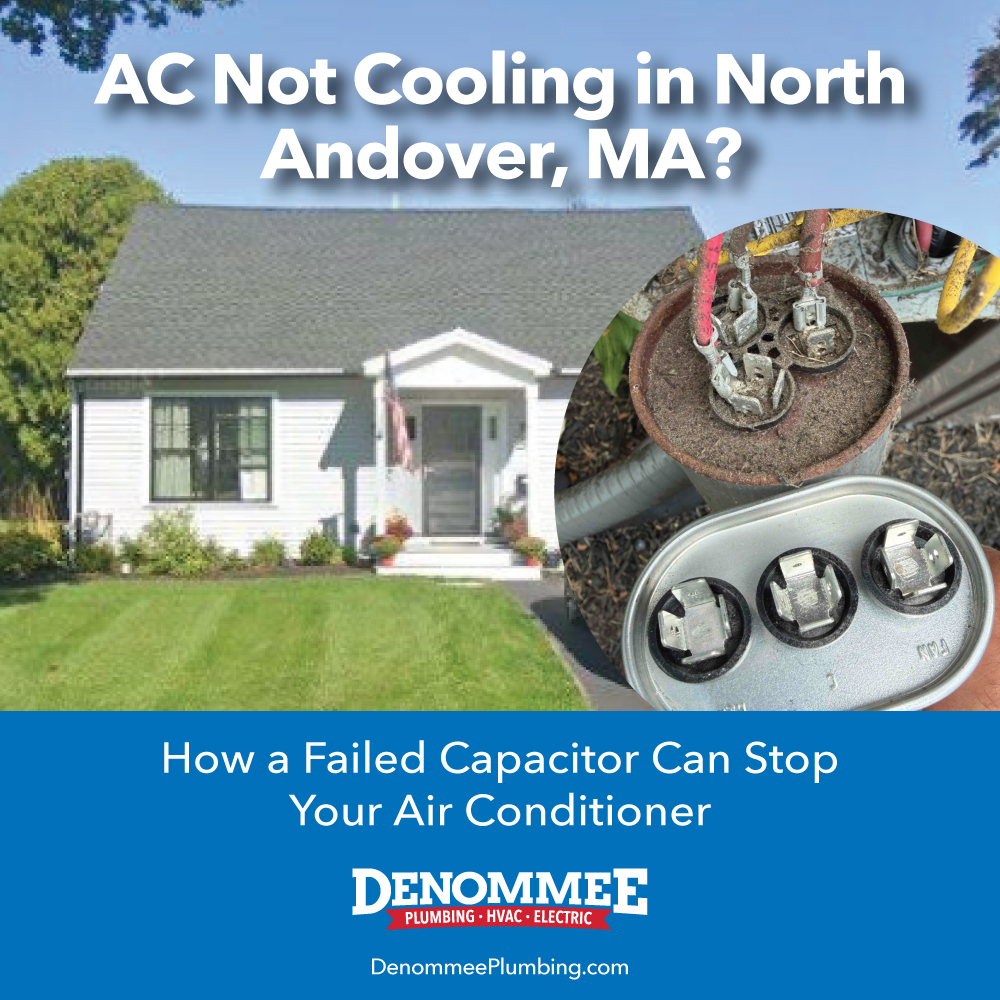
The homeowner's existing central air conditioning system wasn't operating properly. After troubleshooting the equipment, our technician identified a failed capacitor in the outdoor condensing unit. The homeowner elected to have Denommee replace the failed component and, after the repair, enrolled in a Denommee service program membership to help protect and maintain the home's HVAC equipment going forward.
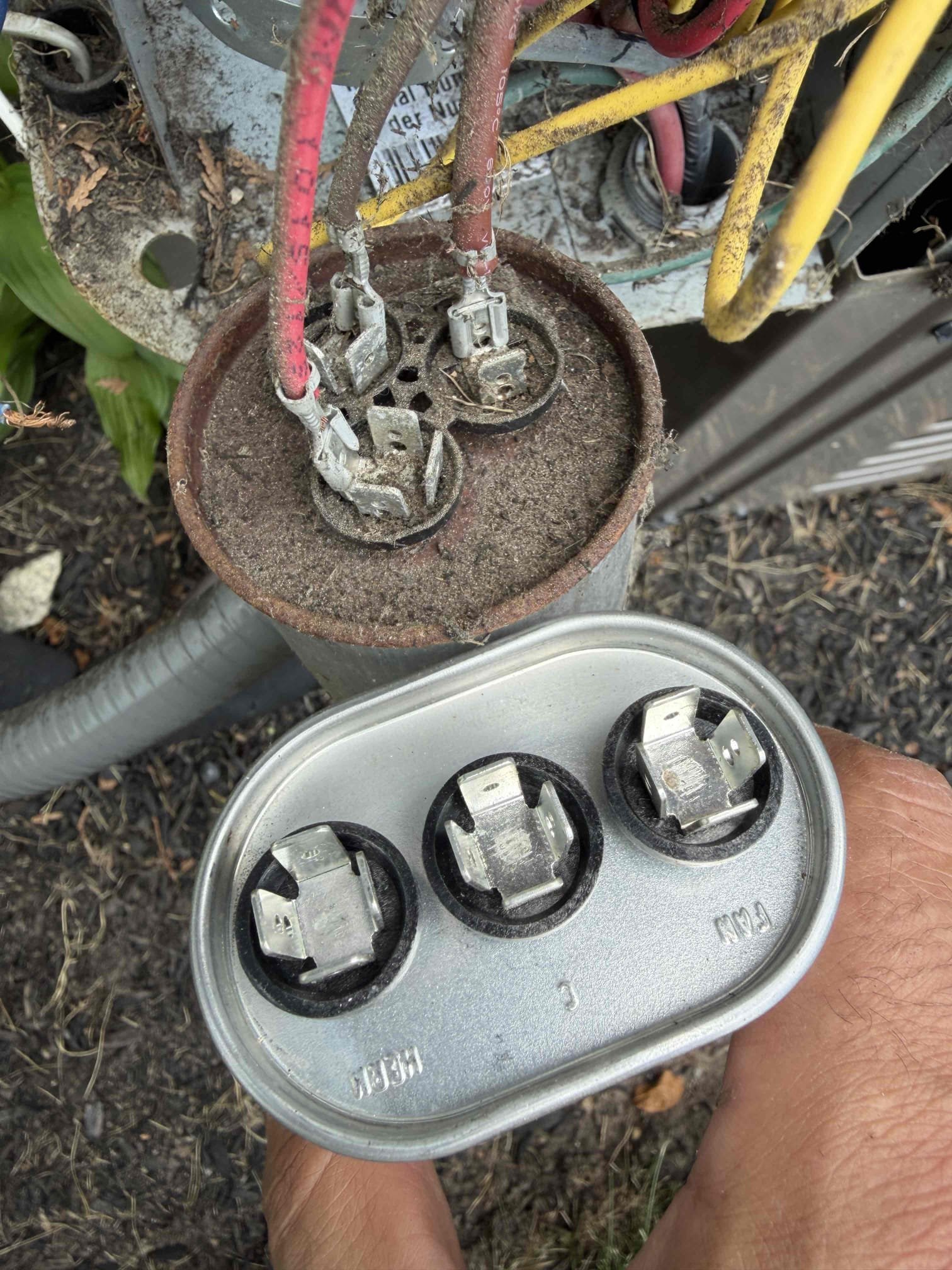
The photographs from the service call provide a particularly useful look at what an AC capacitor failure can involve. The removed capacitor shows substantial age and deterioration around its terminals, while the replacement component has clean terminals and connections. After completing the repair, our technician used professional digital refrigeration gauges to verify the system's operation rather than simply replacing the component and assuming the air conditioner was fixed.
For North Andover homeowners experiencing an AC that won't start, isn't cooling properly, makes a humming sound, or repeatedly struggles during hot weather, a failed capacitor is one of several potential causes worth investigating.
Here's what capacitors do, why they fail, how HVAC technicians diagnose them, and why proper system testing after an air conditioning repair matters.
North Andover AC Repair: Project at a Glance
Location: North Andover, Massachusetts
Service: Residential central air conditioning repair
Equipment: York central air conditioning system
Outdoor Unit Model: YCD30B22SA
Refrigerant: R-410A
Electrical Supply: 208–230V, single phase, 60 Hz
Maximum Fuse/Circuit Breaker: 30 amps
Problem Identified: Failed capacitor
Repair: Removal and replacement of failed capacitor
Post-Repair Work: System operation and cooling performance checked with professional HVAC diagnostic equipment
Additional Service: Homeowner enrolled in a Denommee service program membership
The outdoor equipment data plate identifies this particular York condenser as an R-410A air conditioning system. That's important information for a technician because the refrigerant type, electrical specifications, equipment model, manufacturer data, and operating conditions all factor into accurate HVAC diagnosis.
It also illustrates an important distinction for homeowners:
An older air conditioner experiencing a component failure does not automatically need to be replaced.
A qualified HVAC technician should diagnose the cause of the failure, assess the overall condition of the equipment, and explain reasonable repair and replacement options before the homeowner makes that decision.
What Is an Air Conditioner Capacitor?
A capacitor is an electrical component that helps an air conditioner's motors start and operate.
Central AC systems contain motors that require considerable electrical energy when starting. Depending on the equipment design, capacitors help provide the electrical characteristics necessary for components such as the compressor and outdoor condenser fan motor to start and/or run properly.
Many residential outdoor AC units use a dual-run capacitor, which combines support for the compressor and condenser fan motor within a single component.
The capacitor itself is usually a relatively small cylindrical or oval metal component located inside the electrical compartment of the outdoor condenser.
Despite its size, it can be critical to the operation of the entire cooling system.
When a capacitor fails, the air conditioner may no longer be able to start or operate one of the components necessary to produce cooling.
That is why a seemingly inexpensive electrical component can leave an entire home without air conditioning.
What Does a Failed AC Capacitor Look Like?
There isn't one appearance shared by every failed capacitor.
Some visibly swell, bulge, leak, corrode, or suffer damaged terminals. Others can look relatively normal and still test outside their required capacitance specification.
In the North Andover repair shown here, the removed component displays significant age, dirt and corrosion around its upper surface and electrical terminals compared with the clean replacement capacitor.
That visual deterioration is useful evidence, but appearance alone should not be used to diagnose a capacitor.
An HVAC technician can electrically test the component and compare the measured capacitance with the manufacturer's specified microfarad (µF) rating and allowable tolerance.
Important Safety Warning
Homeowners should not attempt to touch, disconnect, or test an AC capacitor themselves.
Turning the thermostat off does not necessarily make the outdoor equipment electrically safe. Capacitors are electrical components capable of storing energy, and an outdoor condenser is supplied by potentially dangerous line voltage.
If you suspect an electrical problem inside your air conditioner, shut the equipment down using appropriate controls and contact a qualified HVAC professional.
Common Symptoms of a Bad AC Capacitor
Capacitor failures don't always produce identical symptoms because the result depends on the equipment and which portion of the electrical circuit is affected.
Common symptoms can include:
- Outdoor AC unit won't start
- Condenser fan won't spin
- Compressor doesn't start
- Air conditioner hums or buzzes
- System starts and then shuts down
- Intermittent cooling
- AC takes unusually long to start
- Indoor blower operates but the outdoor unit doesn't
- Warm or room-temperature air comes from the vents
- Circuit breaker trips
- Air conditioner stops operating during extremely hot weather
There is an important caveat, however.
These symptoms do not prove that a capacitor has failed.
A non-operating outdoor condenser could also involve a contactor, compressor, fan motor, electrical connection, thermostat/control issue, breaker, disconnect, refrigerant problem, or another fault.
That's why professional troubleshooting matters.
Replacing parts based solely on symptoms can waste money and may leave the actual problem unresolved.
Why Do Air Conditioner Capacitors Fail?
Capacitors are wear components, and eventually they can fail even in otherwise functional HVAC systems.
Several factors can contribute.
Heat
Outdoor condensers operate through the hottest part of the year, often sitting in direct sunlight while rejecting heat from inside the home.
High ambient temperatures combined with heat generated inside the condenser's electrical compartment can place significant stress on electrical components.
This is one reason capacitor problems frequently become apparent during extended periods of hot weather—exactly when homeowners depend on their air conditioners the most.
Age
Repeated heating, cooling, starting, and stopping cycles can gradually degrade a capacitor.
A capacitor that performed normally for years may eventually drift outside its specified operating range.
Electrical Conditions
Voltage irregularities, loose electrical connections, damaged wiring, or problems elsewhere in the system can contribute to electrical component stress.
Motor or Compressor Problems
Sometimes a capacitor failure is the problem.
Other times, it can be a symptom accompanying another equipment issue.
A compressor or fan motor experiencing abnormal operating conditions may place additional demands on electrical components. That's another reason a technician shouldn't stop diagnosing the system simply because a failed capacitor has been discovered.
Why Denommee Doesn't Just Replace the Part and Leave
Finding a failed component is only one part of professional HVAC service.
After replacing a capacitor, a technician should verify that the air conditioner actually returns to appropriate operation.
The photographs from this North Andover repair show Denommee's technician using a Fieldpiece SMAN digital refrigerant manifold while the system is operating.
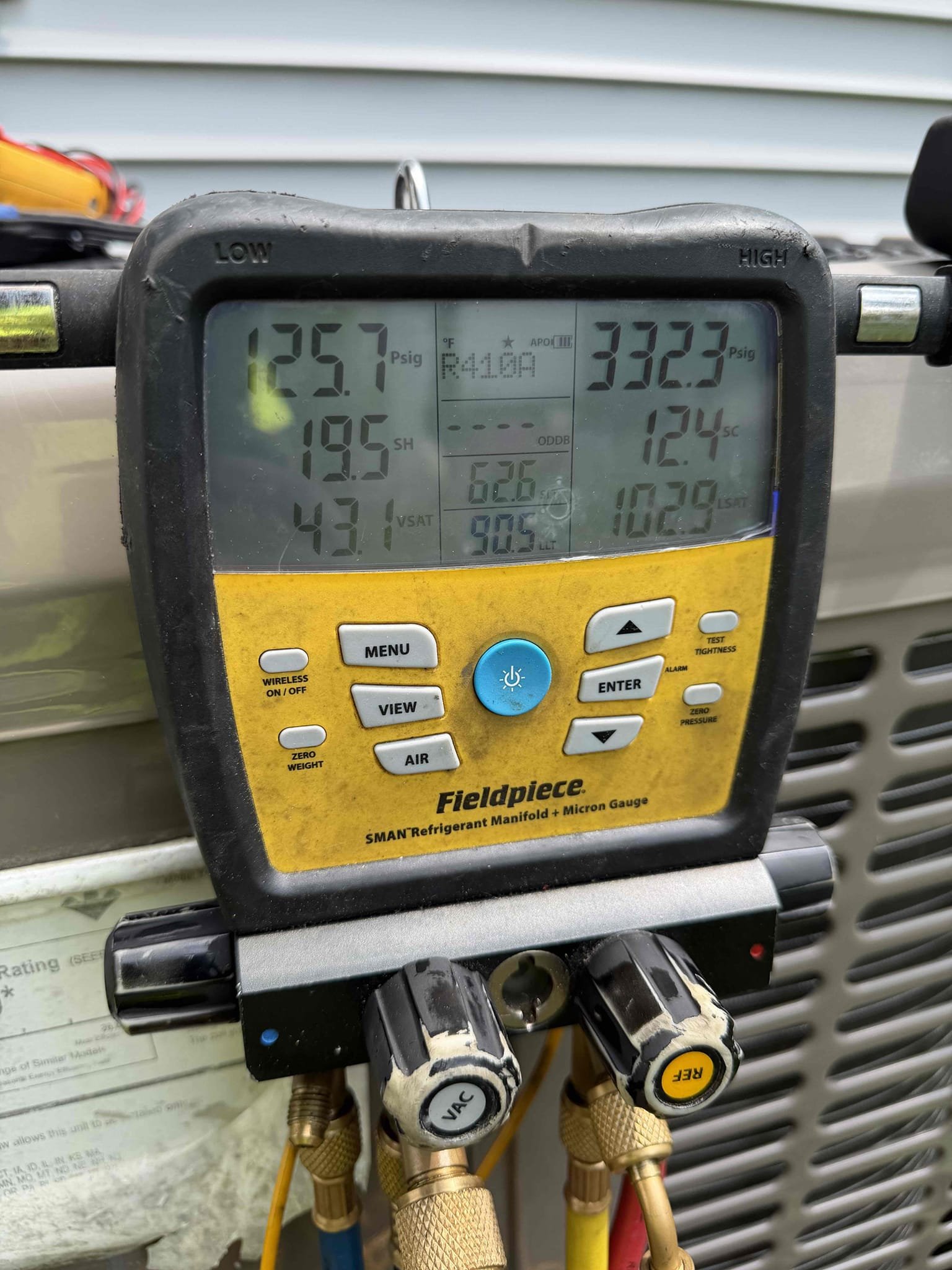
At the moment captured in the photograph, the instrument displays approximately:
- 125.7 PSIG low-side pressure
- 332.3 PSIG high-side pressure
- 19.5°F superheat
- 12.4°F subcooling
- 62.6°F outdoor dry-bulb reading displayed by the instrument
Those numbers are a snapshot of operating conditions—not values homeowners should use as universal targets for their own air conditioners.
Refrigerant pressures and appropriate superheat or subcooling vary based on equipment design, metering device, indoor and outdoor temperatures, airflow, refrigerant type, manufacturer specifications, and system load.
That's an important distinction because refrigerant pressures viewed in isolation don't tell the whole story.
What Do HVAC Gauges Tell a Technician?
Professional diagnostic instruments can help technicians evaluate conditions including:
Suction pressure: The refrigerant pressure on the low side of the system.
Discharge/liquid-side pressure: Higher-side refrigerant pressure during operation.
Superheat: A calculated value that can provide information about refrigerant conditions leaving the evaporator.
Subcooling: A calculated value used when evaluating refrigerant conditions in the liquid line and, on appropriate systems, system charge.
These measurements must be interpreted alongside equipment specifications and actual operating conditions.
In other words, the gauge isn't the diagnosis.
The trained technician interpreting the measurements is.
Why Proper AC Diagnosis Can Save Homeowners Money
When an air conditioner stops working, homeowners sometimes assume the worst:
"My AC is dead. I probably need a new system."
Not necessarily.
The North Andover project is a good example of why diagnosis should come before replacement recommendations.
The homeowner had an air conditioning problem. Denommee diagnosed a failed component, explained the available repair, and the homeowner chose to repair the existing system.
That's the way HVAC service should work.
There are certainly situations where replacement makes more financial sense—particularly when equipment is old, inefficient, uses obsolete refrigerant, has a failed compressor or coil, or requires increasingly frequent repairs.
But there are also situations where a targeted repair can restore operation and allow homeowners to continue using their existing equipment.
A trustworthy HVAC contractor should help you understand the difference.
Repair or Replace? Questions to Ask When an Older AC Breaks
A failed capacitor alone does not necessarily justify replacing an entire central air conditioning system.
Instead, homeowners should consider the larger picture.
How old is the air conditioner?
As equipment gets older, the likelihood of additional repairs generally increases.
What is the overall condition?
A well-maintained older system with a relatively minor isolated failure presents a different decision than equipment with deteriorated coils, compressor problems, refrigerant leaks, and a history of repeated breakdowns.
How expensive is the current repair?
Compare the repair investment with the age and remaining expected service life of the equipment.
Has the system required frequent repairs?
Multiple service calls over a relatively short period can change the economics of continuing to repair older equipment.
Does the system still cool the home comfortably?
An operational system can still be a poor fit if it runs continuously, leaves certain rooms uncomfortable, struggles with humidity, or produces high summer electric bills.
Are you considering a heat pump anyway?
Massachusetts homeowners replacing older central air conditioners have more choices today than simply installing another cooling-only condenser.
A modern cold-climate heat pump can provide both air conditioning and efficient heating, potentially reducing reliance on an existing boiler or furnace.
Denommee works on conventional air conditioners, furnaces and boilers as well as modern ducted and ductless heat pumps. That breadth of experience allows us to discuss repair and replacement options rather than steering every homeowner toward the same solution.
What the York Equipment Tag Tells Us
Every professional HVAC diagnosis should begin with understanding the equipment being serviced.
The manufacturer's data plate photographed during this North Andover repair identifies the outdoor unit as a York YCD30B22SA.
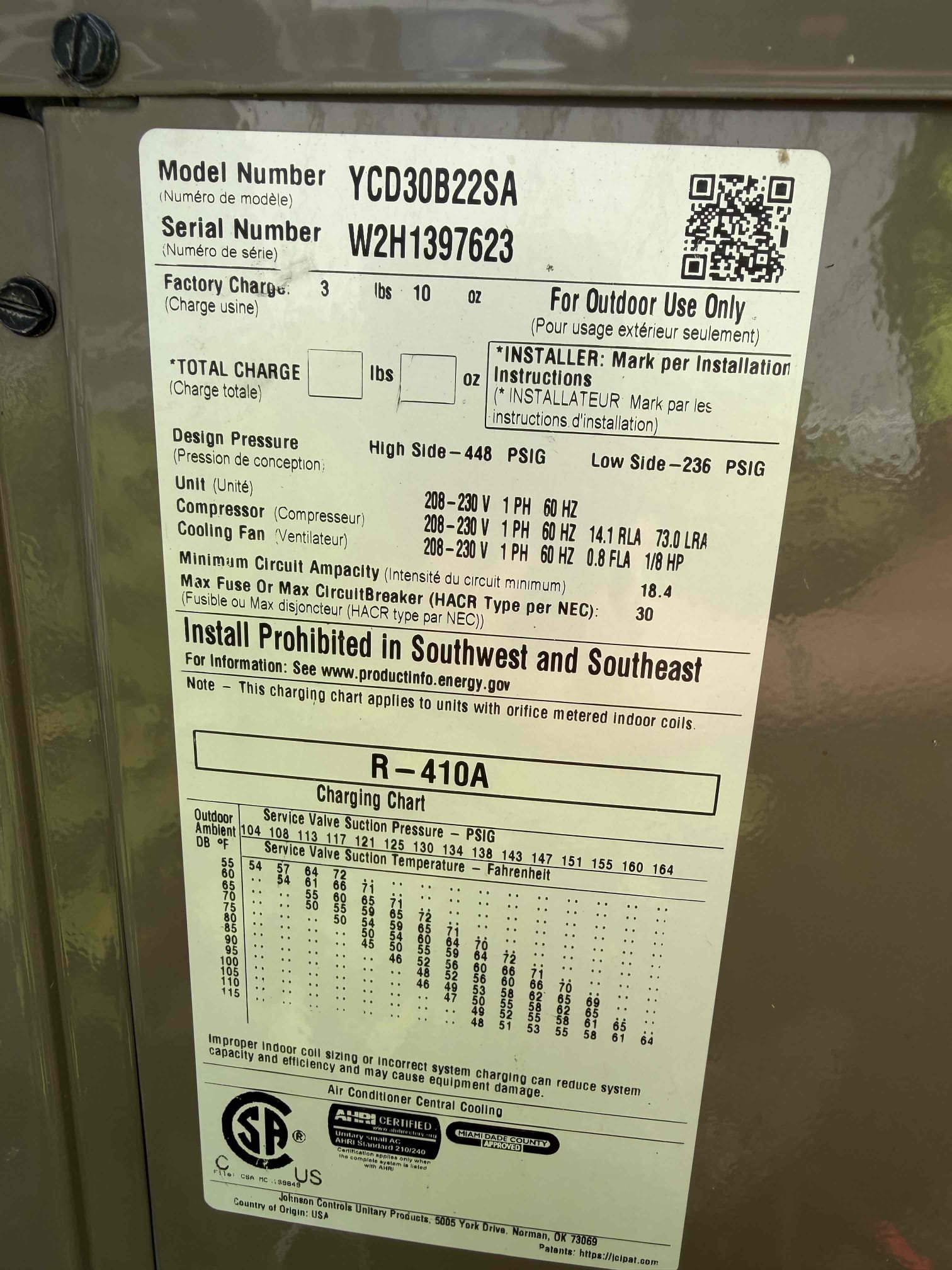
The tag also identifies several important specifications:
- R-410A refrigerant
- Factory refrigerant charge of 3 lb. 10 oz.
- 208–230V electrical supply
- Single-phase, 60 Hz operation
- Minimum circuit ampacity of 18.4 amps
- Maximum fuse or circuit breaker rating of 30 amps
- High-side design pressure of 448 PSIG
- Low-side design pressure of 236 PSIG
Why does that matter?
Because HVAC service should be equipment-specific.
Technicians use manufacturer information together with diagnostic measurements, operating temperatures, electrical testing, and their observations of the system to determine whether equipment is functioning correctly.
The data plate also explicitly warns that incorrect indoor coil sizing or improper system charging can reduce capacity and efficiency and may cause equipment damage.
That's an important lesson for any homeowner considering HVAC repair or replacement: proper system design and commissioning matter just as much as the name printed on the equipment.
R-410A Air Conditioners Can Still Be Repaired
The R-410A designation on this North Andover condenser raises another question we're hearing increasingly often from homeowners:
Can an existing R-410A air conditioner still be repaired?
Yes.
The HVAC industry is transitioning toward lower-global-warming-potential refrigerants in newly manufactured equipment, but that does not mean homeowners must automatically replace a functioning R-410A system simply because it uses R-410A.
Existing systems can continue to be serviced.
The decision to repair or replace should instead consider factors such as the equipment's age, condition, efficiency, repair history, refrigerant circuit integrity, comfort performance, and cost of the proposed repair.
A failed capacitor is fundamentally different from a major refrigerant leak or failed compressor.
That's precisely why an accurate diagnosis is so important.
Why Preventive AC Maintenance Matters
After completing the capacitor repair, this North Andover homeowner made another important decision: enrolling in a Denommee service program membership.
Preventive maintenance can't guarantee that an air conditioner will never break down. Mechanical and electrical components eventually wear out.
What maintenance can do is give a qualified technician opportunities to identify developing problems, verify system operation, keep critical components clean, and establish a service history for the equipment.
During routine HVAC maintenance, technicians can inspect and evaluate areas such as:
- Electrical components and connections
- Capacitors
- Contactors
- Condenser coils
- Refrigerant circuit performance
- Temperature differences
- Condensate drainage
- Air filters
- Indoor coils
- Blower components
- Thermostat operation
- Outdoor equipment condition
- Overall system performance
For homeowners with older HVAC equipment, regular maintenance becomes particularly valuable because it provides opportunities to discuss developing issues before an unexpected no-cooling call on one of the hottest days of summer.
A service program also establishes an ongoing relationship with a local HVAC company that already understands your equipment and its service history.
Why North Andover Homeowners Choose Denommee for AC Repair
Denommee Plumbing, HVAC & Electric isn't simply an air conditioning repair company.
We're a locally owned, multi-trade home service company with generations of experience helping homeowners throughout northeastern Massachusetts and southern New Hampshire maintain the mechanical and electrical systems their homes depend on.
Our technicians service and install:
- Central air conditioning systems
- Ducted heat pumps
- Ductless mini splits
- Mitsubishi Electric Hyper-Heat systems
- Gas furnaces
- Oil heating equipment
- Hydronic boilers
- Steam boilers
- Indoor air quality equipment
- Traditional and heat pump water heaters
- Electrical panels and circuits
- Plumbing systems
That multi-trade capability can be especially valuable when an HVAC problem crosses traditional trade boundaries.
Instead of coordinating separate HVAC, plumbing, and electrical companies, Denommee customers have access to experienced professionals across all three trades from one local company.
We also believe homeowners should know what work costs before approving a repair. Our flat-rate, upfront pricing approach allows customers to review their options and make an informed decision rather than waiting for an hourly service bill to accumulate.
And when cooling problems can't wait, Denommee provides 24-hour emergency HVAC service for customers throughout our service area.
Frequently Asked Questions About AC Capacitor Failure
Can a bad capacitor cause my AC not to cool?
Yes. Depending on the system design and which capacitor function has failed, a bad capacitor can prevent the compressor or condenser fan motor from operating properly. Without proper outdoor-unit operation, the air conditioner may be unable to remove heat from the home.
Can an AC capacitor fail suddenly?
Yes. A capacitor may gradually weaken before failing, but the homeowner may not notice a problem until the system struggles to start or stops operating.
Does a bad capacitor mean I need a new air conditioner?
No. A capacitor is a replaceable electrical component. If the remainder of the air conditioner is in serviceable condition, replacing a failed capacitor may restore normal operation. A technician should evaluate the complete system before recommending repair or replacement.
Can I replace an AC capacitor myself?
Because capacitors can store electrical energy and air conditioners contain hazardous line voltage, capacitor diagnosis and replacement should be left to qualified professionals.
Why is my outdoor AC unit humming but not starting?
A failed or weakened capacitor is one possibility, but a humming condenser can have several causes, including electrical, motor, compressor, or control problems. The system should be professionally diagnosed rather than assuming the capacitor is responsible.
Why does my AC work inside but the outside unit isn't running?
The indoor blower and outdoor condenser are separate parts of the cooling system. If the indoor fan operates while the condenser doesn't, possible causes include electrical supply problems, controls, capacitors, contactors, motors, or compressor issues.
Should refrigerant be added after replacing a capacitor?
Not simply because a capacitor was replaced. The electrical and refrigeration circuits perform different functions. Refrigerant should only be added when diagnostic testing indicates it is necessary and the reason for an improper charge has been understood.
How often should a central air conditioner be maintained?
For most residential systems, annual professional cooling maintenance is a sensible baseline. Equipment usage, age, manufacturer requirements, environmental conditions, and the presence of heating functions can affect the appropriate maintenance schedule.
AC Not Working in North Andover? Start With a Diagnosis, Not an Assumption
If your air conditioner suddenly stops cooling, don't assume you're facing an expensive system replacement.
The problem could involve a capacitor, electrical component, thermostat, condensate safety, fan motor, compressor, refrigerant circuit, airflow issue, or another component—and the right solution begins with finding out why the system stopped working.
This recent North Andover service call is a good example. Our technician identified the failed capacitor, replaced the defective component, and then tested the operating system with professional diagnostic equipment to confirm cooling operation. The homeowner was able to make an informed decision to repair the existing air conditioner and then enrolled in a Denommee service program to help maintain the system going forward.
That's the approach we believe homeowners deserve: diagnose first, explain the findings, provide clear options and let the customer decide.
If your central air conditioner isn't cooling properly in North Andover or elsewhere in Denommee's Massachusetts and southern New Hampshire service area, Denommee Plumbing, HVAC & Electric is ready to help.
Book HVAC service online or use our Text-to-Book option to request an appointment. For urgent no-air-conditioning problems, ask about our 24-hour emergency HVAC service.
And if testing shows that repairing an older air conditioner no longer makes financial sense, our team can also help you compare conventional central AC, high-efficiency heat pumps, ducted systems, ductless mini splits, and hybrid heating and cooling options—so you can make an educated decision about what comes next.


