Weil-McLain ECO Hybrid Heat Pump + Boiler System
A New Heat Pump Option for Massachusetts Homes with Boilers and Hydronic Heat
For generations, hydronic heating has been one of the defining features of New England homes.
Boilers supplying hot water to baseboard, radiators and radiant floors can provide exceptionally comfortable heat. For many Massachusetts homeowners, however, the growing interest in heat pumps creates an obvious question:
Can I add heat-pump technology without giving up my hydronic heating system?
Increasingly, the answer can be yes.

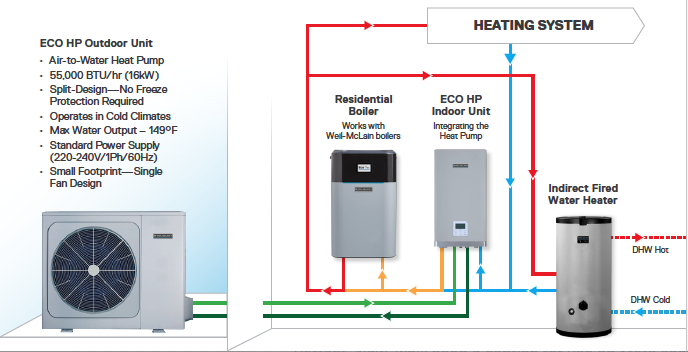
The Weil-McLain ECO Hybrid Dual Fuel Hydronic System combines an ECO HP air-to-water heat pump with a boiler, allowing the two heating technologies to work together instead of requiring homeowners to choose one or the other.
The heat pump can handle much of the heating season using electricity. When outdoor conditions or the home's heating requirements make boiler operation more appropriate, the system can transition to the boiler.
For homeowners in Massachusetts and Southern New Hampshire—particularly those with existing boiler systems—this represents an intriguing middle path between traditional fossil-fuel heating and complete electrification.
And it makes proper system evaluation, heat-loss calculations, hydronic design, electrical planning and installation especially important.
As a Weil-McLain Advantage Authorized Contractor with licensed plumbing, HVAC and electrical professionals in-house, Denommee Plumbing, HVAC & Electric can evaluate the entire home and determine whether an ECO Hybrid system makes sense—not simply whether one can physically be installed.
What Is the Weil-McLain ECO Hybrid System?
The ECO Hybrid is a dual-fuel hydronic heating system.
Instead of a conventional air-source heat pump that heats air and distributes it through ductwork or wall-mounted indoor units, the ECO HP is an air-to-water heat pump.
It extracts heat from outdoor air using a refrigeration cycle and transfers that energy to water.
That heated water can then become part of a hydronic distribution system.
Weil-McLain describes applications including:
- Radiant floor heating
- Hydronic baseboard systems
- Fan coils
- Domestic hot water
- Boiler-assisted hydronic systems
The ECO Hybrid pairs that technology with a boiler, allowing the controls to determine when the heat pump operates and when the boiler is needed. Weil-McLain says the heat pump is intended to serve as the primary source during much of the heating season, with the boiler taking over when conditions make it the more effective source.
That distinction is important.
The objective of a hybrid system isn't necessarily to eliminate the boiler. It is to reduce how often the boiler needs to operate by letting an efficient heat pump carry the load when conditions favor it.
How Is an Air-to-Water Heat Pump Different From a Mini Split?
Most Massachusetts homeowners are now familiar with conventional air-source heat pumps.
A ductless mini split, for example, extracts energy from outdoor air and transfers it to indoor air.
An air-to-water heat pump transfers that energy to water instead.
That makes air-to-water technology particularly interesting for houses that already use hydronic heat.
Rather than automatically abandoning a home's water-based heating infrastructure, an appropriately designed system may be able to incorporate heat-pump technology into it.
That can be attractive in older New England homes where the hydronic distribution system itself remains useful even though the homeowner wants to reduce fossil-fuel consumption.
Why Pair a Heat Pump With a Boiler?
Massachusetts presents a demanding heating environment.
A home's heating requirement on a relatively mild 40°F November afternoon is dramatically different from its requirement during a cold January night.
Heat-pump efficiency and capacity also change with outdoor temperature and required water temperature.
A hybrid system recognizes those realities.
During favorable conditions, the heat pump can provide hydronic heat efficiently. As temperatures fall or heating requirements increase, the boiler is available to provide additional or alternative heating capacity.
Weil-McLain describes this as allowing each technology to operate where it performs effectively rather than requiring one appliance to handle every possible condition.
For a Massachusetts homeowner, that can mean:
Heat pump when it makes sense. Boiler when it makes sense. One integrated hydronic system designed around the home.
How Efficient Is the Weil-McLain ECO HP?
One of the headline specifications is its coefficient of performance, or COP.
Weil-McLain lists performance reaching as high as 5.37 COP, depending upon model and operating conditions.
COP describes the relationship between heat delivered and electricity consumed.
A COP of 3, for example, means the heat pump delivers approximately three units of thermal energy for every unit of electrical energy it consumes.
That does not mean an ECO HP will operate at its maximum published COP all winter.
Actual performance depends on variables including:
- Outdoor temperature
- Required supply-water temperature
- Heating load
- Heat-emitter capacity
- System design
- Controls
- Flow
- Operating conditions
This is one reason a meaningful heat-pump evaluation needs to go substantially further than simply matching equipment to the square footage of a house.
ECO HP Operating Range and Water Temperature Matter
The current Weil-McLain specifications list three ECO HP sizes: ECOHP-41, ECOHP-48 and ECOHP-55, with nominal capacities of approximately 41,200, 49,500 and 54,600 BTU/hr respectively at the manufacturer's stated nominal rating condition.
Published specifications show an outdoor operating range extending to -13°F and heating supply-water temperatures from 77°F to 149°F.
Those numbers are useful.
But they should not be interpreted as meaning every boiler system is automatically an ideal ECO Hybrid candidate.
The more important question is:
How much heat can your home's existing radiation deliver at the water temperatures the heat pump can efficiently produce?
That brings us to one of the most important parts of evaluating an older hydronic home.
Your Existing Baseboards or Radiators Matter
Traditional boilers are frequently designed around relatively high hydronic temperatures.
Heat pumps generally become more efficient when they can satisfy the heating load using lower water temperatures.
That means two homes with apparently similar boilers can have very different ECO Hybrid opportunities.
Consider a house with generously sized radiant flooring or hydronic emitters capable of maintaining comfort at relatively low supply-water temperatures.
That may be an excellent air-to-water heat-pump application.
Another house might have limited amounts of traditional fin-tube baseboard that require much hotter water during cold weather.
That does not necessarily eliminate it from hybrid consideration.
Instead, the boiler may need to assume more of the heating load as the required water temperature rises.
This is exactly where the hybrid concept becomes valuable.
Which Massachusetts Homes May Be Good Candidates for ECO Hybrid?
There isn't one universal "ECO Hybrid house." Weil-McLain's application documentation includes multiple configurations, which underscores the importance of designing around the actual building and existing heating system.
Several types of homes are particularly worth evaluating.
Homes with radiant floor heating
These may be among the most compelling candidates.
Radiant floors often operate at lower water temperatures than traditional high-temperature hydronic systems. Weil-McLain's own ECO Hybrid residential case study describes a roughly 3,000-square-foot home with radiant-floor heating as an especially suitable hybrid application because of its low-temperature distribution system.
Homes with an aging oil or propane boiler
Homeowners facing significant boiler replacement decisions may want to explore whether hybridization offers another path.
Rather than simply replacing one fossil-fuel appliance with another and leaving the rest of the system unchanged, the project can become an opportunity to evaluate future heat-pump integration.
Homes with high fuel costs
For homeowners using oil or propane, reducing annual fuel consumption may be particularly attractive.
Whether it produces actual operating-cost savings depends on local electricity and fuel rates, system performance and how the house operates.
Those numbers should be modeled rather than assumed.
Homes whose owners want to electrify gradually
Complete electrification isn't the only pathway.
A hybrid system can allow a homeowner to begin shifting heating demand toward electricity while retaining a boiler for cold-weather operation or higher-temperature loads.
Homes where the existing hydronic distribution is worth preserving
Well-designed radiant floors, baseboards and other hydronic systems represent significant infrastructure.
If that distribution system is in good condition, homeowners may prefer to modernize the source of heat rather than replace the entire method of distributing it.
Homes already considering a boiler replacement
This may be one of the best times to ask about ECO Hybrid.
The homeowner is already making a long-term heating-system decision. Designing the replacement boiler and piping with heat-pump integration in mind can preserve options that might otherwise be lost.
You May Not Have to Install Everything at Once
One of the more interesting aspects of Weil-McLain's ECO Hybrid strategy is phased installation.
Imagine a boiler failing in January.
That is rarely the ideal time to undertake a larger outdoor heat-pump project.
Weil-McLain specifically designed the system so that a heat-pump-ready boiler installation can potentially be completed first, restoring heat, with the ECO HP indoor and outdoor equipment added later when conditions are more favorable.
The manufacturer outlines three broad approaches:
Retrofit upgrade: A compatible existing boiler may potentially be incorporated into an ECO Hybrid configuration.
Phased installation: Install the heat-pump-ready boiler and appropriate piping first, then add the heat pump later.
All-at-once installation: Install the boiler and ECO HP together as a complete hybrid heating project.
For New England, that flexibility makes considerable practical sense.
Can ECO Hybrid Work With an Existing Boiler?
Potentially—and this is where the design guide becomes especially interesting.
Weil-McLain's application documentation includes a System Type B configuration described as the ECO HP working with any boiler having a thermostat input. In this arrangement, the ECO HP acts as the master and determines when the heat pump or boiler should operate.
That does not mean every existing boiler should automatically be retained.
Age, condition, efficiency, controls, piping configuration, venting and expected remaining life still matter.
But it substantially broadens the retrofit conversation.
A homeowner with an existing hydronic system shouldn't assume that installing an air-to-water heat pump necessarily requires throwing everything else away.
Proper Hydronic Design Is Critical
This isn't simply a matter of attaching a heat pump to two boiler pipes.
Weil-McLain's application guide contains detailed piping and control configurations covering zoning, domestic hot water, boiler integration and primary/secondary piping.
For example, in one multi-zone configuration, Weil-McLain specifies primary/secondary piping and notes that if the boiler and ECO HP operate concurrently, the boiler must be downstream from the heat pump to prevent high return-water temperatures from shutting down the heat pump.
That illustrates why installer expertise matters.
A successful hybrid hydronic system requires understanding both refrigeration and hydronics.
The design has to consider:
- Heat loss
- Heat-pump capacity
- Boiler capacity
- Water temperatures
- Flow requirements
- Existing radiation
- Zone configuration
- Circulators
- Hydraulic separation
- Domestic hot water
- Outdoor reset/control strategy
- Electrical service and circuit requirements
- Refrigerant piping
- Condensate and drainage
- Outdoor-unit placement
- Snow clearance
- Commissioning
That is considerably different from treating the heat pump as a stand-alone appliance.
Weil-McLain's ECO Calc Tool Helps Answer the Most Important Question
Perhaps the most important feature isn't a piece of equipment at all.
It's the design process.
Weil-McLain developed the ECO Calc Application Sizing Tool specifically to help contractors evaluate hybrid applications.
According to the manufacturer's current brochure, ECO Calc incorporates:
- Localized weather-bin data
- Local utility rates
- Rebates and tax credits
- Manual J heating load
- Heat-pump capacity
- Heat-emitter capacity
- Domestic-hot-water considerations
That is exactly how a hybrid system should be approached.
The question isn't simply:
"How many BTUs is my boiler?"
The better questions are:
How much heat does this particular house actually need at different outdoor temperatures?
How much heat can its existing radiation deliver at different water temperatures?
How much of that load can the ECO HP carry?
At what conditions should the boiler take over?
What will electricity and fuel actually cost under those operating strategies?
Those answers determine whether a hybrid design is compelling for a particular homeowner.
What Is the ECO Hybrid Balance Point?
This is one of the most useful concepts for homeowners considering dual-fuel heating.
There is generally a point during changing outdoor conditions where using the boiler instead of the heat pump—or vice versa—makes more sense based on system design and control strategy.
That transition can account for heat-pump capacity, required water temperature, heating demand and potentially operating economics.
Instead of forcing the heat pump to do everything during the most demanding conditions, the hybrid system can use the boiler when appropriate.
For cold-climate homeowners who are interested in heat pumps but hesitant to abandon boiler heat completely, that is a significant distinction.
Can ECO Hybrid Provide Domestic Hot Water?
Yes, depending upon system design.
Weil-McLain states that ECO Hybrid can be configured to support space heating and domestic hot-water production, and its application guide includes DHW configurations and priority strategies.
An indirect water heater can therefore become part of the overall system design.
Again, household hot-water demand needs to be considered during sizing rather than treated as an afterthought.
The ECO HP Uses R-32 Refrigerant
The ECO HP uses R-32 refrigerant, reflecting the industry's broader transition toward lower-global-warming-potential refrigerants.
The outdoor ECO HP is an inverter-driven split heat-pump system connected to its indoor hydronic unit by refrigerant lines.
Weil-McLain's published specifications currently show:
- R-32 refrigerant
- Twin-rotary compressor
- 208–230V single-phase outdoor-unit power
- 34A minimum circuit ampacity
- 50A maximum overcurrent protection
- 1-inch hydronic connections
- Approximately 3.1–13.2 GPM hydronic flow range
These requirements are another reason the evaluation should include the home's electrical infrastructure as well as its boiler room.
Why Denommee Is Particularly Well Positioned to Install ECO Hybrid Systems
The equipment is only one component of a successful hybrid heating project.
System design and integration are arguably more important.
That is where Denommee's combination of capabilities becomes particularly relevant.
Weil-McLain Advantage Authorized Contractor
Denommee is a Weil-McLain Advantage Authorized Contractor.
Weil-McLain describes its Advantage contractor network as heating professionals who are trained and trusted to install and maintain Weil-McLain equipment.
For a conventional boiler replacement, manufacturer familiarity is valuable.
For a hybrid hydronic system combining a boiler, heat pump, refrigerant circuit, hydronic distribution and sophisticated controls, it becomes even more relevant.
Boiler and hydronic expertise
Denommee has extensive experience servicing and installing boilers and hydronic systems throughout Massachusetts and Southern New Hampshire.
That matters because evaluating ECO Hybrid requires understanding what already exists:
the boiler, pumps, zones, baseboards, radiant loops, indirect water heater, controls and piping.
Heat-pump and refrigeration expertise
The other half of the system is a heat pump.
Denommee holds Massachusetts Refrigeration Contractor License RC-148415 and has extensive experience designing, installing and commissioning heat-pump systems.
ECO Hybrid therefore doesn't require Denommee to approach either side of the system as unfamiliar technology. Denommee is also a Mitsubishi Electric Elite Diamond Contractor that installs and services Mitsubishi ecodan® Air-to-Water Heat Pumps and a participating Mass Save® Heat Pump Installer Network and Heat Pump Leader Network contractor, bringing specialized heat-pump experience to system design, installation, commissioning, and ongoing service.
Licensed plumbers in-house
Hydronic systems involve piping, valves, circulators and water.
Denommee's plumbing capabilities allow that work to remain within the same organization responsible for the overall mechanical system.
Licensed electricians in-house
Adding an ECO HP also adds a significant electrical load.
The existing electrical service, panel capacity, overcurrent protection, disconnects and required wiring need to be evaluated.
Because Denommee has licensed electricians in-house, electrical requirements can be considered during the original system design rather than becoming an unexpected problem after the HVAC equipment has already been selected.
That is an unusually good fit for hybrid electrification projects.
Boiler. Hydronics. Refrigeration. Heat pump. Electrical. Controls. One coordinated team.
An ECO Hybrid Isn't Automatically the Right Answer for Every Boiler Home
This is an important point.
New technology shouldn't be recommended simply because it is new.
Some houses may be excellent ECO Hybrid candidates.
Others may make more sense with a different heat-pump strategy, conventional boiler replacement, dual-fuel configuration or other HVAC design.
A home with low-temperature radiant heating may present a very different opportunity than one with undersized high-temperature baseboard.
A relatively new boiler presents a different decision than a 30-year-old boiler nearing replacement.
A 200-amp electrical service with ample capacity presents a different project than a home whose electrical infrastructure already needs upgrading.
Oil, propane and natural-gas costs also differ.
And homeowner goals differ.
That's why the first step should be an evaluation, not an equipment sale.
ECO Hybrid vs. Complete Electrification
Massachusetts homeowners sometimes hear the heating decision framed as a binary choice:
Keep the boiler or electrify the house.
Hybrid hydronics creates another possibility.
A homeowner can potentially shift a substantial portion of annual heating toward electricity without necessarily removing the boiler's ability to provide high-output heating during demanding winter conditions.
For some homes, full electrification will still be the preferred solution.
For others, maintaining a second heating source can provide flexibility.
ECO Hybrid makes that choice a system-design question rather than an ideological one.
Thinking About Replacing Your Boiler? This Is the Time to Ask
If your existing boiler is approaching the end of its useful life, the most important question may no longer be:
"What boiler should I replace it with?"
It may be:
"What do I want my home's heating system to look like for the next 15 or 20 years?"
That opens a much more useful conversation.
Could an air-to-water heat pump carry much of the home's annual heating load?
Can the existing baseboard or radiant system work effectively at lower temperatures?
Should the new boiler be designed as part of a hybrid system?
Would additional radiation improve heat-pump performance?
Can domestic hot water be integrated?
Does the electrical system have sufficient capacity?
Would a phased installation make sense?
Those are questions worth answering before simply replacing one boiler with another.
Frequently Asked Questions About the Weil-McLain ECO Hybrid
Does ECO Hybrid replace my boiler?
Not necessarily. The ECO Hybrid concept specifically combines an air-to-water heat pump with boiler heating. Depending on the existing equipment, the project may involve a new boiler or integration with an appropriate existing boiler.
Can ECO Hybrid work with baseboard heat?
Potentially. The important question is how much heating capacity the existing baseboard provides at the water temperatures available from the heat pump. A proper heat-loss and emitter analysis is necessary.
Is radiant floor heating a good application?
It can be an especially attractive application because radiant systems often operate at comparatively low water temperatures. Weil-McLain's own ECO Hybrid case study identifies an existing radiant-floor system as an advantageous hybrid application.
Does the boiler run all winter?
Not necessarily. The system is designed so the heat pump can carry heating demand when appropriate and the boiler can operate when conditions call for it.
Does the ECO HP work below freezing?
Yes. Weil-McLain publishes an outdoor operating range extending down to -13°F for the current ECO HP models. Available capacity and efficiency vary with operating conditions.
Can it make domestic hot water?
Yes, depending on the selected configuration and system design.
Can I install the boiler now and the heat pump later?
Potentially. Weil-McLain specifically supports phased ECO Hybrid installations, which can be useful when an emergency boiler replacement occurs during winter.
Will ECO Hybrid lower my heating bill?
It may, but no responsible contractor should promise savings without evaluating the home. Fuel prices, electricity rates, building heat loss, water temperature, emitter capacity, equipment performance and control strategy all influence operating costs.
Do I need to replace all of my baseboards?
Not necessarily. Existing radiation should first be evaluated to determine its output at the proposed operating temperatures. In some applications the existing emitters may be suitable; others may benefit from modifications.
Is ECO Hybrid a good replacement for an oil boiler?
It can be worth evaluating, particularly for homeowners interested in reducing oil consumption while retaining hydronic heat and cold-weather backup capability. The appropriate design depends on the existing system and home.
Explore Whether ECO Hybrid Makes Sense for Your Massachusetts Home
The Weil-McLain ECO Hybrid represents something genuinely useful for New England homeowners: another option.
You don't necessarily have to choose between keeping hydronic heat exactly as it is and abandoning it completely for an all-electric forced-air or ductless system.
Air-to-water heat-pump technology creates the possibility of modernizing the energy source while continuing to take advantage of hydronic heating.
But the quality of the result depends heavily on the quality of the design.
Denommee Plumbing, HVAC & Electric is a Weil-McLain Advantage Authorized Contractor with boiler, hydronic, heat-pump, refrigeration, plumbing and electrical expertise under one roof.
For homeowners considering a boiler replacement, air-to-water heat pump, partial electrification or an ECO Hybrid system, Denommee can evaluate the home's heating load, existing radiation, boiler, piping, domestic-hot-water requirements and electrical infrastructure before recommending a system.
The goal shouldn't be to install an ECO Hybrid in every home.
It's to determine whether ECO Hybrid is the right way to heat yours.
Request a no-cost in-home consultation with one of our ECO Hybrid experts by calling 978-649-8886 or texting 857-226-9140.
The Future of Hydronic Heating Doesn't Have to Mean Giving Up Hydronics
For more than a century, hydronic systems have heated New England homes using boilers, radiators, baseboard and radiant floors. Air-to-water heat pumps are creating new possibilities for that infrastructure.
For some homeowners, the right solution may be complete electrification. For others, it may be a hybrid system that allows a heat pump and boiler to work together. And in some homes, keeping the existing heating system may still make the most sense.
Denommee Plumbing, HVAC & Electric is investing in the training, manufacturer relationships and multidisciplinary expertise required to help homeowners navigate that transition.
As a Weil-McLain Advantage Authorized Contractor, Massachusetts Refrigeration Contractor, and experienced installer of advanced hydronic and air-to-water heat-pump systems, Denommee brings boiler, plumbing, refrigeration, HVAC and electrical expertise together under one roof.
We aren't asking homeowners to give up hydronic heat. We're helping them understand what hydronic heat can become.
Current Weil-McLain ECO Hybrid Rebate — Fall 2026
Homeowners purchasing a qualifying complete ECO HP system may currently be eligible for a $1,000 manufacturer rebate on installations completed by October 31, 2026. Program requirements and deadlines apply. Ask Denommee about current manufacturer and available Massachusetts incentives when planning your project.


