Hidden Plumbing Leak Repair in Tewksbury, MA
How a Small Hole in a Copper Shower Drain Caused Water Damage Inside the Wall
A plumbing leak does not always announce itself with a burst pipe, flooded basement or water pouring from a ceiling.
Sometimes the first sign is much less obvious: a damp wall, staining, an unfamiliar odor, peeling paint or moisture appearing in a room that does not contain any obvious plumbing fixtures.
That was the situation for a homeowner in Tewksbury, Massachusetts, who contacted Denommee Plumbing, HVAC & Electric late in the evening after discovering a leak inside the wall between a bathroom and an adjacent living space.
The homeowner did not know exactly where the water was coming from—or how long the leak had been occurring.
That uncertainty is common with concealed plumbing leaks.
Water can travel along framing, pipes and building materials before becoming visible, which means the place where you see moisture is not always the place where the leak actually began.
In this case, the homeowner sent Denommee a text message describing the problem. Our booking agent responded and scheduled a plumber for the following morning.
Shortly after 8 a.m., a Denommee plumber arrived, assessed the situation and carefully opened a section of drywall to locate the source.
The problem turned out to be a hole in a 1-1/2-inch copper drain line serving the shower.
After identifying the failure, our plumber explained the repair and presented the homeowner with upfront pricing before the work began.
The damaged section of copper drain piping was then removed and repaired, restoring the waste line and stopping the leak.
Afterward, the homeowner left Denommee a 5-star Google review, specifically praising the easy scheduling process, prompt response and fair upfront pricing.
This Tewksbury project is a useful example of why hidden plumbing leaks should be investigated quickly—even when the source is not obvious.
Tewksbury Plumbing Leak Repair: Project at a Glance
Location: Tewksbury, Massachusetts
Problem: Hidden leak inside a wall between a bathroom and living area
Initial homeowner concern: Unsure where the water was coming from or how long it had been leaking
Scheduling: Customer contacted Denommee by text late in the evening
Response: Appointment scheduled for the following morning
Arrival: Shortly after 8 a.m.
Diagnosis: Hole in a 1-1/2-inch copper shower drain line
Repair: Damaged drain section removed and repaired
Pricing: Upfront quote provided before authorized work began
Customer outcome: Leak repaired and homeowner subsequently left a 5-star Google review
The Hardest Part of a Hidden Leak Is Often Finding It
When a leak is concealed behind drywall, the first challenge is not repairing the pipe.
It is identifying exactly where the water is coming from.
A visible stain or wet wall can potentially be caused by several different problems, including:
- Water supply piping
- Shower drain piping
- Tub drain piping
- Toilet connections
- Sink drains
- Shower valves
- Waterproofing failures
- Roof or exterior water intrusion
- Condensation
- Waste or vent piping
- Plumbing fittings hidden inside the wall
That is why cutting open a large section of wall before diagnosing the problem is not always the best first step.
A plumber begins by looking at the location of the moisture, nearby plumbing fixtures, when the leak occurs and how the water behaves.
In this Tewksbury home, opening a targeted section of drywall allowed our plumber to inspect the concealed plumbing directly.
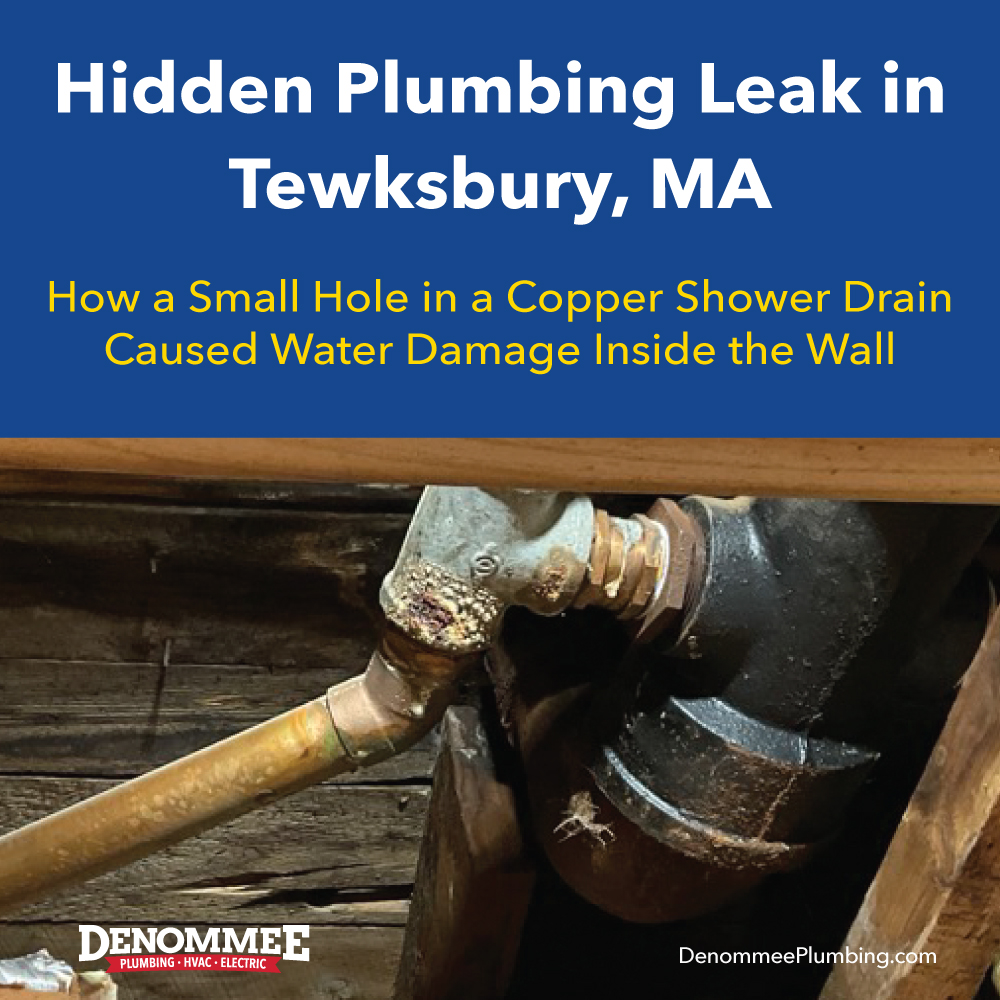
The project photographs show the exposed plumbing cavity and the copper drain line connected to the shower waste system.
Closer inspection revealed the actual problem: a visible hole through the wall of the copper drain pipe.
What the Photos Show
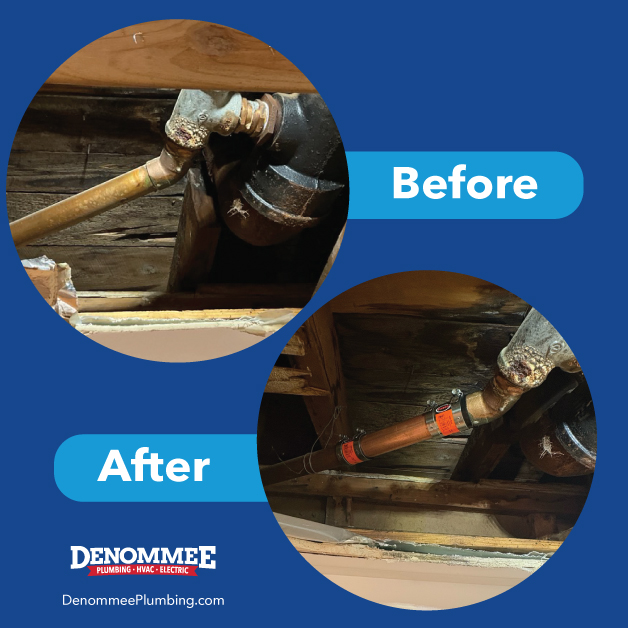
The before-and-after photographs provide a particularly clear look at this type of plumbing failure.
In the first close-up image, the damaged copper pipe shows a distinct perforation in the tubing.
That opening was large enough to allow wastewater from the shower drain to escape inside the wall cavity whenever the shower was used.
The second photograph shows the plumbing after repair, with the compromised section removed and a new copper section installed using approved transition couplings.
The repair re-established a continuous drain path between the existing sections of piping.
That comparison is valuable because hidden plumbing leaks can seem mysterious from the homeowner's perspective.
Once the wall was opened, however, the cause was concrete and visible.
There was physically a hole in the shower drain.
Why Would a Copper Drain Pipe Develop a Hole?
Copper is durable, but no plumbing material lasts forever.
A drain pipe installed decades ago can eventually develop localized deterioration.
Possible contributing factors can include:
- Age
- Long-term corrosion
- Repeated exposure to wastewater
- Chemical drain cleaners
- Internal erosion
- Moisture conditions
- Previous installation conditions
- Material thickness
- Mechanical damage
It is important not to assume one particular cause solely from appearance.
The proper conclusion in this case was straightforward:
The existing copper drain line had deteriorated enough to develop a hole and could no longer reliably contain the shower's wastewater.
The affected section therefore needed to be removed and repaired.
A Drain Leak Is Different From a Pressurized Water Leak
One useful distinction for homeowners is the difference between a water-supply leak and a drain leak.
Water-supply piping is typically under pressure.
If a pressurized pipe develops a significant hole, water may continue flowing whether or not a fixture is being used.
A shower drain works differently.
It primarily carries wastewater when water is flowing through the fixture.
That means a drain leak can sometimes remain hidden for quite a while.
The wall may only become wet:
- When someone showers
- Shortly after the shower is used
- When enough water reaches the compromised section
- After repeated usage gradually saturates surrounding materials
That intermittent behavior can make drain leaks harder for homeowners to identify.
It can also explain why someone may notice unexplained staining or dampness without seeing continuous running water.
Why the Location of the Water Can Be Misleading
Water rarely respects the boundaries homeowners expect.
Once it escapes from a pipe, it can:
- Follow framing
- Run along the outside of another pipe
- Wick into insulation
- Travel across drywall
- Collect on horizontal surfaces
- Appear several feet away from the actual leak
That means the wet spot is not always directly below the plumbing failure.
This is one reason professional diagnosis matters.
The goal is not simply to repair the place where water becomes visible.
It is to trace the moisture back to its source.
Why Hidden Plumbing Leaks Should Be Addressed Promptly
A small plumbing leak can create problems out of proportion to the size of the opening in the pipe.
The longer water is allowed to escape into a concealed building cavity, the greater the opportunity for damage.
Potential consequences can include:
- Damaged drywall
- Damaged plaster
- Wet insulation
- Stained ceilings or walls
- Deteriorated wood
- Mold or microbial growth
- Flooring damage
- Cabinet damage
- Odors
- Damage to adjacent rooms
Not every hidden leak results in severe structural damage or mold.
But because homeowners often cannot see the full extent of what is happening inside a wall, postponing diagnosis introduces unnecessary risk.
This Tewksbury homeowner made the right decision by reaching out when they realized something was wrong.
You Don't Have to Know Where the Leak Is Before Calling a Plumber
One thing homeowners sometimes worry about is that they cannot clearly describe the problem.
That is okay.
In this case, the homeowner knew there was water inside the wall between the bathroom and living space, but did not know the exact source.
That was enough information to begin.
The homeowner did not need to know whether the issue involved:
- A shower valve
- A water pipe
- A drain
- A fitting
- Waterproofing
- Another concealed plumbing component
Finding that answer is part of the diagnostic process.
When contacting a plumber, the most useful information is often simply:
- Where are you seeing water?
- When did you first notice it?
- Does it happen continuously or only when a fixture is used?
- Has anything changed recently?
- Is there a bathroom, kitchen or plumbing fixture nearby?
- Is the leak getting worse?
- Can the affected fixture be avoided until service arrives?
Even incomplete information can help the service team begin troubleshooting.
Text-to-Book Made It Easy to Request Service After Hours
This project also demonstrates why convenient scheduling matters.
The homeowner discovered the problem late in the evening.
Instead of waiting until business hours to call, they sent Denommee a text message describing the leak.
Our booking agent responded and arranged for a plumber to arrive the next morning.
For homeowners dealing with something unexpected, that removes one layer of frustration.
You do not have to wait on hold or remember to call again the following morning.
You can simply start the service request when the problem occurs.
For non-emergency plumbing issues, Denommee's Text-to-Book and online scheduling options give homeowners a convenient way to request service.
For urgent plumbing emergencies, Denommee also provides 24-hour emergency service.
Why Upfront Pricing Matters During a Plumbing Repair
Once the source of the leak was identified, the homeowner needed to decide whether to proceed with the repair.
Denommee's plumber presented an upfront quote before beginning the authorized work.
That is an important part of the service process.
Unexpected plumbing repairs are stressful enough without wondering how large the final invoice will become.
With upfront pricing, the process is straightforward:
Diagnose the problem → Explain the repair → Present the price → Customer decides.
The homeowner knows what the proposed repair will cost before authorizing it.
In this case, the customer later specifically mentioned the fair upfront pricing in their 5-star review.
Repairing the 1-1/2-Inch Copper Shower Drain
Once authorized, Denommee removed the deteriorated portion of the shower drain line.
The project photos show the new section installed between the remaining portions of the existing plumbing.
The repair used new copper piping and transition couplings to restore the drainage path.
The goal was not simply to cover the hole.
A deteriorated section of drain piping needs a durable repair that restores the integrity of the waste line.
Once the new section was installed, the repaired system could again carry shower wastewater through the drainage system rather than releasing it inside the wall cavity.
Why Plumbers Sometimes Need to Open Drywall
Nobody wants holes cut into finished walls or ceilings.
Unfortunately, concealed plumbing is sometimes only accessible by opening the finished surface covering it.
The objective should be to make the smallest practical opening necessary to locate and repair the problem safely and correctly.
In this Tewksbury project, the drywall opening provided direct access to the shower drain piping.
Without access, it would have been impossible to properly inspect and repair the failed section.
Homeowners should be cautious of anyone promising that every hidden leak can be repaired without opening walls.
Sometimes diagnostic tools can reduce unnecessary demolition.
But once a failed concealed pipe is identified, physical access is often required.
Should You Repair the Drywall Immediately After a Plumbing Leak?
Usually, the first priority is stopping the water.
The second is making sure the affected area can dry appropriately.
Closing a damp cavity immediately may trap moisture.
Depending on the severity and duration of the leak, homeowners may need to consider:
- Drying the cavity
- Evaluating wet insulation
- Inspecting surrounding materials
- Replacing damaged drywall
- Addressing staining or finish damage
The appropriate restoration approach depends on how much water escaped and how long the materials were wet.
The plumbing repair and the finish repair are related—but they are separate parts of the overall restoration process.
Signs You May Have a Hidden Plumbing Leak
Not every leak produces visible running water.
Contact a plumber if you notice unexplained symptoms such as:
- Wet drywall
- Ceiling stains
- Soft drywall
- Bubbling paint
- Peeling wallpaper
- Musty odors
- Water appearing near a bathroom wall
- Moisture after using a shower or tub
- Damp flooring
- Discoloration
- Unexplained dripping sounds
- Repeated wet spots that dry and return
The earlier a leak is located, the better the opportunity to limit damage.
Could a Leak Like This Have Been Prevented?
Not every plumbing failure can be predicted.
Pipes age.
Materials deteriorate.
Failures can occur without obvious warning.
Routine plumbing inspections may identify some visible problems, but concealed drain piping inside walls is generally not something homeowners can monitor directly.
That makes changes in the home particularly important.
If something suddenly smells different, looks damp or behaves differently than it used to, it deserves attention.
In this case, the homeowner noticed a problem and acted before they even knew what had failed.
That is often the best thing a homeowner can do.
Why Older Massachusetts Homes Can Develop Concealed Plumbing Problems
Many homes throughout Tewksbury and surrounding communities contain plumbing systems installed decades ago.
Over time, homes may also receive:
- Bathroom renovations
- Kitchen renovations
- Additions
- Pipe repairs
- Fixture replacements
- New heating equipment
- Partial plumbing upgrades
As a result, an older home can contain multiple generations of plumbing materials and installation methods.
Copper drainage piping was commonly used in many homes and can provide long service.
But decades of use can eventually produce localized deterioration.
That is why experience with older New England housing stock is valuable when diagnosing leaks.
The plumber needs to understand what types of piping may be hidden behind the wall and how those systems were commonly installed.
When Is a Plumbing Leak an Emergency?
Not every leak requires emergency response.
But some do.
Seek prompt professional assistance if:
- Water is flowing continuously
- You cannot stop the water
- Water is approaching electrical equipment
- A ceiling is bulging
- Significant water is entering the home
- A major supply pipe has failed
- Sewage is leaking
- A water heater has ruptured
- The leak is causing rapid property damage
If you can safely identify and shut off the affected fixture or water supply, doing so may help reduce damage while waiting for service.
If you are unsure how to isolate the problem safely, contact a professional.
A 5-Star Customer Experience From Start to Finish
After the repair was completed, this Tewksbury homeowner shared their experience on Denommee's Google profile and left a 5-star review.
They highlighted three parts of the experience:
Easy scheduling
The homeowner was able to initiate the service request by text late in the evening.
Prompt service
A plumber arrived shortly after 8 a.m. the next morning.
Fair upfront pricing
The repair cost was explained before work began.
Those details matter because professional plumbing service is about more than the physical pipe repair.
It is also about making an unexpected home problem easier to manage from the first contact through completion.
Why Tewksbury Homeowners Call Denommee for Plumbing Repairs
Denommee Plumbing, HVAC & Electric provides residential plumbing service throughout Tewksbury and surrounding Massachusetts communities.
Our plumbing team handles problems ranging from straightforward fixture repairs to hidden leaks, water-heater failures, drain issues and larger plumbing projects.
And because Denommee also provides HVAC and electrical services in-house, customers have one local company capable of addressing multiple systems within the home.
Our service approach includes:
- Convenient online scheduling
- Text-to-Book
- 24/7 emergency service
- Upfront flat-rate pricing
- Licensed plumbing professionals
- Required permits and inspections where applicable
- Local service throughout northeastern Massachusetts
The objective is simple:
Find the problem, explain it clearly and give the homeowner enough information to decide how they want to proceed.
Frequently Asked Questions About Hidden Plumbing Leaks
How do plumbers find a leak behind a wall?
Diagnosis can include evaluating where moisture appears, nearby fixtures, when the leak occurs and the home's plumbing layout. In some situations, a targeted opening in drywall or plaster is necessary to directly inspect concealed piping.
Can a shower drain leak inside a wall?
Yes. Drain piping, joints or fittings associated with a shower can develop failures that allow wastewater to escape into wall or ceiling cavities.
Why would a copper drain pipe get a hole?
Copper can deteriorate over time because of age, corrosion, chemical exposure, erosion or other conditions. The specific cause should not be assumed without evaluating the actual piping.
Does a drain leak happen all the time?
Not necessarily. A drain line may leak primarily when the connected fixture is being used, which can make the problem intermittent.
Can water from a leak travel inside a wall?
Yes. Water may follow framing, piping or building materials before appearing at a visible location.
Should I stop using the shower if I suspect the drain is leaking?
If the leak appears to be associated with shower use, avoiding that fixture until it is evaluated can help limit additional water damage.
Is a leak inside the wall always an emergency?
Not necessarily, but concealed leaks should be addressed promptly because ongoing moisture can damage building materials.
Will a plumber have to cut open the wall?
Sometimes. If concealed piping cannot otherwise be accessed, a targeted opening may be necessary to properly locate and repair the leak.
Does Denommee offer emergency plumbing service in Tewksbury?
Yes. Denommee provides 24-hour emergency plumbing service for urgent situations within its service area.
Can I request plumbing service by text?
Yes. Denommee offers convenient Text-to-Book and online scheduling options, which is how this Tewksbury homeowner initiated the service request.
Have a Hidden Leak in Tewksbury, MA?
If you see water appearing through a wall or ceiling and cannot determine where it is coming from, you do not need to diagnose the problem yourself before calling for help.
This Tewksbury homeowner did exactly the right thing.
They noticed something was wrong.
They sent Denommee a message late in the evening.
Our team scheduled a plumber for the following morning.
The plumber arrived shortly after 8 a.m., opened the affected area, identified a hole in the 1-1/2-inch copper shower drain, explained the repair and provided upfront pricing.
The damaged piping was repaired, and the homeowner was able to move forward knowing the source of the leak had been addressed.
Denommee Plumbing, HVAC & Electric provides plumbing repair, leak detection, drain service, water-heater service and emergency plumbing throughout Tewksbury and surrounding Massachusetts communities.
Book service online, use Text-to-Book or contact Denommee when something in your home simply does not look right.
With hidden plumbing leaks, finding the source early can make all the difference.
Phone: 978-649-8886
Text: 857-226-9140
Online: DenommeePlumbing.com


