Bosch Dual-Fuel Heat Pump & Furnace Installation in Tyngsborough, MA: A Real-World HVAC Upgrade
For homeowners in Massachusetts with an existing natural gas furnace and central air conditioning, replacing aging HVAC equipment doesn't necessarily require choosing between gas heat and a heat pump.
A dual-fuel—or hybrid—HVAC system can combine a high-efficiency air-source heat pump with a gas furnace, using integrated controls to coordinate the two heating sources while also providing central air conditioning during the summer.
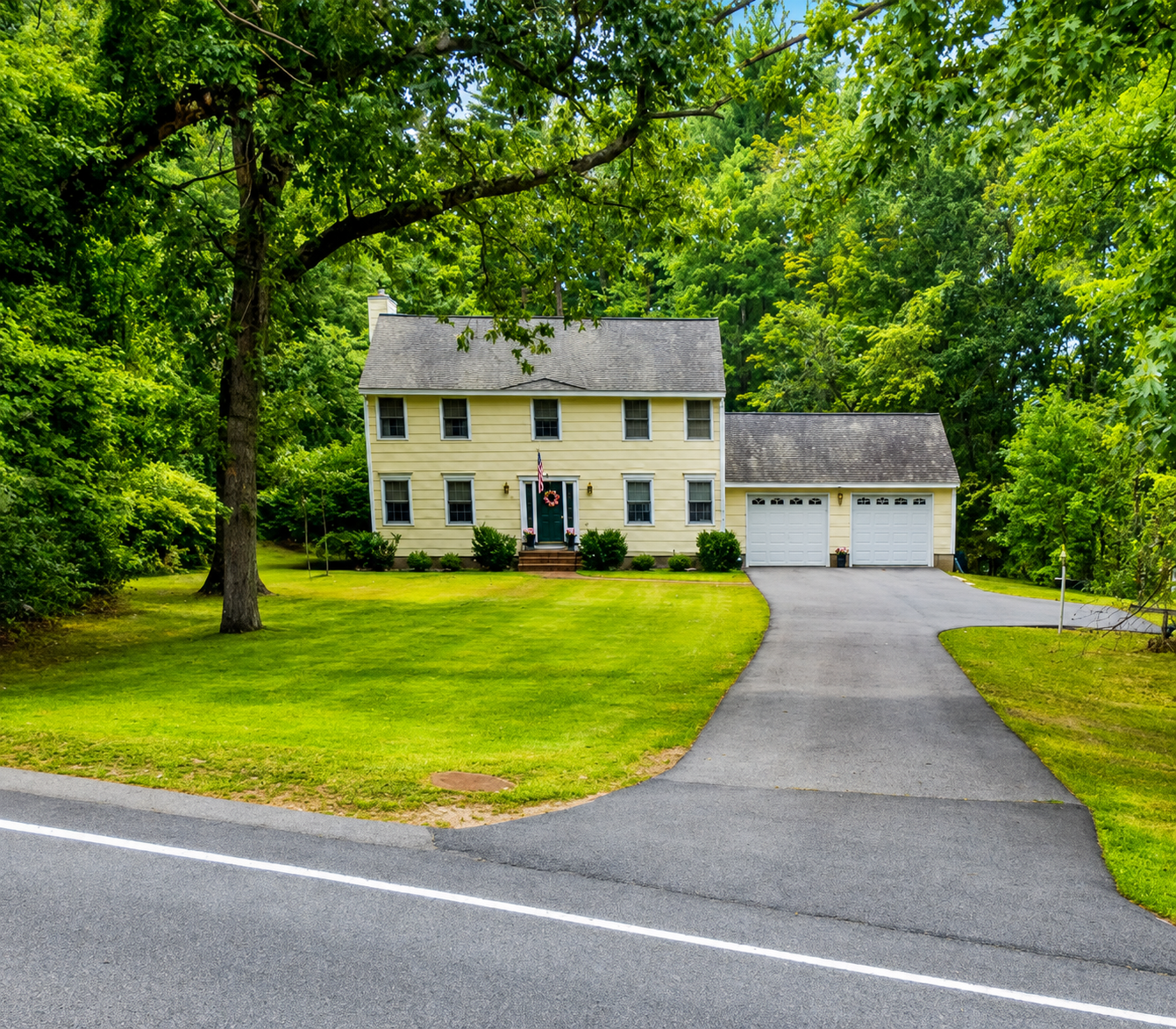
That's the approach Denommee Plumbing, HVAC & Electric took in the summer of 2025 for an installation at a circa-1993, 2,128-square-foot, three-bedroom single-family home in Tyngsborough, Massachusetts.

The project paired a Bosch inverter heat pump with a Bosch 96% AFUE gas furnace and Ecobee integrated control, creating a high-efficiency central HVAC system capable of providing substantial heat-pump heating even during cold Massachusetts weather while retaining natural gas heat as part of the system.
For Tyngsborough homeowners researching heat pump installation, furnace and AC replacement, Bosch heat pumps, dual-fuel HVAC systems or hybrid heating, this completed project provides a useful real-world example of what such an upgrade can involve.
Tyngsborough HVAC Upgrade: Project at a Glance
| Project detail | Installation |
|---|---|
| Location | Tyngsborough, Massachusetts |
| Home | Circa 1993 single-family residence |
| Size | Approximately 2,128 sq. ft. |
| Bedrooms | 3 |
| System type | Ducted dual-fuel/hybrid heat pump system |
| Heat pump | Bosch BOVA-60MTB-M19E |
| Indoor coil | Bosch BMAC4248CBTA |
| Gas furnace | Bosch BGH96M100C5C |
| Integrated control | Ecobee EB-STATE3LT series |
| AHRI reference | 214825964 |
| Rated cooling capacity | 44,000 BTU/h |
| Rated heating capacity at 47°F | 47,000 BTU/h |
| Rated heating capacity at 17°F | 47,000 BTU/h |
| Rated heating capacity at 5°F | 43,000 BTU/h |
| SEER2 | 16.50 |
| EER2 | 11.70 |
| HSPF2 | 9.50 |
| Refrigerant | R-454B |
| Historical project incentive | Estimated $4,583.33 2025 Mass Save partial-home rebate |
| Electrical work | Performed by Denommee's electrical team |
| Membership | One-year Peace of Mind Service Program membership included |
This kind of project-specific information is important because heat-pump performance should be evaluated using the actual matched equipment, rather than broad claims about how heat pumps perform in New England.
Why This Tyngsborough Home Was a Good Candidate for a Dual-Fuel HVAC System
Homes built during the late 1980s and 1990s throughout Tyngsborough and surrounding Merrimack Valley communities commonly have central ductwork and conventional furnace-and-air-conditioner systems.
When that equipment reaches replacement age, homeowners have more choices today than simply installing another furnace and conventional AC condenser.
In this home, Denommee replaced the existing cooling equipment and installed a Bosch heat pump while retaining natural gas as a heating resource through a new Bosch furnace.
The result is a Gas/Electric Hybrid HVAC System.
Rather than asking a homeowner to choose exclusively between a furnace and heat pump, the system incorporates both technologies.
During appropriate conditions, the heat pump can provide efficient electric heating. The gas furnace remains available as another heat source, with the Ecobee integrated control helping coordinate system operation.
That makes dual-fuel particularly interesting for Massachusetts homeowners who want to increase their use of heat-pump heating but aren't necessarily ready to eliminate natural gas completely.
What Equipment Did Denommee Install?
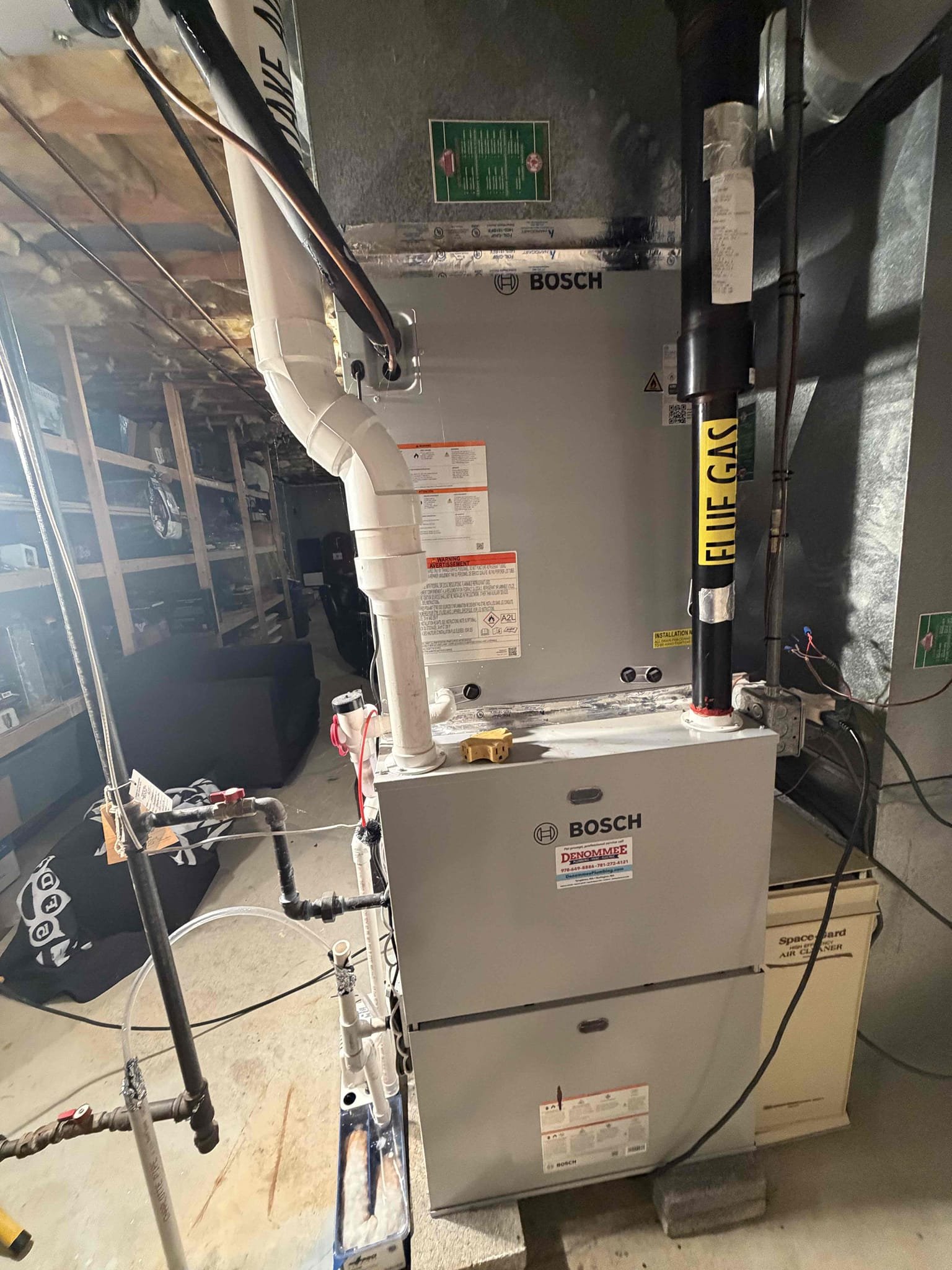
The project wasn't simply a condenser replacement. Denommee installed a matched HVAC system incorporating a new heat pump, evaporator coil, gas furnace and integrated controls.
Bosch BOVA Inverter Heat Pump
At the center of the system is a Bosch BOVA-60MTB-M19E air-source heat pump.
Unlike a conventional air conditioner that only provides cooling, a heat pump can reverse the refrigeration cycle to move heat into the house during heating season.
That allows one outdoor system to provide both:
Cooling in summer and electric heat during colder weather.
For homeowners accustomed to a furnace and central AC, the system can therefore significantly change the role of the outdoor condenser. Instead of sitting unused throughout the heating season, the heat pump becomes an active source of winter comfort.
Bosch BGH96 Gas Furnace
Denommee paired the heat pump with a Bosch BGH96M100C5C high-efficiency gas furnace.
The BGH96 platform provides up to 96% AFUE efficiency, meaning the furnace is designed to convert a high percentage of the fuel it consumes into usable heat.
In this installation, the furnace serves another important purpose: it allows the homeowner to maintain a gas heating source alongside the heat pump.
That's what makes the installation dual fuel.
How Well Does This Bosch Heat Pump Perform in Cold Weather?
This is where the project becomes particularly useful as a homeowner reference.
A frequent question we hear from Massachusetts homeowners is:
Do heat pumps actually work when it's cold outside?
Instead of answering that question with a generic statement, we can look at the certified performance data for the actual matched system installed at this Tyngsborough home.
According to AHRI Reference #214825964, the system is rated for:
- 47,000 BTU/h of heating at 47°F
- 47,000 BTU/h of heating at 17°F
- 43,000 BTU/h of heating at 5°F
That last number is especially informative.
At an outdoor temperature of 5°F, this particular system retains approximately 91% of its listed 47°F heating capacity.
In other words, its rated heating capacity falls by only about 4,000 BTU/h between the 47°F and 5°F rating points.
That's a much more meaningful way to discuss cold-weather heat pumps than simply saying that a unit "works in the cold."
It demonstrates why equipment selection, system sizing and certified performance data matter when designing heat-pump systems for Massachusetts homes.
What Do SEER2, EER2 and HSPF2 Mean?
Homeowners comparing heat pumps will encounter several efficiency ratings.
This particular Bosch system has ratings of:
16.50 SEER2
11.70 EER2
9.50 HSPF2
Here's what those terms tell you.
SEER2
Seasonal Energy Efficiency Ratio 2 is a measure used to describe cooling efficiency over a range of operating conditions.
Generally, a higher SEER2 indicates greater seasonal cooling efficiency.
EER2
Energy Efficiency Ratio 2 evaluates cooling efficiency under specified test conditions and provides another useful point of comparison between systems.
HSPF2
Heating Seasonal Performance Factor 2 relates specifically to heat-pump heating efficiency.
That's particularly relevant in Massachusetts because homeowners aren't only buying these systems for air conditioning. Heating performance can represent a major portion of their annual operation.
These ratings are useful comparison tools, but they should not be considered in isolation. The home's heating and cooling loads, ductwork, equipment sizing, controls and quality of installation all affect how an HVAC system ultimately performs.
Why Keep a Gas Furnace With a Heat Pump?
A homeowner might reasonably ask:
If the Bosch heat pump can provide heat at 5°F, why install a furnace too?
Because capacity and system design aren't the same question.
A heat pump having substantial capacity at a low outdoor temperature doesn't automatically establish that it should be the home's only heating source.
The building's actual heat loss needs to be considered.
A properly designed dual-fuel system allows the heat pump and furnace to serve different roles based on the home's needs and control strategy.
That can be appealing to homeowners who want to use electricity for more of their heating without immediately moving to an all-electric system.
It also illustrates why Denommee doesn't approach heat-pump replacement as a one-size-fits-all product sale.
The equipment needs to fit the house.
What Is an Integrated Control, and Why Does It Matter?
Denommee installed an Ecobee EB-STATE3LT-series integrated control with the system.
In a dual-fuel installation, the thermostat has a more sophisticated job than simply deciding whether the house needs heat.
The control strategy must coordinate two potential heating sources.
That allows the system to determine when heat-pump operation is appropriate and when the furnace should operate according to the configured system strategy.
This is also relevant to Massachusetts heat-pump incentives.
Mass Save currently describes partial-home rebates as applying to qualifying installations where an existing furnace or boiler remains to supplement a new heat pump. Its current requirements include Integrated Controls provisions for applicable fossil-fuel installations.
A Heat Pump Installation Is More Than Setting a Condenser Outside
The visible equipment gets most of the attention, but some of the most important HVAC work occurs during installation and commissioning.
Denommee's scope for this Tyngsborough project included:
- Removing and disposing of the existing cooling equipment
- Installing the new Bosch gas furnace
- Connecting the furnace to the existing gas piping
- Installing the Bosch heat-pump evaporator coil
- Connecting the new equipment to the existing supply and return plenums
- Installing the outdoor heat-pump condenser
- Providing a raised condenser pad
- Completing refrigerant line connections
- Installing an electrical disconnect and UV-resistant whip
- Pressure-testing the refrigerant circuit with nitrogen
- Evacuating the system below 500 microns
- Charging and commissioning the R-454B refrigeration system
- Installing and programming the Ecobee integrated control
- Completing required low- and line-voltage electrical work
- Starting and testing the complete system
- Labeling affected shutoffs
- Registering the equipment for applicable manufacturer warranty coverage
- Providing operating and warranty documentation
- Removing installation-related debris
Those details matter.
A homeowner comparing HVAC quotes shouldn't compare equipment model numbers and bottom-line prices alone. Installation procedures and commissioning are part of the product you're buying.
Why Does Denommee Pressure-Test and Vacuum a Heat-Pump System?
This is an excellent example of an installation detail homeowners rarely see advertised.
Before commissioning the new system, Denommee's technicians nitrogen-pressure-tested the refrigerant circuit and evacuated it below 500 microns.
Why?
A refrigeration circuit needs to be clean, dry and leak-free.
Pressure testing helps technicians verify the integrity of the refrigerant piping and connections. Proper evacuation removes air and moisture from the system before refrigerant operation.
These aren't cosmetic steps. They're part of properly preparing a refrigeration system for operation and long-term reliability.
When homeowners compare heat-pump contractors, asking how the contractor pressure-tests, evacuates and commissions the system can be more revealing than simply asking what brand they install.
This Bosch System Uses R-454B Refrigerant
The Tyngsborough project also represents a newer generation of residential HVAC equipment.
The Bosch heat pump operates with R-454B refrigerants.
Homeowners replacing older central AC equipment may be accustomed to hearing names such as R-22 or R-410A. Newer equipment is transitioning to refrigerants with lower global-warming potential, and R-454B is one of the refrigerants now appearing in modern residential heat-pump and air-conditioning systems.
This transition makes proper training, equipment selection and installation procedures increasingly important.
It is another reason homeowners should compare the contractor—not simply the equipment.
Electrical Work Was Included in the Heat-Pump Installation
Heat pumps aren't purely an HVAC project.
They also require electrical infrastructure.
For this installation, Denommee provided an electrician to complete the necessary line- and low-voltage electrical work and install the outdoor disconnect for the condenser.
The project's electrical scope allowed for a single condenser disconnect not exceeding 65 amps and wiring within the defined project conditions.
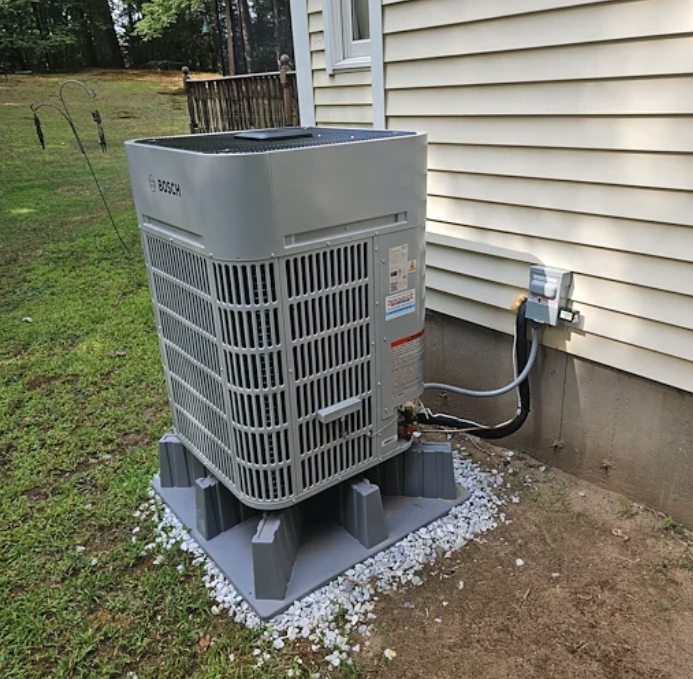
The photograph also shows several details worth noting: the condenser is elevated above grade on a purpose-built stand, the electrical disconnect is mounted nearby, and the refrigerant/electrical connections are routed directly into the home.
Having HVAC and electrical professionals within the same company can simplify coordination on projects like this.
Rather than leaving the homeowner to coordinate separately between an HVAC installer and electrician, Denommee can incorporate the required electrical scope into the overall project.
Why Raise a Heat Pump Above the Ground in Massachusetts?
Look closely at the outdoor equipment and you'll notice that the Bosch condenser isn't sitting directly on a conventional low-profile pad.
It's elevated.
That is particularly relevant for a heat pump operating through a New England winter.
Unlike an air conditioner, the outdoor unit operates during heating season. Snow accumulation, ice and drainage associated with defrost operation therefore need to be considered when determining how outdoor heat-pump equipment is installed.
The appropriate mounting solution depends on the equipment, site and manufacturer's requirements, but the larger point is important:
Installing an outdoor heat pump for year-round Massachusetts operation isn't necessarily the same as replacing a conventional AC condenser.
Can an Existing Duct System Be Used With a Heat Pump?
Often, yes—but it needs to be evaluated.
This Tyngsborough project demonstrates one of the major advantages of a ducted heat-pump conversion for homes that already have forced-air HVAC.
Denommee connected the new Bosch evaporator coil and furnace to the home's existing supply and return plenums.
That allowed the homeowner to gain heat-pump capability while continuing to distribute conditioned air through the home's central duct system.
However, existing ducts shouldn't automatically be assumed to be appropriate for any replacement equipment.
Airflow requirements, duct sizing, static pressure, condition, leakage and the home's heating and cooling loads can all affect performance.
That's why an in-home evaluation remains important even when two houses have similar square footage.
What Did This Bosch Heat Pump and Furnace Project Cost?
Homeowners researching heat-pump installation understandably want real pricing information.
For this project, the quoted equipment portions included:
Bosch furnace: $2,900
Bosch heat-pump system: $16,795.40
Those figures are useful as a historical case-study reference, but they should not be interpreted as a current universal installed price.
HVAC project costs can vary substantially depending on equipment selection, capacity, duct modifications, electrical requirements, controls, refrigerant piping, site conditions, permits and other project-specific factors.
For that reason, the most useful comparison isn't simply:
“What does a Bosch heat pump cost?”
It's:
“What is included in the installed system, and is it properly designed for my house?”
This Project Qualified for a 2025 Mass Save Partial-Home Heat Pump Rebate
Because the homeowner retained a gas furnace as part of the heating strategy, this project was structured around the Mass Save partial-home heat-pump incentive available at the time.
The proposed qualifying system was eligible for an estimated $4,583.33 instant rebate, calculated under the applicable 2025 program at $1,250 per AHRI-rated cooling ton.
Using the system's 44,000 BTU/h AHRI cooling capacity:
44,000 ÷ 12,000 = approximately 3.67 rated cooling tons
At the applicable 2025 incentive of $1,250 per ton:
3.67 × $1,250 ≈ $4,583
This is a good example of why rebate tonnage may not correspond exactly with the model number homeowners see on the outdoor equipment.
Important note for homeowners reading this in 2026
That $4,583.33 figure documents the incentive associated with this 2025 project; it is not the current 2026 rebate amount.
Mass Save currently lists its 2026 partial-home air-source heat-pump rebate at $1,125 per ton, up to $8,500, subject to program eligibility. Current program rules also state that qualifying equipment must meet applicable cold-climate requirements and be installed by a contractor participating in the Mass Save Heat Pump Installer Network.
Mass Save also currently offers potential $500 partial-home bonuses associated with qualifying sizing and weatherization conditions, and its HEAT Loan program offers 0% financing of up to $25,000 toward qualifying improvements. Eligibility and program terms should always be verified for the year in which a homeowner undertakes the project.
This distinction is important because incentive programs change.
A trustworthy contractor should help homeowners understand what incentives actually apply to their project now, rather than advertising an outdated rebate amount as though it remains universally available.
One-Year Peace of Mind Service Membership Included
Installing a new HVAC system is the beginning of its service life—not the end of the relationship with the equipment.
Denommee included a one-year Peace of Mind Service Program membership with this installation.
The program is designed to help homeowners maintain their home's plumbing, HVAC and electrical systems while providing benefits including priority scheduling, waived regular-hours repair dispatch fees, member-only maintenance pricing, annual system safety and performance assessments, documentation of findings and Loyalty Credits toward qualifying future upgrades.
For a sophisticated dual-fuel HVAC system, ongoing professional maintenance is particularly valuable.
The heat pump, furnace, indoor coil, controls, filtration, condensate management, electrical components and overall system operation all need to continue functioning as an integrated system.
Is a Bosch Dual-Fuel Heat Pump Right for Your Massachusetts Home?
It can be an excellent solution, but not every home needs the same system.
A dual-fuel installation may deserve consideration if you:
- Already have natural gas and central ductwork
- Need to replace an aging furnace and/or central air conditioner
- Want to add heat-pump heating without completely abandoning gas
- Want efficient central cooling and heating from the same outdoor system
- Are interested in available Massachusetts heat-pump incentives
- Want the flexibility of two heating technologies
- Prefer a centrally ducted system rather than wall-mounted ductless units
The correct equipment still needs to be selected for the individual house.
Square footage alone isn't enough to size a heat pump.
A 2,128-square-foot house in Tyngsborough can have very different heating requirements from another 2,128-square-foot home depending on insulation, air leakage, windows, orientation, ductwork, layout and other building characteristics.
Frequently Asked Questions About Dual-Fuel Heat Pumps in Massachusetts
What is a dual-fuel heat-pump system?
A dual-fuel or hybrid HVAC system combines an electric heat pump with a fossil-fuel heating system, commonly a natural gas or propane furnace. Integrated controls coordinate operation of the heating equipment according to the system's configured strategy.
Can a heat pump work in Tyngsborough during cold weather?
Modern cold-climate-capable heat pumps can provide meaningful heating output at low outdoor temperatures, but performance varies by equipment. The Bosch system installed in this project is AHRI-rated at 47,000 BTU/h at 17°F and 43,000 BTU/h at 5°F. Whether that is sufficient for a particular home depends on its heating load.
Do I have to remove my gas furnace to install a heat pump?
No. A properly designed dual-fuel system can combine a heat pump and gas furnace. Mass Save currently maintains a partial-home incentive category for qualifying installations where a furnace or boiler remains to supplement heat-pump heating.
Can a heat pump use my existing ductwork?
Often it can. A contractor should evaluate the existing ducts, plenums, airflow requirements and system design before determining whether they are suitable for the proposed equipment.
Why does a dual-fuel heat pump need an integrated control?
The control coordinates operation of the heat pump and secondary heating system. Integrated controls are also relevant to current Mass Save partial-home requirements in applicable installations where fossil-fuel heating remains.
Does a heat-pump installation require electrical work?
Typically, yes. Outdoor heat-pump equipment requires an appropriate electrical circuit and disconnect, while indoor equipment and controls have additional electrical requirements. This Tyngsborough installation included electrical work performed by Denommee as part of the project.
How much was the Mass Save rebate for this project?
The system was estimated to qualify for a $4,583.33 partial-home rebate under the applicable 2025 program. That is historical project information. Mass Save currently lists a different 2026 partial-home incentive of $1,125 per ton, subject to eligibility and program requirements.
Why Tyngsborough Homeowners Choose Denommee for Heat-Pump Upgrades
A high-quality heat-pump installation requires more than delivering equipment to a house.
It requires system design, HVAC installation, refrigeration practices, controls, electrical work, permitting, commissioning and ongoing service.
Denommee Plumbing, HVAC & Electric brings those capabilities together.
For this Tyngsborough homeowner, that meant one team could coordinate the Bosch heat pump, high-efficiency gas furnace, indoor coil, Ecobee controls, refrigerant piping and electrical requirements, then commission and register the completed system.
And because Denommee works across HVAC, plumbing and electrical, homeowners planning broader improvements can consider how those systems interact instead of treating every project as an isolated upgrade.
One Year Later: Continuing to Maintain the System
Denommee's relationship with this Tyngsborough homeowner didn't end when the new Bosch heat pump and furnace were commissioned. Approximately one year after the installation, our team returned to help ensure the HVAC system continued operating at peak performance as part of the home's ongoing service relationship.
The homeowner subsequently left Denommee a five-star review describing the team as “courteous, professional and timely” and saying they would not hesitate to recommend Denommee for the services we provide.
The same customer had also previously trusted Denommee to replace the home's gas water heater—an example of the long-term relationships our Plumbing, HVAC & Electric teams strive to build with homeowners.
Read what happened when we returned to maintain this one year after →
Considering a Bosch Heat Pump or Dual-Fuel HVAC System in Tyngsborough, MA?
If your furnace or central air conditioner is approaching the end of its service life, replacement is an opportunity to consider more than simply installing another version of the system you already have.
A modern heat pump or dual-fuel HVAC system may provide efficient heating and cooling while allowing you to take advantage of your home's existing ductwork and, when appropriate, retain a gas furnace as part of your heating strategy. The right solution depends on the home, however—not just its square footage or the equipment being replaced.
Denommee Plumbing, HVAC & Electric can help you compare your options before you make that decision. Our experienced HVAC team can evaluate your existing equipment, ductwork, heating and cooling needs, electrical requirements, available incentives and long-term plans to recommend a system designed around your home.
As a Bosch Platinum-tier PRO contractor, Denommee has extensive experience designing, installing and servicing Bosch heat-pump and dual-fuel systems throughout Tyngsborough and surrounding Massachusetts communities. And because our HVAC and electrical professionals work together in-house, we can coordinate the mechanical and electrical portions of a heat-pump upgrade without leaving homeowners to manage multiple contractors.
Start With Pricing—or Talk With an HVAC Expert
Want to research your options before scheduling an appointment? Explore Denommee's free online HVAC pricing tool to compare replacement options and get a better idea of what a new heating and cooling system may cost.
When you're ready for recommendations specific to your house, request a no-cost in-home HVAC consultation. One of our experts can evaluate your existing system, answer your questions and help you make an educated decision about whether a conventional replacement, heat pump, or dual-fuel system makes the most sense.
Serving homeowners in Tyngsborough, Chelmsford, Westford, Groton, Littleton and communities throughout the Merrimack Valley and Greater Lowell area.
Denommee Plumbing, HVAC & Electric
Call: 978-649-8886
Text: 857-226-9140
Explore HVAC pricing online →
Request a no-cost in-home consultation →


